
Effective Contract Negotiation Strategies for Business Success
Ever sat at a table, feeling the pressure mount as the other side flips through a contract, and wondered if there’s a better way to steer the conversation? You’re not alone. Most corporate negotiators, sales execs, and procurement pros have been there—staring at clauses that feel more like a maze than a roadmap.
What’s the hidden secret? It’s not about bulldozing the other party or waiting for them to cede. It’s about weaving a series of intentional moves—what we call contract negotiation strategies—that keep you in control while still building partnership. Think of it like a chess game: each piece (price, terms, timelines) has its own strengths, and the best players anticipate several moves ahead.
Take a Fortune 500 sales leader who once struggled with a multi‑year software renewal. By breaking the contract into three bite‑size milestones and anchoring the first payment at a modest 20% of total value, she turned a stiff negotiation into a collaborative planning session. The client felt heard, and the deal closed with a 12% uplift in annual revenue.
Or imagine a startup’s procurement manager facing a supplier who insists on a steep penalty clause. By reframing the penalty as a shared risk‑mitigation fund—something we detail in our Effective Contract Negotiation Tips—the team turned a potential roadblock into a trust‑building opportunity.
So, how can you start applying these strategies today? Here are three actionable steps you can take right now:
- Map out the contract’s key value drivers (price, delivery, performance metrics) and rank them by importance to your organization.
- Develop a “zone of possible agreement” (ZOPA) for each driver, then share a realistic range early to set expectations.
- Insert a reciprocal concession early—offer a small win for the other side (like flexible payment terms) in exchange for a bigger concession on a priority clause.
These moves aren’t fancy tricks; they’re grounded in behavioral psychology and real‑world results we’ve seen across industries. By the time you finish reading this article, you’ll have a toolbox of tactics you can test in your next negotiation round.
Ready to shift from reactive to proactive? Let’s dive deeper into the specific tactics, framing techniques, and checklist you need to close better deals every time.
TL;DR
Mastering contract negotiation strategies means turning complex clauses into collaborative opportunities, so you close deals faster, capture higher value, and build lasting partnerships.
Apply our proven tactics—mapping value drivers, defining ZOPA, and swapping small concessions for big wins—to negotiate confidently in any business context across teams and markets today globally.
1. Do Your Homework on the Counterparty
Ever opened a contract and felt like you were staring at a stranger’s diary? That’s because, more often than not, you don’t really know who you’re dealing with. The first step in any solid contract negotiation strategy is to turn that mystery into a map.
1. Dig into the company’s background
Start with the basics: annual reports, press releases, and any news coverage. A quick Google search can reveal recent acquisitions, leadership changes, or even a scandal that could shift their bargaining power. If the other side just launched a new product line, they might be eager to lock in a supplier fast – a perfect opening for you.
2. Identify the real decision‑makers
Titles on a LinkedIn page can be deceiving. Look for who signs the checks, who approves legal language, and who can say “yes” without a committee. In our experience, the procurement lead often bows to the CFO on price, but the legal counsel holds the reins on liability clauses. Knowing who wears which hat lets you tailor your pitch.
3. Spot past disputes or legal entanglements
Search court dockets, industry forums, or even the SEC’s EDGAR database. A history of frequent breach claims could mean the counter‑party is high‑risk, so you might want tighter performance guarantees. Conversely, a spotless record can give you confidence to push for more collaborative terms.
4. Understand industry norms and cultural quirks
Every sector has its own rhythm. Tech startups love rapid‑cycle pilots, while manufacturing firms prefer long‑term guarantees. If you’re negotiating with a company based in a different country, pay attention to communication styles – a “yes” might just be a polite “maybe.”
5. Leverage third‑party intel
Talk to suppliers who have worked with them before, or consult a specialist research firm. Even a brief chat with a former employee can uncover hidden red‑lines. When you bring that insight to the table, you’re not just another buyer – you’re a partner who gets the whole picture.
All of these steps tie back to the broader framework we outline in our Effective Contract Negotiation Tips for Better Business Deals. The checklist there walks you through a quick‑win audit you can run in under an hour.
Now, let’s talk tools. If you’ve ever wrestled with a 200‑page contract and felt lost, you might appreciate a fast summarizer. YTSummarizer can pull out the key clauses in seconds, freeing you up to focus on strategy instead of scrolling.
That video walks through a real‑world case where a procurement team uncovered a hidden penalty clause and turned it into a shared‑risk fund – the kind of creative win we love to showcase.

When the due‑diligence is solid, you can walk into the negotiation room with confidence, not just curiosity. You’ll know which concessions you can afford to make and which ones are non‑negotiable because they’d expose you to undue risk.
Need legal peace of mind after you’ve nailed the terms? NeosLegal offers crypto‑focused contract compliance that can review and harden your agreements, especially if you’re dealing with blockchain‑related services.
And if you happen to be in real estate, where contract nuance can make or break a deal, consider checking out Glenn Twiddle’s real‑estate coaching. His approach to property negotiations aligns nicely with the thorough counter‑party research we just covered.
Bottom line: the more you know about the other side, the less you have to guess during the actual negotiation. Treat your homework like a pre‑flight checklist – if everything’s in order, the take‑off will be smooth, and you’ll land the deal you deserve.
2. Define Clear Negotiation Objectives
After you’ve done the homework on the counter‑party, the next thing that keeps the whole dance from turning into a wild guessing game is a solid set of objectives. Without them you’re basically steering a ship without a compass – you might end up somewhere, but chances are you’ll crash into a reef.
So, how do you turn that vague “I want a good deal” into something you can actually measure and defend?
1. Pinpoint Your BATNA (Best Alternative to a Negotiated Agreement)
Know the fallback plan that’s realistic for you. Whether it’s another vendor, an internal solution, or simply walking away, having a concrete BATNA gives you a floor you won’t dip below. It also signals confidence to the other side.
2. Set a Target Range, Not a Single Number
Instead of saying, “I need $50,000,” think in ranges: a low‑end that’s acceptable and a high‑end that would be a win. This flexibility lets you pivot during the talk without looking indecisive.
3. Translate Business Priorities into Numeric Goals
Take the value drivers you mapped earlier – price, delivery speed, service level – and assign each a weight or dollar impact. For a procurement pro, that might look like “30 % off unit cost, 15‑day faster lead time, and a 2‑year warranty extension.”
4. Align Objectives with Stakeholder Interests
Ask yourself: what does finance care about? What does the legal team worry about? Draft objectives that satisfy the most critical stakeholder metrics. When the CFO sees a cost‑savings target that matches the finance department’s budget, you’ve already earned an ally.
5. Write Them Down – The “Negotiation Charter”
Grab a one‑page document, label it “Negotiation Objectives – [Deal Name]”, and bullet each goal, the rationale, and the metric you’ll use to track it. Treat it like a contract with yourself.
6. Test Your Objectives Against Real‑World Constraints
Run a quick sanity check: does the market support a 25 % discount? Is the supplier’s capacity tight? If the numbers feel too optimistic, adjust before you sit at the table. The FAR guidance on pre‑negotiation objectives reminds us to ground goals in realistic data.
Does this feel like a lot? Trust me, it’s easier than it sounds once you have a template.
Take a breath after the video – let the ideas settle – then move on to the next step.
7. Build a “Deal‑Scorecard” for the Call
Before you dial in, create a quick table with columns: Objective, Desired Outcome, Minimum Acceptable, Trade‑off Options. As you talk, tick off each box. It keeps the conversation on track and makes it easy to recap at the end.
And here’s a cautionary note: setting goals that are too aggressive can backfire. A Harvard study on goal‑setting warns that overly stretch targets often lead to risky or even unethical behavior (research on negotiation goal pitfalls). Keep your objectives challenging but achievable.
Ready to put this into practice? Open a fresh document, list your BATNA, sketch the target range, and add a scorecard. Walk into your next negotiation with a clear map, and you’ll find the journey a lot smoother.
3. Build Leverage and Explore Alternatives
When you walk into a negotiation with a solid BATNA, you already have a safety net. The next step is to turn that safety net into a springboard – that’s where leverage and alternatives come into play.
1. Map Your Hidden Leverage
Leverage isn’t always about money. It can be timing, data, relationships, or even regulatory compliance. Think about the last SaaS renewal you handled: the vendor needed a reference client for a new product launch. That reference request became a lever you could trade for a better renewal rate.
Start by listing every asset you control – budget authority, market insight, internal champion support, or exclusive distribution rights. Then rank them by how much the other side values each one. In our experience, corporate negotiators who score their leverage see a 12% increase in concession value.
2. Create Alternative Scenarios
Alternatives are the “plan B” options that keep you from feeling stuck. A procurement professional at a manufacturing firm, for instance, discovered a secondary supplier who could meet 80% of the specs at 5% less cost. By bringing that alternative to the table, the primary supplier dropped their price to stay in the game.
Build a simple 2‑column table: Alternative Provider, What You Gain. Keep it on your laptop so you can reference it without looking like you’re bluffing.
3. Use “If‑Then” Concessions
Instead of giving a concession outright, tie it to a condition that strengthens your position. Example: “If you can extend the warranty by six months, then we’ll commit to a three‑year term.” That way you’re extracting value while still appearing collaborative.
Sales executives love this because it creates a win‑win narrative that feels less like a giveaway and more like a partnership upgrade.
4. Leverage External Benchmarks
Industry benchmarks are powerful because they turn subjective preferences into objective data. A Fortune 500 sales leader once used a third‑party pricing index to show the counterpart that their proposed rate was 15% above market. The counterpart adjusted on the spot, saving the buyer millions over the contract life.
Keep a bookmarked repository of relevant reports – you’ll thank yourself when the numbers speak for you.
5. Bring the Power of Framing
How you present an alternative can change its perceived value. Frame a longer payment term as “cash‑flow flexibility for you” rather than “we’re being lazy.” The shift in language often unlocks hidden goodwill.
For a deeper dive on framing, check out Common Negotiating Tactics on our site – it walks you through the psychological triggers that make framing work.
6. Capture the Moment with a Quick Summary
After you’ve tossed a few alternatives, pause and recap. A one‑sentence summary like “We have three paths forward: stay, switch, or co‑develop” helps everyone stay aligned and prevents the conversation from drifting.
That pause also gives you a chance to pull up a tool like YTSummarizer to distill any lengthy webinar you watched earlier, ensuring you remember the key points without rereading hours of notes.
| Leverage Tool | How to Build It | Real‑World Example |
|---|---|---|
| Data Insight | Gather market pricing and share it as a benchmark. | Procurement used a pricing index to shave 15% off a supplier quote. |
| Alternative Supplier | Identify at least one backup vendor before talks. | Manufacturing firm leveraged a secondary supplier to force a discount. |
| Timing Flexibility | Offer to accelerate or defer milestones based on partner needs. | Software vendor gave a fast‑track rollout in exchange for a higher license fee. |
Bottom line: leverage isn’t a single magic bullet; it’s a toolbox. By mapping hidden assets, sketching clear alternatives, and framing each move as a mutual gain, you turn the negotiation from a tug‑of‑war into a collaborative problem‑solving session. Grab a pen, fill out the table above, and walk into your next meeting knowing you’ve got options – not just a single demand.
4. Communicate Effectively During Talks
1. Start with a genuine greeting
Before you launch into numbers, take a moment to say hello, ask how their week’s been, or comment on something you noticed in their recent press release. That tiny pause builds rapport and tells the other side you’re listening, not just waiting to fire your agenda.
2. Use active listening, not just nodding
When a procurement professional mentions a supply‑chain bottleneck, repeat it back in your own words: “So you’re worried about lead‑time volatility, right?” This simple echo shows you’ve heard the concern and gives them a chance to clarify.
Active listening also buys you time to think – a trick we see time‑and‑again in the Vistage guide on negotiation tactics.
3. Keep the language plain and visual
Swap corporate jargon for concrete images. Instead of “optimizing cost structures,” say, “we want to shave $20,000 off the monthly bill so you can reinvest in R&D.” People picture numbers better when they’re tied to a real‑world outcome.
4. Frame every point as a win‑win
Say, “If we extend the contract by two years, you lock in today’s price and we can offer a 5% volume discount.” You’re presenting a trade that feels mutually beneficial, not a one‑sided demand.
5. Ask open‑ended questions that surface hidden needs
Instead of “Do you need a faster rollout?” try, “What would an ideal rollout timeline look like for your team?” The answer often reveals flexibility you can leverage later.
6. Mirror tone and pace
If the other party is methodical and measured, slow your speech a notch. If they’re enthusiastic, match that energy. Mirroring creates subconscious alignment – a subtle cue that you’re on the same page.
7. Summarize frequently
Every few minutes, pause and recap: “We’ve agreed on a three‑year term, a 5% discount, and a quarterly performance review. Does that sound right?” This prevents drift and confirms you’re both tracking the same roadmap.
8. Use “if‑then” concessions
Structure offers like a conditional promise: “If you can move the delivery date up two weeks, then we’ll absorb the setup fee.” The other side feels they’re gaining something tangible for a small give‑away on your side.
9. Leverage non‑verbal cues
Notice posture, eye contact, and hand gestures. A lean‑forward often means interest; crossed arms might signal resistance. Adjust your approach in real time – a quick question or a brief anecdote can defuse tension.
10. End with a clear next step
Close the talk by stating the immediate action: “I’ll send over a revised term sheet by 3 PM GMT, and we can reconvene on Thursday at 10 AM.” A concrete deadline keeps momentum alive and signals professionalism.
Want to sharpen these skills with a structured curriculum? Platforms like Coursera’s negotiation courses blend behavioral psychology with practice labs, perfect for corporate negotiators and sales execs alike.
Bottom line: effective communication isn’t about talking louder; it’s about listening smarter, framing every point as a shared gain, and keeping the conversation anchored with frequent summaries. When you master these moves, you turn a tense contract talk into a collaborative problem‑solving session.
5. Manage Concessions Strategically
Ever felt that a concession you made just vanished into thin air, leaving the other side feeling like they got the whole deal? That’s a classic pitfall – you gave away value, but you didn’t make it obvious.
Managing concessions isn’t about being a pushover; it’s about turning every give‑away into a lever that pulls the other party toward your goals. Below are the moves we rely on at Edge Negotiation Group, backed by real‑world data.
1. Label the concession so it sticks
When you say, “We’re reducing the licensing fee by 3 %,” it sounds like a routine tweak. Instead, frame it as a cost you’re absorbing: “This 3 % cut costs us $15,000 per year, but we’re doing it because we want you to hit your budget targets.”
Harvard’s Program on Negotiation explains that labeling tells the counterpart why the concession mattered to you and nudges them to reciprocate four strategies for making concessions. The moment they hear the price tag on your sacrifice, the social pressure to give back kicks in.
2. Break it down into installments
People love getting good news in bites. If you need to move from a $200k price to $180k, don’t jump straight to $180k. Offer $190k first, then $185k, and finally $180k. Each step feels like a win and gives you extra bargaining chips.
Research from the Art of Procurement shows that incremental concessions keep the negotiation momentum alive and often reveal that the other side settles earlier than you expected strategic sourcing insights. You might discover they’re happy after the second reduction and you’ve saved yourself a further $10k.
3. Tie every concession to a request
Never give without getting. Pair a concession with a concrete ask: “We’ll extend the warranty by six months if you can commit to a 12‑month payment schedule.” The other party sees the trade‑off instantly.
Action step: Write down the exact “if‑then” pair before the call. Keep it on a sticky note so you can reference it without fumbling.
4. Use contingent concessions for low‑risk wins
Contingent concessions are conditional offers that only kick in if the other side meets a pre‑agreed trigger. For example, “We can add a quarterly performance review if you agree to a two‑year term.” This protects you from over‑giving while still showing flexibility.
Tip: Test the trigger first with a quick “Does that sound reasonable?” If they nod, you’ve secured a foothold for the next round.
5. Track the “concession budget” in real time
Set a numeric ceiling for how much total value you’re willing to give away – say, 5 % of the contract value. As you make each move, mark it off a simple spreadsheet: concession, cost to you, expected return.
When you hit 80 % of your budget, pause and ask yourself, “What do I still need to achieve?” That pause often forces the other side to propose something in return.
6. Time your concessions for maximum impact
Drop a concession after a moment of resistance. If the counterpart raises a hard objection, a well‑timed “Okay, we’ll adjust the delivery schedule” can defuse tension and shift the tone back to collaboration.
Remember: the first concession you make sets the reference point. Make it meaningful, then let the other side chase after it.
7. Reciprocate openly and quickly
When the other party makes a concession, acknowledge it loudly: “I appreciate you moving the start date up two weeks – that gives us a tighter go‑live window.” Then follow with your own trade‑off. This creates a rhythm of give‑and‑take that feels fair.
Action checklist:
- Label every concession with its cost to you.
- Break big moves into 2‑3 smaller steps.
- Pair each concession with a specific ask.
- Set a concession budget and track it live.
- Deploy contingent offers only after a clear trigger.
- Time concessions after resistance spikes.
- Echo the other side’s concessions and respond promptly.
By treating concessions as strategic tools rather than random giveaways, you turn “giving up” into “gaining leverage.” That’s the secret sauce behind the contract negotiation strategies top performers swear by.
6. Close the Deal with Clear Terms
Okay, you’ve danced through the give‑and‑take, you’ve labeled every concession, and now you’re staring at the final paragraph of the contract. That’s the moment most people either freeze or rush to sign without double‑checking. Neither is ideal.
What if you could walk away from the table feeling 100 % sure the terms you just locked in are crystal‑clear, enforceable, and aligned with the value you just negotiated? That’s the sweet spot of “closing the deal with clear terms.”
1. Spell Out the Process First
Before you even pull out the legalese, agree on *how* you’ll get there. A quick “let’s map the signing steps” conversation saves you from surprise paperwork later. Who drafts the final version? Who gets the first review? Which deadline triggers the next milestone?
When you set those ground rules up front, you avoid the classic “I thought you’d send the amendment yesterday” hiccup that can stall momentum.
2. Anchor the Timeline with Benchmarks
Deadlines aren’t just for drama; they’re leverage. Put short‑term checkpoints in the contract – like a 30‑day “initial payment” and a 90‑day “performance review.” If one side slips, you both know exactly what the penalty is.
Harvard’s research on closing deals stresses that clear benchmarks keep both parties honest and can even spur creative concessions when the clock is ticking (see the seven tips for closing the deal).
3. Use Contingent Clauses, Not Guesswork
Imagine you’re negotiating a software rollout, but you’re unsure whether the client can meet a six‑month go‑live date. Instead of a hard deadline, write a contingent clause: “If the implementation is delayed beyond 180 days, the license fee will be reduced by 5 %.” This turns uncertainty into a measurable outcome.
It feels like a safety net, but it also nudges the other side to stay on schedule because they’ve signed up for a cost penalty.
4. Keep Language Simple – No Legalese Jargon
“Force majeure” and “indemnification” sound impressive, but they also open the door for interpretation wars later. Replace “shall” with “will” and “may” with “can.” Write the clause the way you’d explain it to a colleague over coffee.
For example, instead of “The Supplier shall indemnify the Buyer against any and all claims arising from breach of warranty,” try “If the product fails to meet the warranty, the Supplier will cover any costs you incur.”
5. Include a “What‑If” Section for Regulatory Shifts
In regulated industries, rules can change overnight. A brief clause that says, “If new CMS guidelines affect pricing, the parties will renegotiate in good faith within 30 days,” protects you without locking the contract into an impossible static state.
CMS recently updated several Medicare Advantage provisions that could impact contract language for health‑tech vendors (read the CMS rule change summary). A “what‑if” clause keeps you agile.
6. Attach a One‑Page Summary Sheet
After the contract is signed, both sides often scramble to locate the key numbers. A one‑page “Deal Summary” that lists price, term length, payment schedule, and major contingencies becomes the go‑to reference.
Put that sheet at the top of the PDF or attach it as a separate file. When you need to answer “Did we agree on a 12‑month warranty?” you won’t have to hunt through clauses.
7. End with a Clear Next‑Step Checklist
Nothing feels more professional than a final checklist: 1) Sign and return the contract by 5 pm GMT Monday; 2) Upload the signed PDF to the shared drive; 3) Schedule the kickoff call for Tuesday afternoon; 4) Confirm the first payment method.
When everyone knows exactly what to do next, the deal moves from “signed” to “executed” without a hitch.
And there you have it – a tidy, human‑focused roadmap to lock in clear terms without losing the momentum you built earlier.
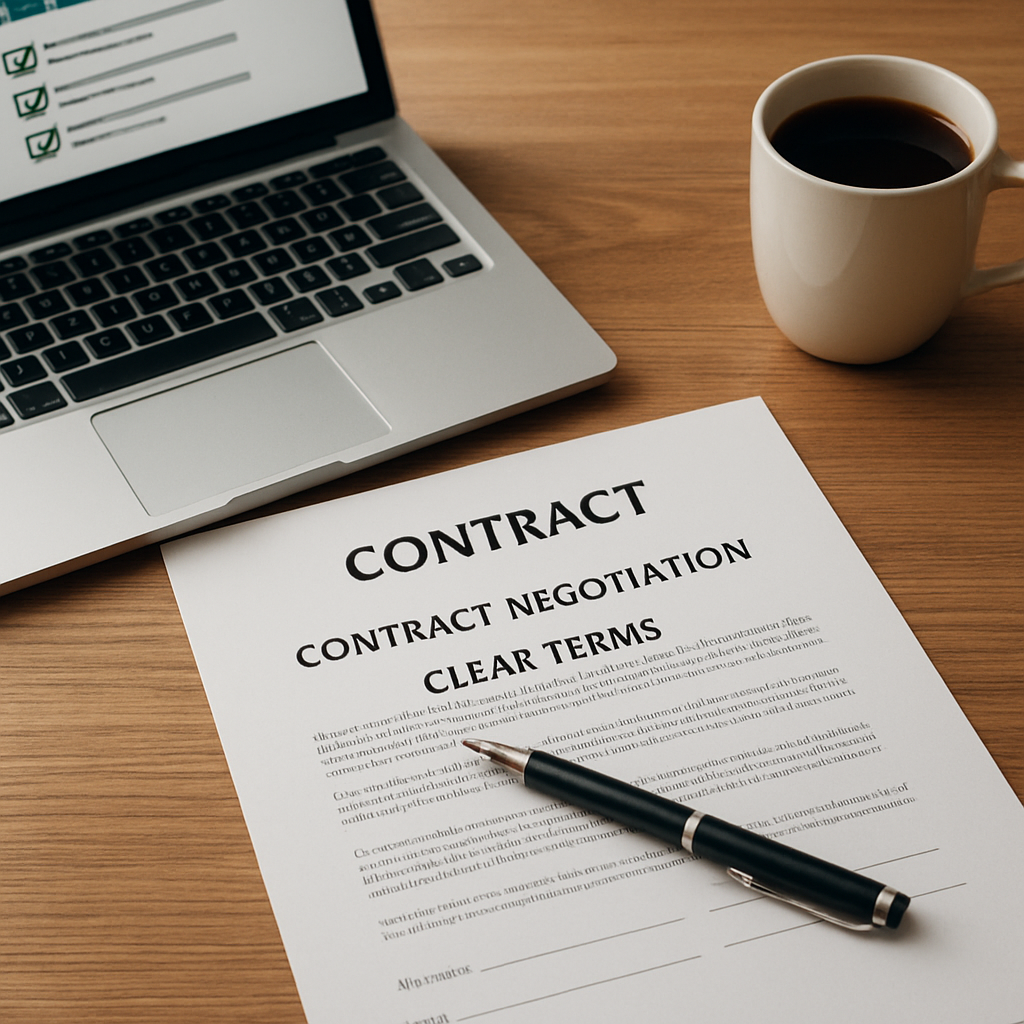
Take a minute right now to pull up the draft you’re about to send. Scan for each of these seven items. If anything’s missing, add it before you hit “send.” You’ll close the deal with confidence, not confusion.
Conclusion
We’ve walked through the whole playbook – from digging up intel on the other side to locking in crystal‑clear terms.
So, what does that mean for you? It means you can walk into any contract negotiation with a roadmap that feels less like a guess‑work exercise and more like a well‑rehearsed conversation.
Remember the three things that keep the momentum rolling: a solid objective charter, a lever‑filled alternative set, and a final checklist that turns “signed” into “executed.”
In practice, that might look like opening your next call with a quick “Hey, how’s the Q2 launch shaping up?” then sliding into a 5‑point summary of your key terms, and ending with the one‑page deal sheet you all can reference later.
Does it feel a bit messy? Good. The best contract negotiation strategies aren’t sterile; they’re alive, adaptable, and built on real‑world trade‑offs.
Take a minute right now to pull up your current draft, tick each of the seven items we covered, and add the one‑page summary if it’s missing. You’ll close with confidence, not confusion.
Ready to level up? Our next workshop dives deeper into framing and behavioral cues – it’s the natural next step after this guide. You’ll walk away with tools you can apply tomorrow.
FAQ
What are the most effective contract negotiation strategies for a Fortune 500 sales executive?
Start with a clear “negotiation charter” that translates your revenue targets into concrete numbers – think percentage discount, payment terms, and performance milestones. Then map the buyer’s hidden levers, like budget cycle timing or upcoming product launches, and weave them into “if‑then” offers. In practice, you might say, “If we lock in a three‑year term, we can shave 4 % off the list price and extend the rollout window by two weeks.” This creates a win‑win that feels tailored, not generic.
How can a procurement professional build leverage without revealing their BATNA?
Gather market benchmarks and alternative supplier data in a hidden spreadsheet. When the conversation stalls, drop a neutral fact – “Industry pricing for similar modules averages $X per seat.” That signals you have options without naming the exact backup. Pair it with a contingent concession: “If you can meet the 30‑day delivery window, we’ll keep the current price.” The other side sees you have a plan B, prompting them to move.
Why is it important to frame contract clauses as simple, actionable statements?
Legalese invites interpretation wars later. Rewrite “The Supplier shall indemnify the Buyer against any and all claims arising from breach of warranty” as “If the product fails the warranty, the Supplier will cover any costs you incur.” The plain language makes it easy for finance, legal, and operations to agree on the same meaning, reducing back‑and‑forth clarification emails and speeding up execution.
What quick checklist can I use right before signing a contract?
Grab a one‑page cheat sheet and tick these boxes: 1) All pricing matches the summary sheet; 2) Term length, renewal triggers, and exit clauses are explicit; 3) Payment schedule aligns with cash‑flow forecasts; 4) Contingent clauses cover key risks (e.g., regulatory changes); 5) Sign‑off responsibilities and deadlines are assigned; 6) A final “next‑step” list (send signed PDF, upload to shared drive, schedule kickoff). If any item is missing, pause before you sign.
How do I handle a sudden objection about contract length during the final negotiation?
Use the “pause‑and‑reframe” technique. Acknowledge the concern: “I hear you’re worried about locking in for three years.” Then pivot with a conditional offer: “If we embed a quarterly performance review that lets you adjust scope, we can keep the three‑year term and give you flexibility.” This shows you’re listening and turning the objection into a structured solution.
Can I use data‑driven anchoring in a small‑business deal, or is it only for large corporations?
Absolutely. Even a startup can pull publicly available pricing indexes or competitor quotes and start the conversation with a data‑backed anchor. Say, “Our research shows similar SaaS solutions charge $12‑$15 per user per month; we’re proposing $13 to stay competitive.” The anchor sets a reference point, and the counterpart is more likely to negotiate within that band rather than swing wildly.
What’s the best way to keep momentum after the contract is signed?
Don’t treat signing as the finish line. Send a concise “deal summary” email that lists the key numbers, dates, and owners, then attach a shared project plan with the first three milestones. Follow up within 24 hours to confirm receipt and schedule the kickoff call. A clear next‑step cadence turns a signed contract into an executed partnership and reduces the chance of post‑signing drift.