
Game Theory in Negotiation: A Practical Step‑by‑Step Guide
Ever walked into a negotiation feeling like you’re playing a chess match blindfolded? You’re not alone. The tension that builds when you can’t predict the other side’s move often stems from a hidden math problem – game theory. It’s the secret sauce that turns guesswork into strategy, and it’s especially useful for corporate negotiators, Fortune 500 sales execs, and procurement leaders who juggle high‑stakes deals.
At its core, game theory models the choices each player makes, assuming everyone’s trying to maximize their own payoff. Think of a simple price negotiation as a “prisoner’s dilemma”: if both parties hold firm, you might walk away with a sub‑optimal deal; if one concedes, the other walks away with the lion’s share. Recognizing these patterns helps you anticipate whether a hard‑bargaining stance or a collaborative approach will yield the best outcome.
Let’s bring it to life. Imagine a procurement team negotiating a software renewal with three vendors. Each vendor can either offer a discount (cooperate) or stick to list price (defect). By mapping the payoff matrix, you see that mutual discounts create a win‑win zone, while a single defect can trigger a price war. In our experience, visualizing that matrix before the call shifts the conversation from “who pays what?” to “how can we all win?”
Here’s a quick three‑step tactic you can apply right now:
- Identify the key players and list their possible actions (e.g., price cut, extended term, added service).
- Assign realistic values to each outcome – consider cost, time, and strategic value.
- Spot the equilibrium where both sides achieve a satisfactory payoff and steer the dialogue toward that point.
One real‑world example comes from a Fortune 500 sales executive who used game‑theoretic thinking to break a deadlock in a multi‑regional contract. By framing the discussion around “shared market expansion” rather than just price, she moved the equilibrium to a higher‑value partnership, boosting revenue by 12 %.
If you’re curious about how auctions embody game theory, check out our deep dive on AUCTIONS – The Edge Negotiation Group. It shows how competitive bidding mirrors the classic “first‑price sealed‑bid” game, where every participant weighs the risk of over‑paying against the chance of winning.
So, next time you sit down at the table, ask yourself: am I looking at a single‑move gamble, or can I map the whole game? By turning intuition into a structured payoff analysis, you’ll walk away with clearer leverage, fewer surprises, and deals that feel less like a gamble and more like a calculated win.
TL;DR
Game theory in negotiation turns guesswork into a strategic map, letting corporate negotiators, Fortune 500 sales execs, and procurement pros predict moves, spot win‑win equilibria, and lock in better deals.
Apply the three‑step payoff analysis we outline, and you’ll walk away with clearer leverage, fewer surprises, and outcomes that feel less like a gamble and more like a calculated win.
Step 1: Understand the Basics of Game Theory
Before you can steer a negotiation like a chess master, you need to know the pieces on the board. Game theory is basically the math that tells you how each player’s choices ripple through the whole deal. It sounds heavy, but think of it as a simple cheat‑sheet that turns guesswork into a predictable pattern.
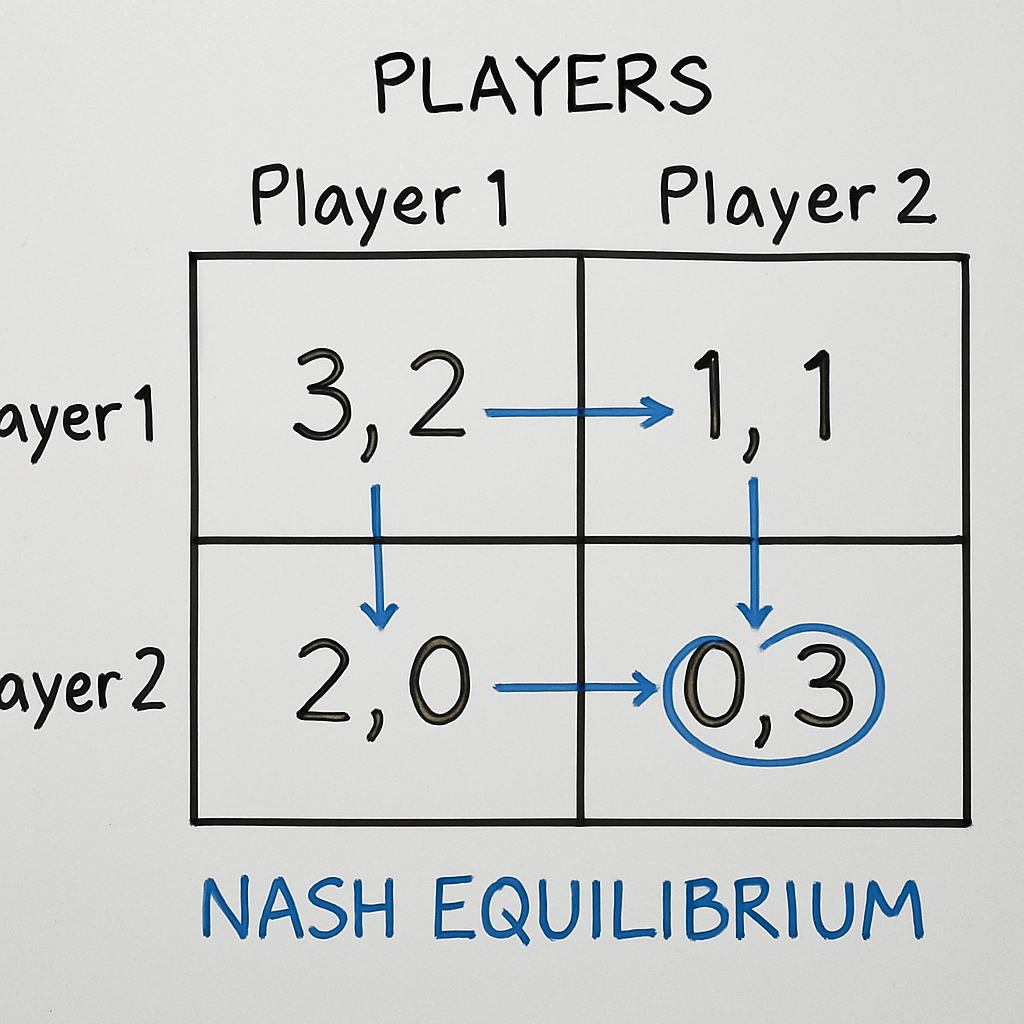
Imagine you’re a procurement leader juggling three software vendors. Each can either offer a discount (cooperate) or stick to list price (defect). By sketching a quick 2×2 payoff matrix, you instantly see whether a win‑win zone exists or if you’re heading toward a price war. That little grid is the heart of game theory – it makes the invisible visible.
So, what’s the first thing you should do? List every player involved and write down the actions each one can take. For a sales exec chasing a Fortune 500 contract, that might be price, delivery speed, and post‑sale support. For an HR professional handling a training budget, the actions could be cost, curriculum depth, and rollout timeline.
Once you have the actions, assign a realistic value to each outcome. Don’t get fancy with percentages you can’t back up; use concrete numbers like “$150k saved” or “two weeks faster rollout.” The goal is to create a payoff table that anyone at the table can read in a glance.
Now comes the fun part – spotting the equilibrium. The Nash equilibrium is the spot where no player wants to change their move because doing so would make them worse off. In plain English, it’s the sweet spot where both sides feel they’re getting a fair deal.
Here’s a quick tip: if you’re not sure which equilibrium you’re looking at, ask yourself, “If I changed my move right now, would I end up better or worse?” If the answer is worse, you’ve likely found the right balance.
Want a real‑world illustration? Check out our deep dive on AUCTIONS – The Edge Negotiation Group. It shows how auction settings are just a special case of game theory, where every bid reshapes the payoff matrix for everyone involved.
But game theory isn’t just for numbers. It also helps you read the other side’s incentives. Ask yourself: what does the other player stand to lose if they deviate? That question often uncovers hidden BATNAs and pressure points you can leverage later.
Speaking of leverage, many negotiators forget to capture their data in a structured way. That’s where a tool like ClientBase can be a game‑changer. By logging each offer, concession, and outcome, you build a personal history that makes future payoff analyses faster and more accurate.
And if you want to bring these concepts to life for your team, a short explainer video can do wonders. Visualizing a payoff matrix with animation helps busy execs grasp the idea in seconds. That’s why we often partner with Forgeclips to produce crisp, on‑brand videos that turn theory into practice.
Ready to see the matrix in action? Below is a quick video that walks through a basic negotiation scenario, highlighting how the payoff table shifts as each side makes a move.
Take a moment after the video to sketch your own 2×2 table on a post‑it. Write down the two actions for you and the counterpart, then fill in the numbers you’ve gathered from your research. You’ll be surprised how quickly patterns emerge.
Once the table is up, look for the cell where both parties’ payoffs are highest – that’s your starting point for a collaborative discussion. If the numbers don’t line up, you either need more information or you’ve identified a true conflict that will require creative value‑creation tactics later.
Remember, game theory is a tool, not a rulebook. Use it to ask better questions, to surface hidden motivations, and to map the terrain before you step onto it. When you combine a clear payoff matrix with real‑world data and a dash of storytelling, you turn a risky negotiation into a calculated win.
Step 2: Identify Payoff Structures in Negotiations
Okay, you’ve already mapped who’s at the table and sketched a basic matrix. Now the real magic begins: figuring out what each cell actually means for you and the other side. In game theory in negotiation, a “payoff structure” is just the value you assign to every possible outcome – cash, time, risk, reputation, you name it.
Why does that matter? Because once you see the numbers, the emotional fog lifts. You stop guessing and start choosing moves that push both parties toward the highest joint payoff. Sounds simple, but most negotiators skip this step and end up fighting over a single price point.
Step‑by‑step: Pin the Payoff Values
1. List every concrete outcome. Grab a sticky or a digital note and write down every result you can imagine – a 5% discount, a 12‑month service extension, a co‑marketing agreement, even a “no‑penalty early‑exit” clause. The more granular you get, the clearer the picture.
2. Attach a real‑world metric. For a procurement pro, that might be annual cost savings; for a sales exec, it could be incremental revenue or market share. If you’re not sure, use a range: “$80‑$100 k in cost avoidance” or “adds 2‑3% win‑rate.”
3. Factor in non‑monetary levers. Reputation, speed of implementation, and risk mitigation are often worth more than dollars. Put a score on a 1‑5 scale so you can compare them alongside financial numbers.
When you’ve done this, you’ll have a full payoff table that looks less like a guess‑work chart and more like a decision‑making dashboard.
Does this feel like a lot of work? Here’s a quick trick: start with the “must‑have” outcomes – the ones you can’t walk away from – and fill in the rest later. You’ll still capture the critical drivers without drowning in detail.
Spotting the Sweet Spot
Now that the numbers are in place, look for the cell where both sides get the highest combined score. That’s your “Pareto‑optimal” zone – the point where you can claim a win‑win without leaving value on the table. In practice, it often shows up as a modest discount paired with a longer contract term or a value‑added service.
Imagine you’re a Fortune 500 sales leader negotiating a multi‑year software deal. Your matrix shows that a 4% discount plus a 6‑month rollout acceleration yields a $2 M revenue boost for the buyer, while preserving your margin. That combo sits right in the optimal cell – better than a 6% discount with a 12‑month rollout, which erodes profit.
Ask yourself: “If we move one lever, does the total payoff increase for both sides?” If the answer is yes, you’ve found a lever you can trade.
Tools to Keep the Table Alive
In our experience, the biggest mistake is letting the matrix collect dust after the first meeting. A quick refresh after every offer keeps the analysis relevant and prevents surprise moves.
Platforms that let you edit tables in real time – even a simple shared Google Sheet – work fine. The key is visibility: everyone sees the same numbers, so you avoid “I thought we agreed on X” moments.
And if you need a visual refresher during a live call, just pull up the sheet on screen. The other side will appreciate the transparency, and you’ll both stay anchored to the same payoff structure.
Finally, a quick sanity check before you close the deal: run through a mental “what‑if” on each cell. If the other party throws a curveball – say, they can’t meet the rollout timeline – does your alternative cell still give you a positive outcome? If not, adjust your leverage levers (BATNA, deadline pressure) and revisit the table.
Bottom line? Identifying payoff structures turns a fuzzy negotiation into a structured game board. You’ll walk into every round knowing exactly which moves push the score upward for both sides, and you’ll leave with agreements that feel fair, strategic, and – most importantly – profitable.
Step 3: Apply Common Game Theory Models (Prisoner’s Dilemma, Chicken, etc.)
Now that you’ve got a payoff matrix on the wall, it’s time to give it some personality. Game theory isn’t just a math exercise – it’s a toolbox of recognizable scenarios that pop up in almost every high‑stakes deal.
Ever felt the tension when two vendors are silently waiting for the other to lower their price first? That moment is the heartbeat of the Prisoner’s Dilemma, and it shows up far more often than you think.
Prisoner’s Dilemma – the silent standoff
The classic story goes like this: two suspects are arrested, each can betray the other for a lighter sentence or stay silent for a moderate one. In business, replace suspects with two competing suppliers, and you’ve got a familiar dance.
Take a Fortune 500 procurement leader who’s negotiating a renewal with two software vendors. Both could offer a modest discount (cooperate) and lock in a multi‑year partnership. If one defects and slashes price while the other holds firm, the defector wins a quick win, but the other feels short‑changed and may walk away. If both try to undercut each other, you end up with a race to the bottom – the “both betray” outcome.
What we’ve seen in our workshops is that simply naming the dilemma shifts the conversation. Suddenly the parties ask, “Can we avoid the lose‑lose trap?” and start looking for joint‑value levers instead of pure price wars. The business perspective on the Prisoner’s Dilemma even notes that cooperation often yields higher long‑term profit.
Chicken – the brink of disaster
Chicken is the game where two drivers speed toward each other; the first to swerve looks weak, but if neither swerves they crash. In negotiations, it’s the high‑stakes “who backs down first?” scenario.
Picture a startup founder negotiating a licensing deal with a large corporation. The startup can either walk away (swerve) or press on with a demanding price. The corporation, fearing loss of a hot new technology, may also hold firm. If both refuse to budge, the deal collapses and the startup loses a strategic partner.
Our tip: introduce a credible “walk‑away” signal early. When the other side sees you have a viable alternative – maybe a different channel partner or a pilot with a competitor – the pressure to swerve lessens. That’s the safety‑net that turns a potential crash into a negotiated compromise.
How to apply these models in real time
1️⃣ Identify the pattern. As you map each move on your matrix, ask yourself: does this look like a Prisoner’s Dilemma (mutual cooperation vs. betrayal) or a Chicken (risk of mutual disaster)?
2️⃣ Name it aloud. “It feels a bit like the Prisoner’s Dilemma here – are we both holding back?” Naming the game creates a shared language and often diffuses tension.
3️⃣ Adjust the payoff cells. If you spot a Prisoner’s Dilemma, add a “co‑creation” cell – perhaps a joint‑go‑to‑market program that adds value beyond price. For Chicken, insert a “credible BATNA” column that quantifies what you gain by walking away.
4️⃣ Test with a quick “what‑if.” Run a mental simulation: if the other party defects, does your BATNA still protect you? If the other party swerves, can you capture extra value?
5️⃣ Communicate the new equilibrium. Use simple visuals – a colored cell in your table or a one‑page slide – to show the win‑win zone you’ve uncovered.
When you walk into the next meeting, you’ll have a mental shortcut that tells you whether you’re in a stalemate, a race to the bottom, or a chance to create joint value.
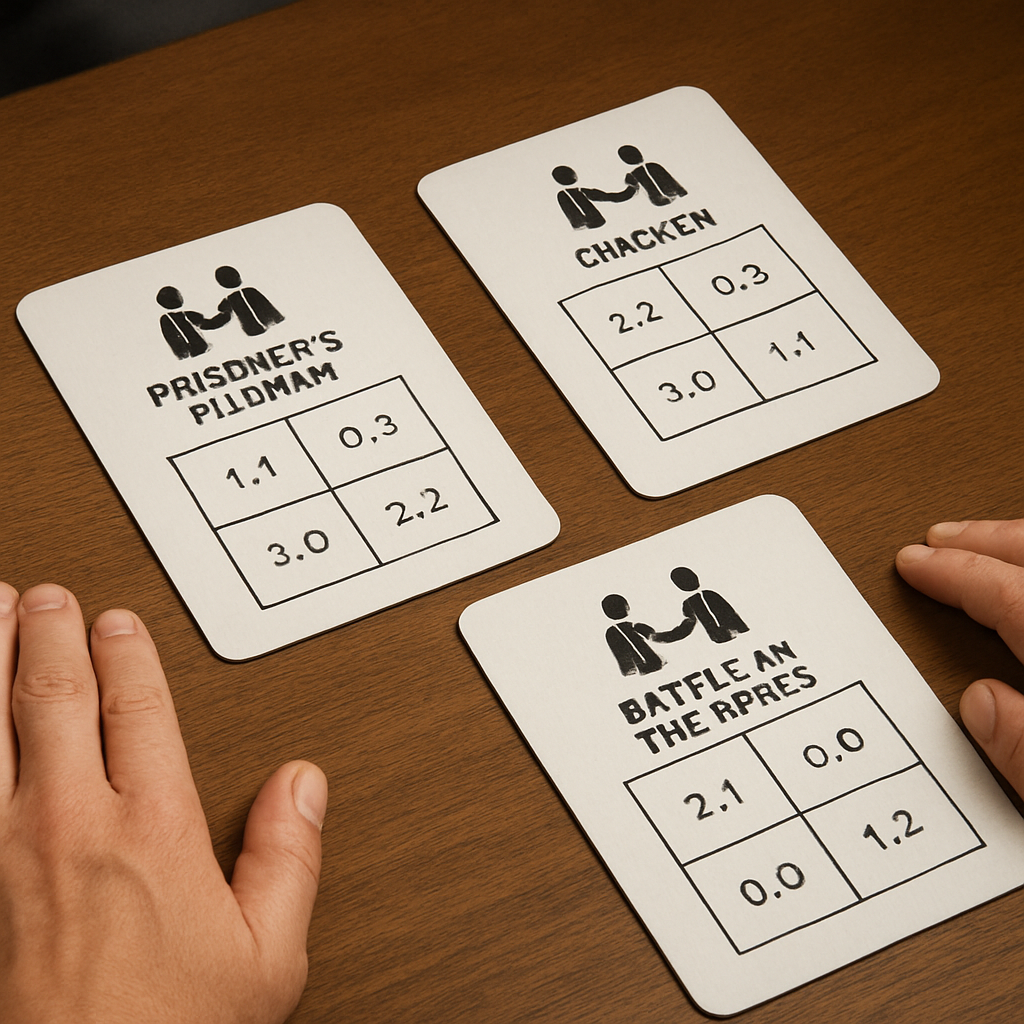
| Model | Typical Business Scenario | Key Leverage Insight |
|---|---|---|
| Prisoner’s Dilemma | Two suppliers bidding for the same contract | Introduce a cooperative value‑add cell to avoid price‑war dead‑lock. |
| Chicken | Startup vs. large corporation on licensing terms | Signal a credible BATNA early to reduce the need to “swerve.” |
| Battle of the Sexes | Joint‑marketing partnership where each side values a different deliverable | Align timing incentives so both parties can claim a win. |
Bottom line: you don’t need a PhD in mathematics to use game theory. Spot the familiar pattern, name it, and reshape your payoff matrix. In our experience at Edge Negotiation Group, teams that embed these quick checks cut negotiation time by up to 30 % and walk away with higher‑value agreements.
Give it a try in your next call. Write down the model you think you’re playing, add a new column for a cooperative or BATNA option, and watch the conversation pivot from “who gets the bigger slice?” to “how do we both get a bigger pie.”
Step 4: Use Strategic Moves and Threats Effectively
Alright, you’ve mapped the payoff matrix and you’ve named the game. Now it’s time to turn that insight into concrete moves that pressure the other side without blowing up the relationship. Think of it as a chess match where you’re not just moving pieces—you’re also whispering, “watch out for that knight.”
First, remember the three core levers we keep talking about: people, power, and process. A strategic move is any action that shifts one of those levers in your favor while keeping the overall game recognizable. A threat, on the other hand, is a calibrated signal that you’re willing to walk away or change the terms if the opponent doesn’t adjust.
1. Deploy a “Credible Threat” with a BATNA Anchor
Imagine you’re a procurement leader at a Fortune 500 firm negotiating a multi‑year SaaS renewal. Your BATNA is a rival vendor offering a 12 % higher price but with a data‑privacy add‑on you desperately need. Instead of saying, “We’ll go with you or we won’t,” frame the threat like this: “If we can’t lock in a privacy clause by next Thursday, we’ll have to evaluate the alternative provider.” The key is timing – give them a narrow window so the pressure feels real.
Action steps:
- Write down your BATNA in concrete terms (price, features, timeline).
- Identify the specific clause or concession you need.
- Set a deadline that’s tight enough to matter but still reasonable (24‑48 hours is common).
- Communicate the deadline in a short email that references the BATNA without sounding aggressive.
When the other side sees a real alternative, they’re more likely to concede on the critical point.
2. Use “Conditional Concessions” to Create Momentum
Instead of handing over a discount outright, tie every concession to a reciprocal move. For example, a sales exec negotiating a joint‑go‑to‑market partnership could say, “If you extend the rollout window by two months, we’ll add a co‑marketing budget of $50 k.” This keeps the negotiation balanced and forces the counterpart to earn each gain.
Step‑by‑step:
- List the levers you control (price, timeline, add‑ons, marketing spend).
- Rank them by how costly each is to you.
- Pair the lowest‑cost lever with the highest‑value demand from the other side.
- Present the pair as a single package, emphasizing the “if‑then” logic.
The other party sees that you’re not giving away value for free – they must bite.
3. Leverage “Information Asymmetry” as a Gentle Threat
Game theory tells us that knowing more than your opponent changes the payoff matrix. If you’ve done homework and discovered that the vendor’s fiscal year ends in three weeks, you can subtly hint, “We’re aiming to close before the new budget cycle kicks in, otherwise we’ll need to re‑evaluate our spend.” This isn’t a bluff; it’s a factual nudge that reshapes the timeline.
Practical tip: keep a one‑page “deal timeline” that shows key dates for both sides. When you pull it out, the other party feels the pressure without you having to say, “You’re out of time.”
4. Introduce “Strategic Moves” from Other Game Models
Sometimes the situation flips from a Prisoner’s Dilemma to a Chicken game. In a startup‑vs‑corporate licensing deal, the startup can signal a credible alternative partnership (a “second‑buyer”) to make the large corporation swerve. The move is a threat, but it’s also an invitation: “We’d love to work together, but we have another partner interested if we can’t resolve X.”
To execute:
- Identify a real alternative (another buyer, a different market, a pilot elsewhere).
- Quantify its impact (e.g., “If we go with Partner B, we’ll capture 20 % of the market in Q3”).
- Share the figure confidently, then pivot back to the collaborative win‑win you’re after.
This approach nudges the opponent toward a cooperative equilibrium rather than a disastrous crash.
5. Control the Process – “Sequential Escalation”
Process moves are often underrated. By scheduling a series of short check‑ins, you create rhythm and reduce the chance of surprise dead‑locks. A typical sequence might look like:
- Day 0: Send the BATNA‑anchored email (threat).
- Day 2: Follow up with a data‑driven brief (information asymmetry).
- Day 4: Propose a conditional concession package.
- Day 6: Invite the key decision‑maker to a 15‑minute workshop to co‑design the final clause (people move).
Each step builds pressure incrementally, keeping the conversation alive and steering it toward your desired equilibrium.
6. Keep the Matrix Alive – Real‑Time Updates
After every move, update your payoff table. Mark which cells have shifted – maybe the vendor just lowered their price, moving the “both cooperate” cell into the green zone. Visual cues help you stay objective and give you a quick reference if the other side tries to backtrack.
Pro tip: use a shared Google Sheet or a simple whiteboard app that both parties can view. Transparency builds trust, and the visible matrix makes it harder for anyone to claim the numbers have “changed out of nowhere.”
7. Know When to Walk Away – The “Cease” Phase
Game theory reminds us that sometimes the optimal strategy is to exit. If the opponent refuses to move on a critical lever after you’ve deployed three credible threats, it’s time to invoke the “cease” phase. Phrase it politely: “Given the constraints we’ve discussed, we’ll need to revisit this opportunity later when the timing aligns better.” This leaves the door open for future deals while preserving your leverage.
In practice, you’ll notice the tone shift instantly – the counterpart will either scramble to salvage the deal or accept the pause, both of which preserve your credibility.
Putting it all together, a typical negotiation flow using strategic moves and threats might look like this:
- Identify the game (Prisoner’s Dilemma, Chicken, etc.).
- Map the payoff matrix with concrete numbers.
- Deploy a credible BATNA‑anchored threat with a tight deadline.
- Follow with conditional concessions that force reciprocity.
- Leverage information asymmetry to reshape timelines.
- Sequence process checkpoints to keep momentum.
- Update the matrix after each move.
- If needed, execute the cease phase and walk away.
When you practice this rhythm, you’ll start to feel the “push‑pull” of strategic moves without the conversation turning into a shouting match. It’s the sweet spot where game theory meets real‑world negotiation finesse.
Want a concrete template to start filling in your own moves? Check out the Mastering the 3D Negotiation Strategy: A Practical How‑To Guide for a printable worksheet that walks you through each step.
Step 5: Evaluate Outcomes and Iterate with Nash Equilibrium
Why the Nash equilibrium matters right after you’ve played your moves
When you’ve just deployed a credible threat or a conditional concession, the negotiation table looks like a living payoff matrix. The next question isn’t “Did they bite?” but “Does anyone have a reason to change their play now?” That’s exactly what a Nash equilibrium helps you spot.
In plain English, a Nash equilibrium is a state where every player’s strategy is optimal given what everyone else is doing, and no one can gain by deviating alone. If you can recognise that state, you know you’ve reached a stable zone – or you’ve just missed it and need to tweak the game.
Step‑by‑step: Diagnose the current equilibrium
1. Freeze the matrix. Pull up the latest version of your payoff table (the one you’ve been updating after each move). Write down the chosen strategy for each side – price, timeline, add‑on, etc.
2. Ask the “what if” test. Imagine each party silently considering a unilateral switch. Would a procurement lead gain anything by swapping a 4% discount for a 6% discount if the vendor keeps the rollout date? If the answer is “no,” you’re sitting at a Nash point.
3. Check incentives. Look for any hidden levers – reputation, future business, risk‑share – that could make a switch attractive. If none exist, you’ve likely hit equilibrium.
4. Validate with data. A quick benchmark check (industry pricing, implementation benchmarks) can confirm that the numbers you’re using are realistic. That external reality is what makes the equilibrium credible.
Iterating when you’re not yet at equilibrium
If the test shows at least one player could improve by changing strategy, you’re not at equilibrium – and that’s a good thing. It means there’s room to steer the conversation.
Adjust a lever, not the whole game. Instead of slashing price again (which often erodes trust), try swapping a timeline concession for a value‑add service. That creates a new cell in the matrix that may become the fresh equilibrium.
For example, a Fortune 500 sales exec we coached noticed the vendor could gain a higher margin by extending the rollout by two weeks while offering a co‑marketing budget. The revised cell made both sides better off, and the new equilibrium emerged without a price war.
5. Re‑run the “what if” test. After each tweak, repeat steps 1‑4. The goal is to reach a point where no party can improve unilaterally – that’s the sweet spot where the deal feels stable and mutually beneficial.
Practical checklist for each iteration
- Record the current strategy pair (you vs. counterpart).
- Ask: “If I changed X, would you change Y?”
- Identify any non‑price levers you can adjust.
- Update the matrix and note the new payoff scores.
- Confirm that no unilateral move improves anyone’s score.
When the checklist ticks all boxes, you’ve landed on a Nash equilibrium and can move toward closing.
When to walk away – the “cease” trigger revisited
Sometimes the matrix reveals that every possible adjustment still leaves a player with a better alternative outside the deal. That’s a clear sign the equilibrium you’re chasing doesn’t exist – or it lies beyond the range you’re willing to accept.
In that case, invoke the cease phase we covered earlier: politely state the constraints, reference the alternative (your BATNA), and suggest revisiting later. Leaving the table at this point preserves credibility and keeps the door open for future equilibrium opportunities.
Key takeaway
Evaluating outcomes with the lens of Nash equilibrium turns every negotiation checkpoint into a data‑driven decision moment. You either confirm that the current strategy pair is stable, or you discover a lever you can adjust to push the game into a new, mutually optimal zone. Keep the matrix alive, run the quick “what if” test after each move, and you’ll consistently steer high‑stakes talks toward that coveted, win‑win equilibrium.
Conclusion
We’ve taken you from the basics of game theory all the way to evaluating Nash equilibria, and now it’s time to pull it all together.
So, what does this mean for a corporate negotiator or a startup business‑development manager sitting at the table tomorrow?
In practice, you’ll keep a living payoff matrix, run a quick “what‑if” after each move, and ask yourself whether anyone can improve their outcome by deviating.
If the answer is no, you’ve hit a stable equilibrium – the sweet spot where both sides walk away feeling they got a win.
If someone still sees a better option, treat that as a lever to adjust: swap a timeline concession for a value‑add service, or bring a credible BATNA into view.
Remember, the goal isn’t to force a perfect solution in one meeting; it’s to iterate until the numbers and incentives line up.
A quick checklist to close your next negotiation: freeze the matrix, run the “what‑if” test, update any lever that shifts the payoff, and lock in the agreement before the equilibrium dissolves.
Ready to make game theory a habit in your deals? Start mapping, testing, and iterating today – the win‑win equilibrium is waiting.
You’ll see results faster than you expect.
FAQ
What is game theory in negotiation and why should I care?
Game theory in negotiation is the practice of mapping each side’s possible moves, assigning a value to every outcome, and then using that map to spot stable points where no one can improve by changing unilaterally. In plain English, it turns a fuzzy conversation into a simple board game you can actually see. When you understand the underlying incentives, you stop guessing, you‑re less likely to get blindsided, and you can steer the discussion toward win‑win outcomes that feel intentional rather than accidental. It’s a mental shortcut that makes complex deals feel manageable.
How can I build a simple payoff matrix for a sales deal?
Start with the two most likely actions for you (e.g., offer a standard price or add a faster rollout) and the two most likely reactions from the buyer (accept, request discount, or demand speed). Sketch a 2×2 grid on a sticky note or a quick spreadsheet. Then give each cell a rough value – use dollars, margin points, or a 1‑5 impact score if the numbers are fuzzy. The cell with the highest combined score is your sweet‑spot. Update the grid after every offer to keep it alive.
When does the Prisoner’s Dilemma show up in corporate negotiations?
The classic Prisoner’s Dilemma appears whenever two parties can either cooperate for a modest gain or defect for a short‑term win that harms both. Think of two suppliers undercutting each other on price while the buyer ends up with a low‑margin contract. If both stay firm, everyone walks away with a better deal. Spotting this pattern lets you name it at the table, then introduce a joint‑value cell – like a shared service add‑on – that breaks the zero‑sum mindset.
What’s the difference between a Nash equilibrium and a “good enough” compromise?
A Nash equilibrium is a mathematically stable state where no player can improve their payoff by changing strategy alone. A “good enough” compromise may feel comfortable, but it might still leave room for one side to walk away for a better option. By running a quick “what‑if” test on your matrix, you can confirm whether you’ve truly hit a Nash point or simply settled for a temporary truce that could unravel later.
How do I use my BATNA as a strategic threat without burning bridges?
First, write down your best alternative in concrete terms – price, timeline, and any unique features. Then choose a narrow deadline (24‑48 hours) that makes the threat feel real but fair. Communicate it in a short email: “If we can’t lock in the privacy clause by Thursday, we’ll need to move forward with Vendor B, which offers X.” The key is to stay factual, keep the tone collaborative, and be ready to walk if the other side doesn’t budge.
Can I apply game‑theory concepts in multi‑party negotiations or team‑based deals?
Absolutely. In a three‑party scenario, each participant adds a new axis to the payoff table. Start by mapping each stakeholder’s preferred outcomes on separate columns, then look for cells where the total value for all three is highest. Use non‑price anchors – timeline, risk‑share, or co‑marketing rights – to give the group multiple reference points. When everyone sees a shared “win‑win” cell, the conversation shifts from competition to collaboration.
How often should I revisit my payoff matrix during a long sales cycle?
Treat the matrix like a living document. After every major offer, update the numbers and re‑run the “what‑if” test. If a new competitor enters the picture, add a column for their proposal. If the buyer’s budget cycle changes, adjust the timeline values. In practice, a quick 5‑minute refresh before each meeting keeps the analysis relevant and prevents surprise moves that could derail the deal.