
Anchoring in Negotiation: A Practical Guide to Mastering First Offers
Ever walked into a negotiation and felt the conversation swing like a pendulum before you even said a word?
That jittery feeling often comes from the first number or term that lands on the table – the anchor. In anchoring in negotiation, the opening figure isn’t just a starting point; it’s a mental shortcut that shapes every subsequent concession.
Why does that matter? Because research shows people rely heavily on the initial reference point, even when they know it’s arbitrary. That bias can turn a modest deal into a win‑win or a costly loss, depending on who set the anchor.
Think about a corporate negotiator at a Fortune 500 firm who walks into a supplier contract meeting. If she lets the vendor name the price first, she’s essentially handing them the reins. But when she walks in with a well‑crafted, data‑backed opening offer, she forces the vendor to negotiate around her numbers, nudging the final agreement closer to her target margin.
Or picture a sales executive pitching a new SaaS solution to a startup. By opening with a high‑value package that includes premium support, she creates a perception of greater overall worth. Even if the client trims some features, the final price often stays above what it would have been if she’d started low.
From a behavioral psychology angle, anchoring taps into the “adjustment heuristic.” Our brains make quick adjustments from the anchor rather than calculating from scratch. That’s why a well‑placed anchor can shave weeks off the back‑and‑forth of price haggling.
One common mistake I see is treating the anchor as a hard ceiling. In reality, it’s a flexible reference point. If the other side pushes back hard, you can recalibrate by introducing a secondary anchor – perhaps a timeline or volume discount – to keep the conversation anchored in your favor.
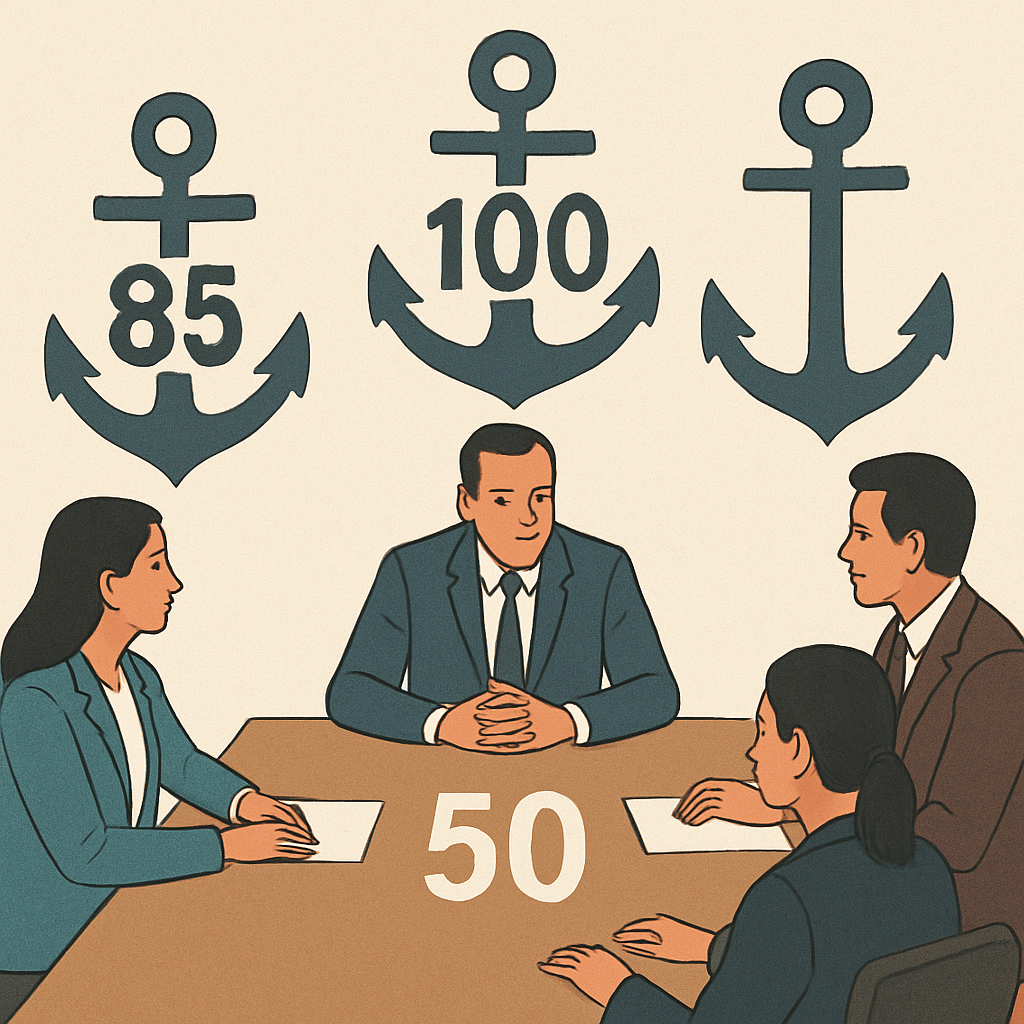
Quick tip: before any meeting, write down three possible anchors – a bold number, a realistic compromise, and a stretch‑goal. Pick the one that aligns with your ultimate objective and rehearse it until it feels natural.
Now that you’ve got a sense of how powerful that first number can be, let’s dive deeper into the specific tactics you can use to set, test, and protect your anchor throughout the negotiation process.
TL;DR
When you drop a strong opening number, you set the mental anchor that steers every later concession, letting you shape the deal in favor of your target outcome.
In our experience, prepping three anchor options—a bold ask, a realistic middle, and a stretch goal—then rehearsing them, gives corporate negotiators and sales executives the flexibility to pivot confidently and keep the conversation anchored to value.
Understanding Anchoring: Psychological Foundations
Core mechanism
Let me be blunt: anchoring in negotiation is a mind trick, not magic.
It starts with a number — any number — and your brain builds from there.
You don’t recalculate from first principles; you adjust away from that anchor.
This is the classic adjustment heuristic from Tversky and Kahneman.
Why anchors stick
Why does a random figure steer judgments so reliably?
Because our cognitive bandwidth is limited and we take mental shortcuts.
An initial number primes comparisons, frames value, and reduces the effort you spend searching for alternatives.
Think of the anchor as a gravitational pull; every concession or counteroffer happens inside that field.
What’s happening under the hood?
First, priming: exposure to a number makes related magnitudes more accessible.
Second, selective adjustment: we stop adjusting once the number “feels” good enough.
Third, reference dependence: outcomes are judged relative to the anchor, not absolute value.
And emotions, context, and expertise change how much you adjust.
For example, research on consumer experience shows anchors are stronger when people rely on sensory impressions and have less product knowledge — see the Frontiers study on consumer anchoring: experimental evidence on experience-driven anchoring.
Now, what does that mean for you in a real negotiation?
If you’re a sales executive or procurement lead, notice how the first price sets the conversational coordinate system.
If you let the other side open, you’re negotiating around their map.
If you open, you move the map to where you want the final town to be.
How anchoring shows up at the table
So, how do you test and protect your anchor?
Plan three anchors: bold opening, realistic target, and a stretch anchor to pull perceptions upward.
Use data to justify each number; the brain is likelier to accept anchored ranges when evidence supports them.
Don’t forget early warning: a simple callout — “don’t let a first number lock the discussion” — helps teams avoid mechanical adjustments, a tactic supported by experimental anchoring research in negotiation studies (negotiation research summaries).
Small checklist you can use right away:
Before the meeting, write your three anchors and practice the phrasing.
Force the other side to justify their first figure with specifics.
Re-anchor with non‑price references if necessary (timeline, volume, scope).
Call out the anchor explicitly if it’s arbitrary.
Need a quick refresher on the psychological evidence?
The literature shows anchors operate across contexts — from consumer price judgments to formal negotiations — and are maddeningly robust.
If you want to press the advantage, rehearse phrasing that ties your anchor to specific outcomes.
Use staged offers: open with value heavy, then offer value‑removal concessions that still keep price anchored.
And when you’re on the receiving end, ask for time to unpack the anchor and bring external benchmarks into the room.
Want to see the cognitive science behind anchoring in action? Watch this short explainer below.
Micro‑tactics you can use today
Apply these as micro‑habits and you’ll stop reacting to numbers and start shaping them.
Start tomorrow, not later.
Practice, rehearse, and review.
Step 1: Setting Your Initial Offer Effectively
Ever walked into a room and felt the weight of the first number you say? It’s like dropping a stone into a calm pond – the ripples spread fast and you end up steering the whole conversation.
That’s the power of anchoring in negotiation. If you can set the right stone, you control where the ripples go.
Why a well‑crafted anchor matters
Research from Harvard’s Program on Negotiation shows that even a random number can swing judgments dramatically. In one classic experiment, participants who saw a wheel stop at 10 guessed a factual percentage about 25%, while those who saw 65 guessed around 45%. The anchor, even when meaningless, became the reference point.
For a corporate negotiator, that means a bold opening price can tilt a multi‑million‑dollar contract toward your target range. For a startup business‑development manager, it can make a modest seed‑funding round look far more attractive.
Step‑by‑step: Crafting your initial offer
1. Map the ZOPA first. Before you even think about a number, know the Zone of Possible Agreement. Pull any market data, past deals, or internal cost models you have. The tighter your ZOPA knowledge, the more confident you can be about where to drop the anchor.
2. Create three anchor candidates. – A bold “high‑anchor” that stretches the perceived value. – A realistic “mid‑anchor” that aligns with the most likely outcome. – A safety‑net “low‑anchor” you can fall back to if the other side pushes back hard.
3. Tie each anchor to concrete outcomes. Don’t just say, “We’re asking $2 million.” Explain, “We’re asking $2 million because it includes a 12‑month support package, a 5 % discount for volume, and a guaranteed ROI timeline.” The more specific, the more the brain accepts the anchor as legitimate.
4. Practice the delivery. Say the line aloud, record yourself, and tweak the tone until it feels natural. In our experience, a confident, conversational delivery (think coffee‑chat, not courtroom) makes the anchor stick.
Real‑world examples
Example A – Fortune 500 sales exec. Maria was pitching a SaaS suite to a fast‑growing tech startup. Instead of leading with a $50k annual fee, she opened with a $75k “enterprise‑value” package that bundled premium onboarding, 24/7 support, and a custom analytics dashboard. The startup’s CFO balked at $75k, but because the package felt high‑value, they negotiated down to $62k – still 24% above Maria’s original target of $50k.
Example B – Procurement lead. Jake was renegotiating a supply contract. He knew the supplier’s cost basis and the market ceiling. He opened with a “new‑partner” price of 15% above the current rate, justifying it with projected volume growth and a multi‑year commitment. The supplier, anchored to the higher figure, counter‑offered at only 5% above the old price, leaving Jake with a win‑win.
Protecting your anchor
When the other side drops an anchor, don’t jump straight to a counter‑offer. First, defuse: “I see where you’re coming from, but $100 k feels way off our range.” Then re‑anchor with your data‑driven number and the benefits attached.
Another trick is to introduce a non‑price anchor – timeline, delivery scope, or risk‑sharing terms. That shifts the focus away from the initial price anchor and gives you fresh leverage.
Checklist for your first offer
- Identify ZOPA with at least three data points.
- Draft three anchor options.
- Attach specific value drivers to each number.
- Rehearse the phrasing until it feels like a story.
- Plan a defusing line for opponent anchors.
And remember, you don’t have to stick to the first number forever. You can re‑anchor later with new information – just make sure the new anchor is backed by fresh evidence.
Want to dive deeper into how anchoring intertwines with other negotiation styles? Check out our guide on hard‑bargaining tactics for complementary strategies.
For a broader perspective on content strategy that can help you frame your proposals, see this practical guide to using a topic cluster generator. And if you’re curious about the environmental side of negotiations – like choosing sustainable procurement options – the German resource on kaminofen BImSchV regulations provides a detailed look.
Step 2: Framing the Anchor with Persuasive Language
Now that you’ve got a solid number, the next trick is how you dress it up. Framing is the storytelling glue that makes your anchor feel inevitable rather than arbitrary.
Think about it like this: you’re not just saying $2 million, you’re saying “a $2 million investment that guarantees a 12‑month ROI and shields you from future price hikes.” The language you choose nudges the counterpart’s brain toward the benefits before they even start subtracting costs.
So, how do you turn a raw figure into a persuasive package?
Step‑by‑step framing formula
1. Pinpoint the core value driver. Before you speak, ask yourself what the other side cares about most – speed, risk reduction, market share, or cost certainty. That driver becomes the anchor’s backbone.
2. Pair the number with a concrete outcome. Instead of “we charge $150k,” try “we charge $150k because it secures a 6‑month implementation window that cuts time‑to‑value by 30 %.” The outcome acts like a proof‑point that justifies the price.
3. Use contrast language. Show the gap between the status‑quo and your proposal. For example, “most firms spend $200k on fragmented tools, but our bundled solution at $150k eliminates duplicate licenses and saves you $50k annually.” The contrast makes the anchor feel like a bargain.
4. Sprinkle credibility cues. Reference data, past wins, or third‑party benchmarks. A quick “our last three clients saw a 20 % margin lift” gives the anchor a research‑backed veneer.
5. Practice the delivery with tone. Say the line as if you’re sharing a tip over coffee, not reciting a script. A relaxed, confident tone signals that you truly believe in the number.
Does that sound doable? Absolutely – you just need a checklist in front of you.
Real‑world mini‑scenarios
Corporate negotiator. Maria, a Fortune 500 sales exec, wants a $75k enterprise package. She frames it: “$75k gets you a 24/7 support team, a custom analytics dashboard, and a guaranteed 15 % cost‑avoidance in the first year.” The client sees the $75k not as a price tag but as a risk‑mitigation plan.
Startup business‑development manager. Jake is pitching a partnership to a fast‑growing SaaS startup. He says, “For $30k we deliver a go‑to‑market playbook that typically drives $120k in ARR within six months.” The contrast (four‑to‑one ROI) frames the anchor as an investment, not an expense.
Notice how each story ties the number to a specific benefit, uses contrast, and drops a credibility nugget. That’s the essence of persuasive framing.
| Framing Element | What to Say | Why It Works |
|---|---|---|
| Value Driver | Because you need faster time to market | Aligns anchor with the prospect’s top priority |
| Concrete Outcome | which saves $50k annually | Turns abstract cost into a tangible gain |
| Contrast Cue | Most buyers pay $200k for fragmented tools | Creates a reference point that makes your anchor look cheap |
Want a quick refresher on why framing matters as much as the anchor itself? This concise study guide breaks down the psychology behind anchoring and framing in distributive bargaining: anchoring and framing study guide.
And remember, framing isn’t a hard‑ball ploy. If you find yourself slipping into extreme demands, Harvard’s Program on Negotiation warns that hard‑ball tactics can sabotage trust and derail integrative value creation: hardball tactics overview. Keep the focus on mutual gain, and your anchor will feel like a natural step forward.
Take a moment now: write down one of your upcoming offers, then apply the five steps above. Read it aloud, tweak the language, and notice how the same number suddenly feels far more compelling. That’s the power of framing – it turns an anchor into a story your counterpart wants to be part of.
Step 3: Counter‑Anchoring and Responding to Opponent’s Anchors
Imagine you’re midway through a contract discussion and the other side drops a number that feels like a cold splash. Your heart jumps, you wonder if you’ve just lost the high‑value range you fought to set.
That moment is exactly where counter‑anchoring shines. Instead of reacting with a knee‑jerk concession, you flip the script, reset the reference point, and keep the negotiation anchored on your terms.
Why counter‑anchoring matters
In our experience, the first figure a counterpart throws out creates a mental “anchor” that pulls every subsequent offer toward it. If you let that anchor dominate, you’ll end up negotiating around their reality, not yours.
Research from Red Bear Negotiation shows that effective counter‑anchoring “shifts the perceived value of the offer before the full discussion unfolds,” allowing you to steer the bargaining zone back toward your target range. Read their deep dive on the technique.
So, how do you do it without sounding defensive or aggressive? Below is a step‑by‑step playbook you can run in the moment.
Three tactical moves
1. Acknowledge, then pivot. Start with a brief, neutral nod – “I hear you, and $120 k is higher than our budget.” This validates the other side, diffusing tension. Immediately follow with your own anchor tied to concrete value: “Our data shows that a $95 k package delivers a 20 % cost‑avoidance over 12 months, which aligns with your CFO’s goal of cutting expenses.”
2. Introduce a non‑price anchor. When price battles stall, shift the conversation to timeline, risk‑sharing, or service scope. For example: “If we lock in a 12‑month rollout, we can offer a $5 k discount and a performance‑based clause that protects both parties.” This creates a new reference point that dilutes the impact of their original price anchor.
3. Use a “contrast cue” of market data. Bring an independent benchmark that frames your offer as reasonable. “Industry surveys indicate that similar solutions average $100 k to $110 k for the same features. Our $95 k proposal is already 10 % below the market baseline.” The contrast cue re‑anchors the discussion around external standards, not just their opening number.
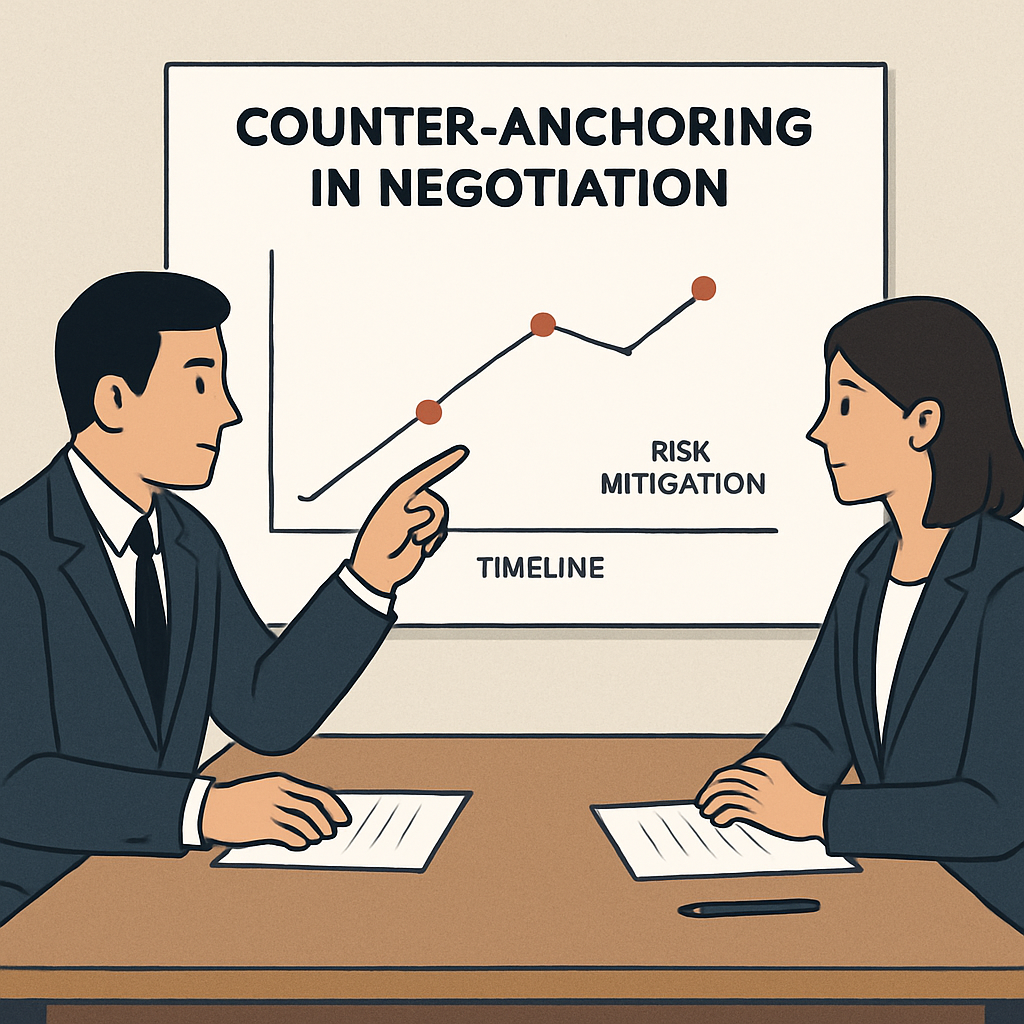
Each of these moves can be combined or used alone, depending on how aggressive the opponent’s anchor is. The key is to keep the tone collaborative – you’re not battling numbers, you’re shaping a mutually beneficial outcome.
Check‑list for real‑time response
- Listen fully – repeat their anchor back in your own words.
- State a calibrated counter‑anchor linked to a specific benefit.
- Offer a non‑price lever (timeline, risk‑share, volume).
- Drop a market‑based contrast cue.
- Pause, let silence settle; let the new anchor breathe.
- Confirm alignment: “Does this address the cost‑uncertainty you mentioned?”
Practice this checklist in role‑plays, and you’ll develop the muscle memory to pivot instantly when a rival anchor lands. Remember, the goal isn’t to “win” the number; it’s to keep the conversation anchored on value you control.
Finally, after you’ve reset the anchor, ask for a brief “think‑time” or a data‑gathering pause. That extra minute often forces the other side to reassess their own opening figure, giving you more room to negotiate toward your sweet spot.
Give these steps a try in your next meeting. You’ll notice how quickly the conversation moves from a defensive scramble to a strategic alignment – and that’s the true power of counter‑anchoring.
Step 4: Using Data and Benchmarks to Strengthen Your Anchor
Why data matters more than intuition
Ever notice how a number that’s backed by a spreadsheet feels harder to shake than a gut‑feel guess?
That’s because the brain treats concrete evidence like a safety net – it reduces the mental fuzz that makes anchors sticky.
In fact, research on anchoring bias shows that even seasoned negotiators adjust only marginally when the first figure is backed by market data.
Step‑by‑step: Turning raw data into a credible anchor
1. Collect three data points. Pull internal cost models, recent contract prices, and an industry benchmark. The more sources you have, the less likely the other side can dismiss your number as “just your opinion.”
2. Translate raw numbers into a story. Instead of saying, “Our average spend is $1.2 M,” say, “Our last three contracts averaged $1.2 M, which delivered a 15 % cost‑avoidance compared with the market average.”
3. Build a visual cue. A quick chart on a laptop or a one‑page slide that shows the range (low‑mid‑high) makes the anchor feel tangible. Even a hand‑drawn graph in a virtual call works – it signals confidence.
4. Anchor with a range, not a single figure. People love a “sweet spot” – e.g., $950k‑$1.05 M – because it gives you wiggle room while still framing the conversation around your preferred zone.
5. Practice the delivery. Rehearse saying, “Based on these three data points, we’re comfortable starting at $975k, which aligns with the market’s median and protects your budget.”
Real‑world examples that stick
Example 1 – Fortune 500 procurement lead. Jake was renegotiating a raw‑material supply contract. He pulled three pieces of data: his company’s 2023 spend ($4.3 M), the supplier’s 2022 price list, and a third‑party market index that showed the sector average at $4.5 M. He opened with a $4.6 M “future‑value” offer that bundled a two‑year price‑lock and a volume‑growth clause. The supplier, seeing the data, countered at $4.4 M – still $200k above Jake’s original target, which he happily accepted.
Example 2 – Startup sales executive. Maya needed to sell a SaaS platform to a VC‑backed startup. She gathered internal ARR growth metrics, competitor pricing sheets, and an industry‑wide benchmark from a recent strategic sourcing benchmarks report. She framed her anchor as, “Our $120k package matches the median market rate but includes a 12‑month ROI guarantee that typically adds $30k in value for similar companies.” The founder, impressed by the data, closed at $115k – still 15 % above Maya’s baseline.
Quick checklist you can copy‑paste
- Identify three credible data sources (internal, external, historical).
- Convert each data point into a clear benefit statement.
- Sketch a simple visual (chart or graph) that shows the range.
- Choose a anchored range that sits slightly above your true target.
- rehearse the opening line until it feels like a casual chat.
- When challenged, ask: “What data do you have that suggests a different baseline?”
Expert tip: Use benchmarks as a defensive shield
When the other side drops a surprise anchor, pause and say, “That’s interesting – can we look at the latest market benchmark together?” This flips the floor to an objective standard and forces the opponent to justify their number.
Benchmarks also work as a “reset button.” If you’ve been negotiating for 20 minutes and the conversation is stuck, pull out a recent industry report and say, “Let’s align on this third‑party figure before we move forward.” Suddenly the original anchor loses its grip.
Putting it all together
So, what’s the final formula?
Data + Story + Visual = A rock‑solid anchor that’s hard to shake.
Next time you walk into a negotiation, bring three numbers, turn them into a narrative, and let the data do the heavy lifting. You’ll notice the other side’s anchor wobble, and you’ll steer the discussion back to the value you control.
Step 5: Adjusting Anchors in Multi‑Party Negotiations
Picture this: you’re at a roundtable with three other decision‑makers, each with their own agenda, and someone just dropped a number that feels way off the mark.
In multi‑party settings that first figure can hijack the whole conversation, because everyone latches onto it as the reference point.
Why multi‑party anchoring feels different
When you have more than one counterpart, you also have more mental shortcuts at play. Each participant brings a personal bias, a budget ceiling, and a preferred timeline.
That means the anchor you set—or the one you receive—gets multiplied across a web of expectations. If you don’t manage it, the group can swing to a range that leaves you with a weak deal.
Step‑by‑step: Re‑anchor with the whole table
1. Surface the hidden anchors. Start by asking each stakeholder what metric matters most to them—price, delivery date, risk sharing, or scalability. A quick round of “What’s your top priority?” pulls out the secondary anchors that are hiding behind the loudest number.
In our experience corporate negotiators find that the procurement lead often anchors on cost, while the product manager anchors on timeline. Naming those silently shifts the conversation from a single price figure to a multi‑dimensional map.
2. Create a shared reference frame. Bring a neutral data point that everyone can agree on—industry benchmark, historic spend, or a third‑party study. Once the group acknowledges the benchmark, you can say, “Based on the latest market data, the median price for this solution sits between $X and $Y.” This collective anchor dilutes any outlier that was thrown in earlier.
Harvard’s Program on Negotiation explains how a neutral benchmark can reset the negotiating zone and give all parties a common foothold.Read more
3. Layer non‑price anchors. Introduce a timeline or risk‑share component as an alternative anchor. For example, “If we can lock in a 12‑month rollout, we’re willing to move the price down 5%.” The group now has two anchors to compare, and the price anchor loses its monopoly.
Sales executives in Fortune 500 firms often use this trick to keep the deal moving when the finance director pushes a low‑ball price.
4. Use “anchor‑plus” framing. Instead of saying “Our price is $120k,” say “Our price is $120k, which includes a 6‑month performance guarantee and a phased payment schedule that eases cash‑flow pressure.” You’re attaching extra value to the same number, turning the anchor into a package rather than a flat figure.
Business development managers love this because it gives them a story to tell multiple partners simultaneously.
5. Pause and let the new anchor breathe. After you’ve presented the revised anchor, stay silent for a few seconds. Silence forces the group to process the new reference point instead of jumping back to the old one.
Checklist for multi‑party anchor management
- Ask each participant for their primary metric.
- Introduce a neutral benchmark that all agree on.
- Pair price with a non‑price lever (timeline, risk, volume).
- Frame the anchor as a bundled value package.
- Insert a deliberate pause after you state the new anchor.
- Confirm alignment with a quick “Does this address everyone’s top concern?”
So, what’s the real trick? It’s not about shouting the highest number; it’s about weaving a web of anchors that reflects the whole table’s interests.
When you walk into your next multi‑party negotiation, bring a spreadsheet of benchmarks, a list of stakeholder priorities, and a few value‑add levers ready to attach. You’ll notice the conversation gravitating toward the range you control, and the other side will feel like they’re collaborating rather than being forced.
That’s how you turn the chaotic swirl of multiple anchors into a coordinated, win‑win outcome.
Conclusion
We’ve walked through why anchoring in negotiation isn’t a gimmick but a psychology‑driven lever you can set, protect, and reshape. From picking three anchor numbers to pairing price with timeline or risk‑share, each step builds a reference point that steers the whole discussion.
So, what’s the next move for you? Grab a spreadsheet, pull three data points that matter to your stakeholder—cost, timeline, ROI—and draft a short story around each. Practice saying the anchor out loud, then pause. That silence is the secret sauce that forces the other side to breathe and reconsider.
Here’s a quick checklist to keep in your back pocket:
- Identify your ZOPA and three concrete anchors.
- Tie every number to a tangible benefit.
- Introduce a non‑price lever as a secondary anchor.
- Use a neutral benchmark to reset the conversation if needed.
- Insert a deliberate pause after you state the anchor.
In our experience, negotiators who treat the anchor as a flexible package walk away with deals that feel like wins for everyone at the table. Ready to make your next negotiation feel effortless? Start applying these habits today and watch the numbers shift in your favor.
Remember, the right anchor can turn a tense discussion into a collaborative breakthrough, and you have the tools to do just that.
FAQ
What is anchoring in negotiation and why does it matter?
Anchoring in negotiation is the tendency to let the first number you hear become the reference point for everything that follows. The brain latches onto that “anchor” and only adjusts a little from there, so later offers feel reasonable even if they’re still far from the true value. Harvard’s Program on Negotiation breaks it down as a cognitive bias that steers judgments from the very first figure explaining why the effect is so powerful. Knowing this helps you set the opening number deliberately instead of letting the other side set the tone.
How many anchor numbers should I prepare before a meeting?
Most experts recommend three: a bold “high‑anchor,” a realistic “mid‑anchor,” and a safety‑net “low‑anchor.” The high‑anchor stretches perception, the mid‑anchor gives you a credible sweet spot, and the low‑anchor lets you retreat gracefully if the other side pushes hard. Write them down, attach a concrete benefit to each, and rehearse the phrasing until it feels like a casual story you’d tell over coffee.
Can I use non‑price anchors, and does that really work?
Absolutely. Timeline, risk‑share, or service‑level guarantees can become secondary anchors that dilute a tough price figure. For example, you might say, “We can hit a $95k price if we lock in a 12‑month rollout and a performance‑based rebate.” That bundles value with the number, making the price feel more flexible and the overall package harder to reject.
What’s the best way to counter an opponent’s anchor without sounding aggressive?
Start with a neutral acknowledgment – “I hear you, $120k is higher than we anticipated.” Then pivot to your calibrated counter‑anchor tied to data: “Our analysis shows $95k delivers a 20 % cost‑avoidance over twelve months, which aligns with your CFO’s budget goal.” Follow up with a non‑price lever or a market‑benchmark cue to re‑frame the conversation.
How do I keep the anchor from locking me into a bad deal?
Treat the anchor as a flexible package, not a hard ceiling. After you drop your number, insert a deliberate pause – that silence forces the other side to process the reference point. If you sense the discussion drifting away, re‑anchor with fresh data or a new lever (like a volume discount) to shift the reference frame before you concede.
Do multi‑party negotiations require a different anchoring strategy?
Yes. With several stakeholders, you’ll have multiple hidden anchors – one person may care about price, another about delivery speed. Start by surfacing each priority, then introduce a neutral benchmark that everyone can agree on (industry median, past spend, etc.). Layer price with a timeline or risk‑share anchor, and pause after you state the new package. That way the group’s focus spreads across several reference points instead of a single, possibly unfavorable, number.
How can I measure whether my anchoring technique is actually improving outcomes?
Track three metrics after each negotiation: the final price relative to your target, the number of concessions you gave up, and the satisfaction rating from the counterpart (often captured in post‑meeting surveys). If you see the final price edging closer to your mid‑anchor, fewer unwanted concessions, and higher partner satisfaction, you’re likely harnessing the anchoring effect effectively. Adjust your anchor range based on these data points for the next round.