
The Ultimate Negotiation Strategy
The Ultimate Negotiation Strategy workshop blends high-level consulting with hands-on training to help teams design real, multi-phase negotiation strategies they can execute immediately. This is not theory or role-play for its own sake. Participants learn proven strategic frameworks and then apply them live—architecting strategies for their own active deals, contracts, and negotiations.
Unlike traditional negotiation training that focuses on tactics in isolation, this workshop is built around decision-making under pressure. Every negotiation is shaped by power, leverage, timing, and risk—and those forces change as the negotiation unfolds. Our approach gives leaders a clear, repeatable way to think several moves ahead rather than reacting moment-by-moment.
Start With Power—Not Tactics
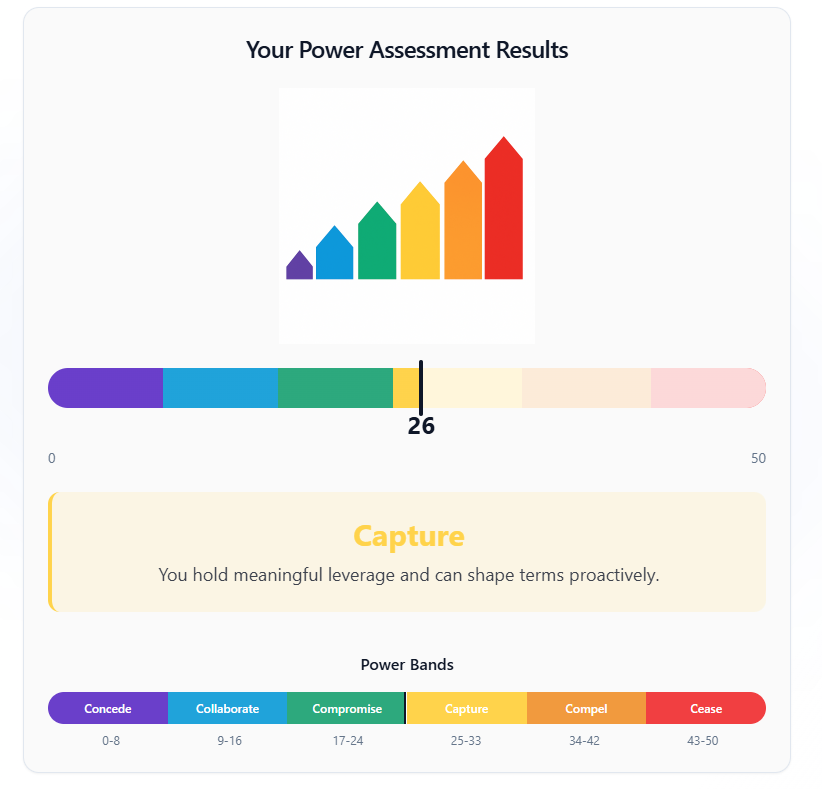
Effective negotiation strategy begins with understanding where you sit on the power curve and how that position should guide your behavior. Early in the workshop, participants complete a structured power assessment that reveals their current leverage band and the implications for strategy.
Rather than treating power as something you “have or don’t have,” we show how power shifts across six strategic positions:
-
Concede – when protecting the relationship or avoiding loss is paramount
-
Collaborate – when value can be expanded through shared problem-solving
-
Compromise – when tradeoffs are required to move forward
-
Capture – when leverage allows you to claim value deliberately
-
Compel – when pressure must be applied to drive outcomes
-
Cease – when walking away is the strongest move available
Participants learn when each position is appropriate, how to move between them, and—just as importantly—how to avoid mismatches that destroy value.
Strategy That Anticipates Pressure
Pressure is the silent force that derails even experienced negotiators. Under pressure, thinking narrows, assumptions go untested, and simple calculation errors multiply. Concessions are made too early, signals are misread, and leverage is often surrendered unintentionally.
This workshop gives leaders a structured way to manage pressure instead of reacting to it. Participants learn how to:
-
Identify where pressure will spike in a negotiation
-
Design strategies that reduce cognitive overload at critical moments
-
Separate emotional urgency from strategic necessity
-
Build contingency paths when counterparts escalate, stall, or bluff
The result is greater clarity, fewer mistakes, and better outcomes—especially in high-stakes or time-compressed negotiations.
From Training to Live Strategy Design
Half of the workshop focuses on understanding the model; the other half is spent building actual strategies for your pipeline. Teams leave with concrete, time‑bound plans—not theoretical notes.
Typical strategy projects include:
- Price increases and commercial terms
- Payment terms and working‑capital improvements
- Large, mission‑critical customer or supplier deals
- Acquisitions, divestitures, and joint ventures
- Multi‑party and cross‑cultural negotiations
- Strategic alliances and complex partnerships
Strategic planning is an exercise in critical thinking around power, people, and process. Our team stays engaged from initial design through execution checkpoints so your strategy survives first contact with the other side.
Build a Multi-Phase Negotiation Strategy
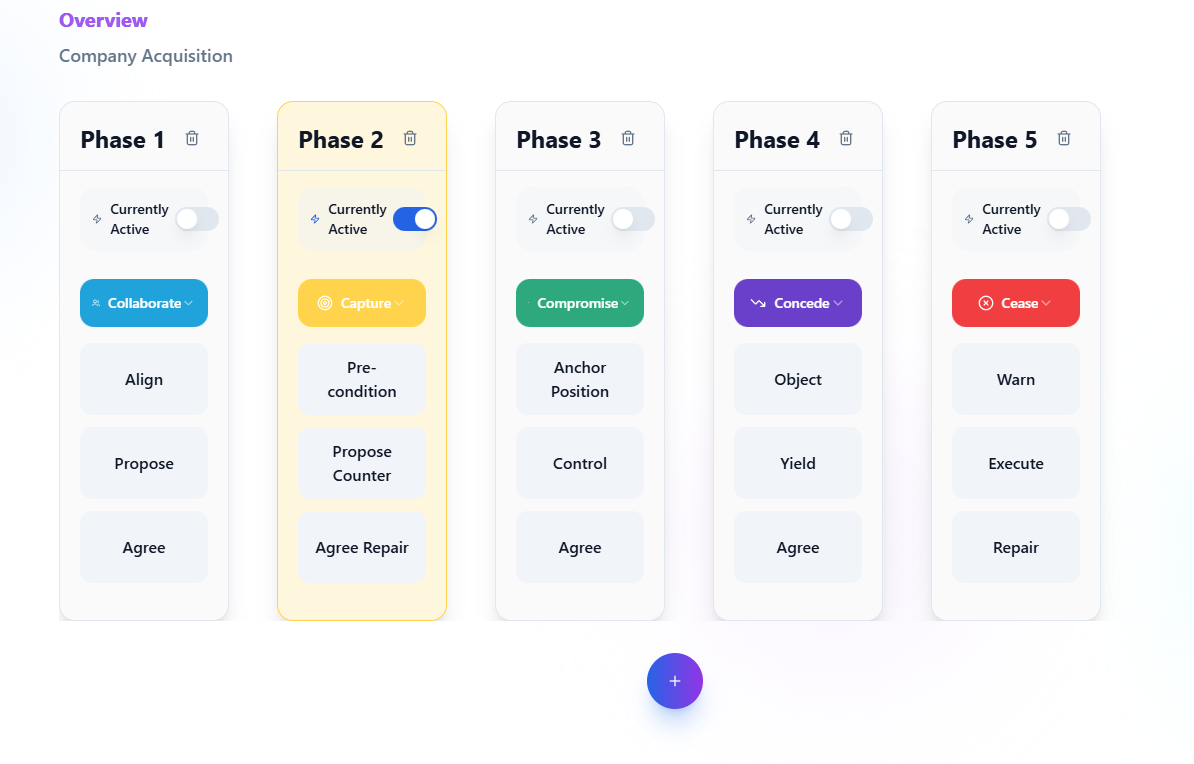
Rather than treating negotiation as a single conversation, participants design multi-phase strategies that account for:
-
Information gathering and signaling
-
Sequencing of offers and concessions
-
Conditional trades and value exchanges
-
Escalation points and decision gates
-
Exit criteria and walk-away thresholds
By the end of the workshop, each participant leaves with a clear, documented strategy for their own negotiations—one that aligns power, pressure, messaging, and tactics across the full lifecycle of the deal.
A Competitive Advantage You Can Repeat
The Ultimate Negotiation Strategy workshop equips teams with a repeatable strategic process, not just inspiration. Leaders gain a common language, shared frameworks, and practical tools they can apply across negotiations—creating consistency, confidence, and better decision-making under pressure.
Preparation becomes a competitive advantage. Strategy becomes deliberate. And negotiations stop feeling reactive—and start delivering measurable results.
Triggers, Timeline, and Phase Planner
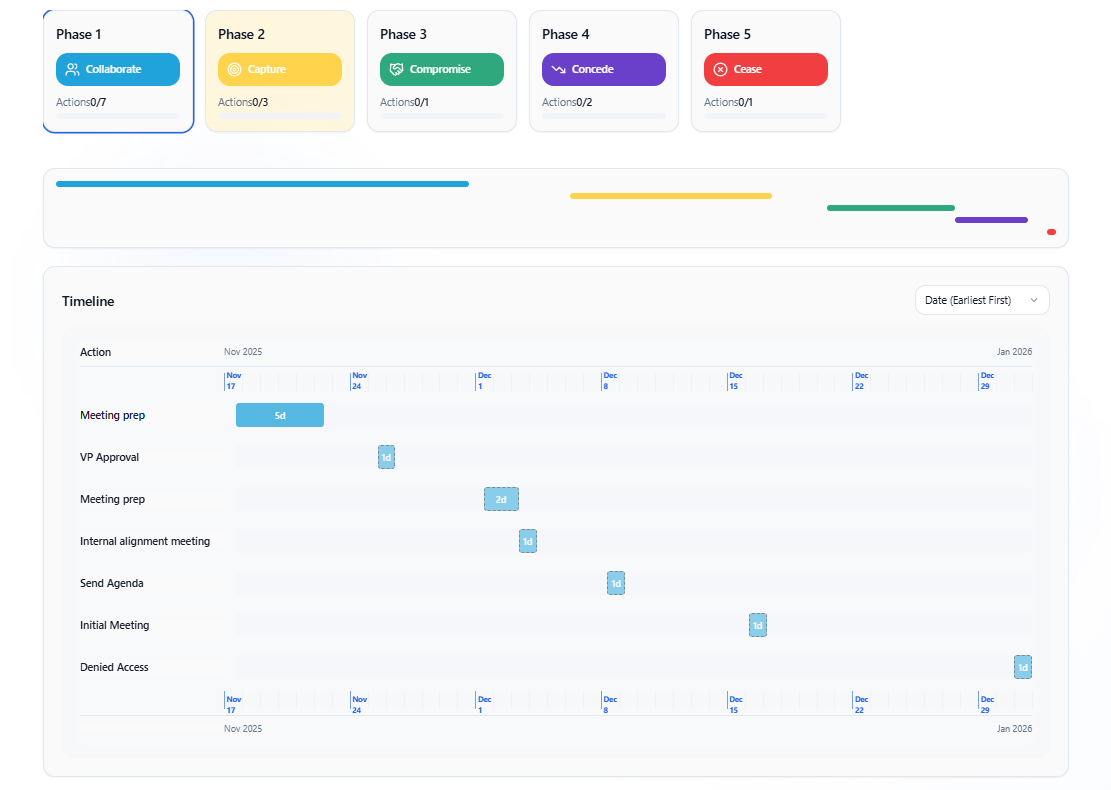
Great negotiation strategies don’t rely on gut instinct in the moment—they rely on pre-defined decision rules. In this section of the workshop, teams convert strategy into action by designing clear triggers, timelines, and phase plans that govern how the negotiation unfolds.
For every phase of the negotiation, participants define specific triggers—observable events or signals that indicate when it’s time to escalate or de-escalate pressure, adjust an offer, pause engagement, or move to an alternative path. These triggers remove ambiguity and prevent emotional or reactive decisions when stakes are high.
Rather than asking, “What should we do now?” in the heat of the moment, teams already know:
-
What conditions justify applying pressure
-
When collaboration should replace hard positioning
-
Which signals require a strategic reset
-
When walking away becomes the strongest move
Turning Strategy Into a Timeline
Participants then map their strategy onto a shared visual timeline that shows how the negotiation is expected to progress over time. This timeline highlights:
-
Key phases and decision points
-
Planned offers, concessions, and conditional trades
-
Escalation thresholds and review gates
-
Internal deadlines and external constraints
This makes the negotiation visible and manageable, especially in complex deals involving multiple stakeholders, long cycles, or regulatory and budgetary constraints.
Clear Ownership and Decision Control
The Phase Planner assigns clear ownership to every action and decision. Teams identify:
-
Who is responsible for delivering each message
-
Who approves moves at each escalation level
-
What information must be gathered before advancing
-
When leadership review is required before committing
This alignment eliminates last-minute confusion, internal contradictions, and unintentional concessions. Leadership stays synchronized, negotiators stay confident, and counterpart behavior is met with deliberate—not reactive—responses.
Designed for Adaptation, Not Rigidity
While the plan is structured, it is not rigid. The Trigger and Phase Planner is built to adapt as new information emerges, ensuring teams stay strategically flexible without losing control. When conditions change, the strategy changes intentionally—based on pre-agreed rules—not emotion or pressure.
The result is a negotiation team that knows exactly what happens next, why it happens, and who owns it, turning preparation into disciplined execution and significantly reducing risk at critical moments.
Align Your Team Around the Table
Complex negotiations rarely fail because of the counterpart alone—they fail when internal alignment breaks down. Conflicting messages, unclear authority, delayed approvals, and parallel conversations quietly erode leverage and credibility long before a deal collapses.
This section of the workshop focuses on aligning your internal team as deliberately as you manage the external negotiation.
Clarifying Relationships and Influence
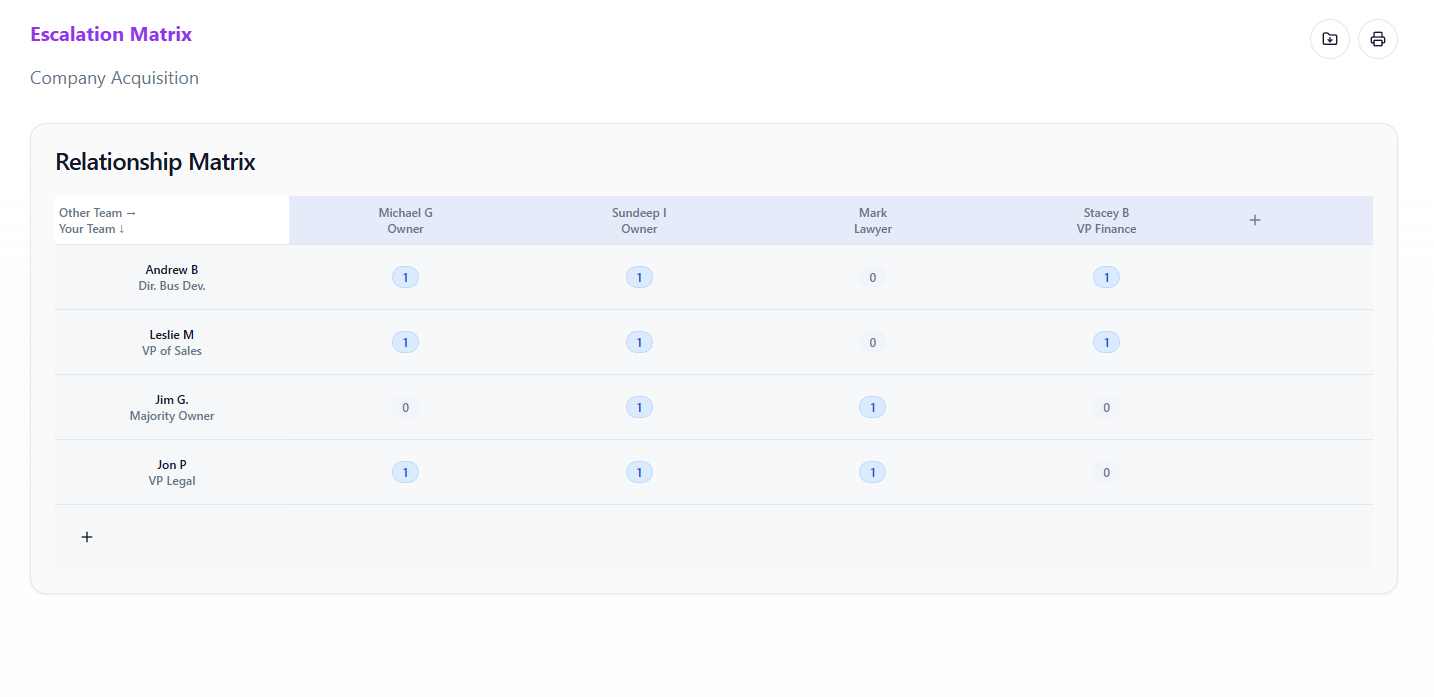
Participants use a Relationship and Escalation Matrix to map every critical relationship surrounding the deal. This includes:
-
Who owns each external relationship
-
The relative strength and credibility of each connection
-
Where influence is concentrated—and where it is weak
-
Which relationships should be protected, leveraged, or avoided
By making relationships visible, teams avoid accidental overreach, mixed messaging, and authority leakage that counterparts often exploit.
Defining Authority and Escalation Paths
The workshop then establishes clear decision rights across the negotiation. Teams explicitly define:
-
Who is authorized to negotiate which issues
-
What approvals are required—and when
-
Who can make concessions, and within what limits
-
How and when issues are escalated to leadership
This structure eliminates ambiguity at the table and ensures negotiators can move decisively without constantly stopping to “check internally.”
One Voice Under Pressure
As negotiations intensify, internal misalignment becomes more costly. The Relationship and Escalation Matrix ensures the organization speaks with one coherent voice, even under pressure.
Negotiators know:
-
Who speaks to whom
-
What messages can be delivered independently
-
What information must be coordinated or withheld
-
How to respond when counterparts attempt to bypass or divide the team
The result is greater discipline, faster decision-making, and stronger perceived power at the table.
Alignment That Protects Value
By aligning roles, authority, and communication paths in advance, teams reduce risk, protect value, and prevent internal friction from undermining the strategy. Negotiation stops being an individual performance and becomes a coordinated, disciplined team effort—exactly what complex, high-stakes deals require.
What You Leave With
Every team leaves with a deal-ready negotiation strategy playbook designed to guide the full lifecycle of the negotiation—from early positioning through execution and closure.
Core Strategy Outputs
-
Segmentation Strategy
Group customers, suppliers, or stakeholders (e.g., grow, maintain, rationalize) and apply a tailored strategy to each segment. -
Communication Sequencing
Define who to approach first, how to stagger conversations and offers, and how to conserve and grow power across multiple counterparties. -
Phase Overview (Visual Strategy Map)
A clear, at-a-glance visual of the overall negotiation strategy and how each phase connects. -
Tactical Plans by Phase
Detailed actions, meetings, proposals, and triggers for each phase, aligned to changing dynamics. All actions are time-bound with assigned ownership. -
Issue Identification & Risk Planning
Surface potential problems early and design preventive actions and contingency plans for both situational risks and personality-driven friction. -
Information Management Strategy
Audit what you know, identify critical gaps, and define what to share now, what to withhold, and what to disclose later. -
Question Strategy
Develop targeted questions to uncover missing information, test assumptions, and set agendas that prepare the other side while signaling clear intent. -
Critical Trigger Identification
Define the specific triggers in each phase that signal when to escalate, de-escalate, or shift strategy as pressure changes. -
Anticipated Reactions & Contingency Planning
Predict likely counterpart responses to identify gaps, stress-test the strategy, and prepare disciplined responses to multiple scenarios.