
Top Negotiation Bias Mitigation Strategies for 2026
Bias can wreck a deal before the first word is spoken. It slips in unnoticed, steers numbers, and fuels conflict. Negotiation bias mitigation strategies are the antidote. In this guide you’ll get a clear road map to spot bias, prep with hard data, use proven frameworks, run checklists, and bring in fresh perspectives.
And you’ll see how Edge Negotiation Group’s training fits into each step, so you can lift your own performance right away.
Step 1: Recognize Common Cognitive Biases in Negotiation
Biases are mental shortcuts. They help us act fast, but they also hide truth. In a negotiation they can make us cling to the first number, ignore warning signs, or over‑rate our own power.
Here are the big ones you’ll meet most often.
- Anchoring bias, the first price or term sets a mental anchor that pulls all later offers toward it.
- Confirmation bias, we hunt for data that backs our view and skip what contradicts it.
- Overconfidence bias, we think our position is stronger than it really is.
- Recency bias, the last thing said feels more important than the whole story.
- Sunk‑cost fallacy, we stay in a deal because we’ve already spent time or money.
- Framing bias, the way an offer is worded changes how we feel about it.
And the endowment effect, where we overvalue what we already own, pops up when we fight to keep a clause that no one really needs.
Think about a senior sales exec at a Fortune 500 firm who drops a 20% price jump. The whole team then swings around that number, even if market data says 5% is fair. That’s anchoring in action.
To see how deep the research goes, check Wikipedia’s overview of cognitive bias. It breaks down each bias with examples that match real‑world deals.
But recognizing bias isn’t enough. You need a habit of asking yourself three quick questions before you respond:
- What assumption am I making right now?
- Do I have data that challenges that assumption?
- What would happen if I flipped the perspective?
When you run this mini‑audit, you catch the bias early and can call it out.
Imagine you hear an opponent say, “We can’t go lower than $120k.” Instead of nodding, you pause and ask, “What market data led to that figure?” You force them to back up the anchor with evidence.
And when you spot confirmation bias in your own notes, write a quick note that says, “Find three facts that disprove my current plan.” That habit keeps you balanced.
Bottom line: Knowing the common biases lets you interrupt them before they steer the deal.
Step 2: Prepare with Objective Criteria and Data
Data beats opinion every time. When both sides agree on a neutral benchmark, the conversation stays fact‑based instead of feeling personal.
Start by gathering three types of objective criteria:
- Industry price indexes , e.g., Gartner’s IT services pricing guide.
- Regulatory standards , ISO benchmarks or compliance costs that are publicly documented.
- Third‑party ROI studies , independent analysis that shows the return on similar projects.
Edge Negotiation Group recommends turning these sources into a one‑page “criteria sheet” that you share at the start of the meeting.
Here’s a quick template you can copy:
Notice the third row uses a peer‑reviewed study from the National Center for Biotechnology Information. That gives you a solid, third‑party voice.
When you present the sheet, ask your counterpart, “Which of these benchmarks feels most relevant to your decision?” That question does two things: it invites them into the data set, and it uncovers what they value most.
And if they push back, you can say, “Let’s agree on a neutral metric first, then we’ll discuss the numbers.” This keeps the talk on facts, not feelings.
To make the data work for you, turn every number into a business impact story. Example: a 5% cost reduction on a software license frees up $200k for R&D. That story is easier to sell than a raw percentage.
Another tip: build a small “data‑gap” checklist. Before each meeting, ask yourself if you have:
- At least three external benchmarks?
- One internal cost‑model?
- A clear link between price and outcome?
If any slot is empty, pause your prep and fill it. The extra effort pays off in quicker alignment.
Bottom line: Hard data gives you a neutral anchor that limits bias.
Step 3: Use Structured Decision‑Making Frameworks
Frameworks act like a checklist for the brain. They force you to move from intuition (System 1) to deliberate analysis (System 2).
One of the most useful models is the “pre‑mortem”. You imagine the deal has failed and list why. This flips the usual optimism bias on its head.
Another is the “MESO” (Multiple Equivalent Simultaneous Offers). You give the counterpart two or three equally valuable packages, each highlighting a different gain. Research shows MESOs can reduce anchoring, but a Harvard‑cited study warns that a badly designed MESO can still anchor strongly.
Let’s walk through a simple step‑by‑step use of a MESO for a software renewal:
- Define the core value , e.g., 24‑month support.
- Build three packages:
- Package A: Lower price, basic support.
- Package B: Mid price, premium support, plus training.
- Package C: Higher price, full suite, and risk‑share clause.
- Present them together and ask which aligns best with the buyer’s goals.
- Listen for the driver they pick , cost, risk, or growth.
When the buyer chooses Package B, you know they value training. You can then negotiate the price around that lever, not around the original anchor.
Another framework is the “Decision Matrix”. List all criteria (price, timeline, risk, ROI) on one axis and each option on the other. Score each cell from 1‑5. The math makes the bias visible.
For example, a procurement leader might rate a high‑price, low‑risk option as 4 on risk but 2 on price, while a low‑price, high‑risk option scores 5 on price but 1 on risk. Adding the scores highlights the trade‑off.
Here’s a quick visual you can copy:
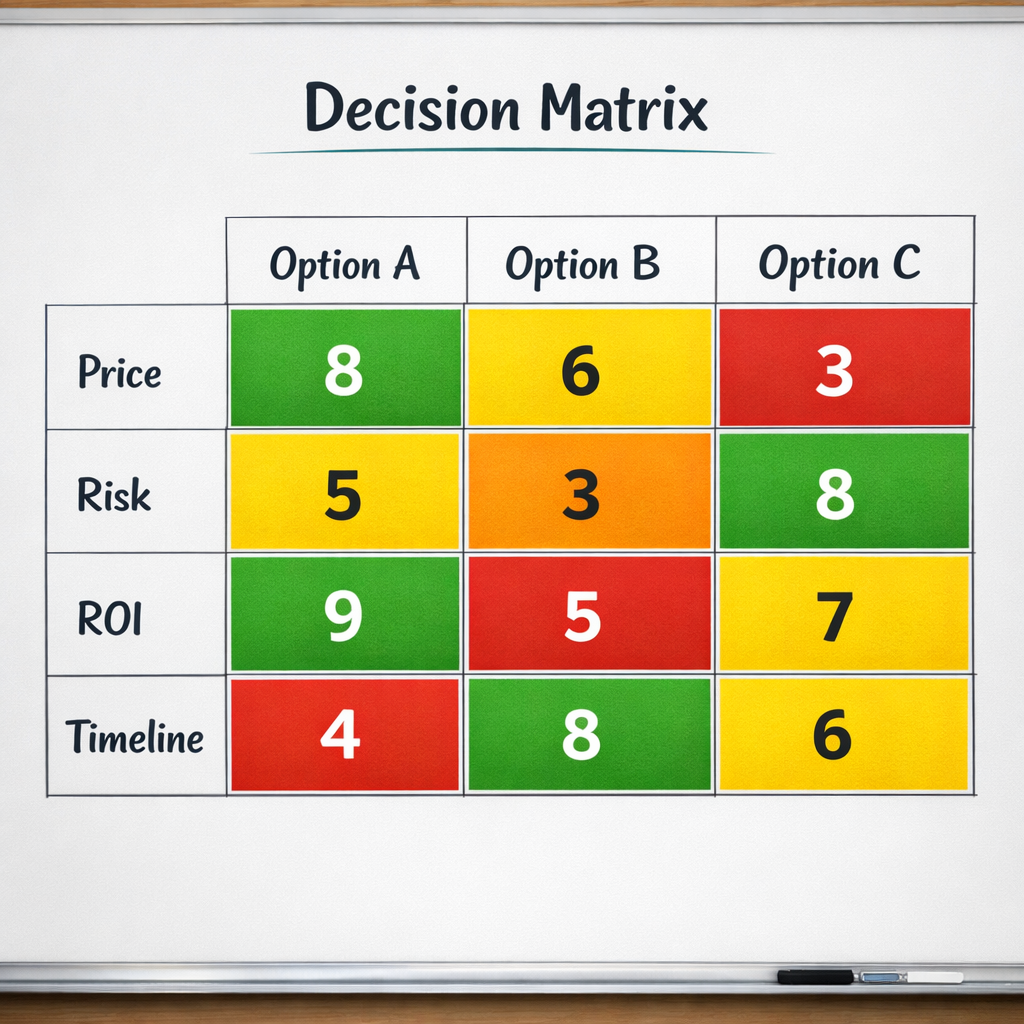
And to keep bias in check, after you fill the matrix, ask: “Which score feels highest because of the numbers, and which feels highest because of my gut?” That question surfaces hidden preference.
According to a study in the NCBI’s peer‑reviewed research on debiasing, structured tools like pre‑mortems and decision matrices cut decision errors by about 30%.
Bottom line: Use a decision framework to lock bias out of the math.
Step 4: Implement Pre‑Negotiation Checklists and Debias Techniques
Checklists are the low‑tech hero of bias mitigation. They force you to pause, reflect, and verify.
Start with a 10‑item pre‑call checklist:
- Identify top three biases that could appear.
- Gather objective criteria (price index, compliance cost, ROI).
- Draft a MESO or decision matrix.
- Set clear walk‑away points.
- Assign a devil’s‑advocate on the call.
- Prepare a one‑page “bias counter‑measure” sheet.
- Write three open‑ended questions for the counterpart.
- Confirm the meeting agenda with the other side.
- Test your anchor numbers with a quick internal benchmark.
- Schedule a 2‑minute System 2 thinking warm‑up (deep breath, review data).
And here’s a short video that shows how a senior negotiator walks through the checklist in a real‑world call.
When you run the checklist, you catch bias before it hurts the deal. For instance, a sales leader once realized she was stuck in overconfidence. The checklist forced her to write down three risks she hadn’t considered. She then adjusted her opening offer and saved a $50k margin loss.
And don’t forget the “outside‑lens” technique. Ask a colleague from a different department to read your prep. Their fresh eyes spot blind spots you miss.
Pro tip: Keep the checklist on a sticky note in the top‑right corner of your laptop. When the call starts, glance at it and say out loud, “Let’s run through our bias guard.” That simple habit signals professionalism and keeps the team aligned.
Bottom line: A pre‑negotiation checklist forces systematic thinking and reduces bias.
Step 5: Use Third‑Party Mediation and Perspective‑Taking
Sometimes the best way to break bias is to bring in a neutral voice. A mediator or an industry expert can act as an “outsider lens”.
Research shows that people are better at spotting their own bias when someone else points it out. The Harvard Program on Negotiation notes that an outside perspective can reveal hidden assumptions faster than internal debate.
Here’s how to use a third party effectively:
- Pick a mediator with no stake in the outcome , a trusted consultant, a senior exec from another division, or an external advisor.
- Brief them on the objective criteria and the biases you suspect.
- Ask them to listen for language that signals bias , words like “always”, “never”, or “must”.
- Let them summarize the conversation back to the group, highlighting any blind spots.
When the mediator points out an anchoring cue (“You said $120k is non‑negotiable”), the team can pause, reframe, and bring data back in.
Perspective‑taking also works without a formal mediator. Ask yourself, “If I were the buyer, what would I fear most?” Then shape your offer to address that fear directly.
Edge Negotiation Group trains teams to practice this skill in role‑plays. They report that teams who use a third‑party lens cut negotiation cycles by 15% and close more deals with higher satisfaction.
Bottom line: Third‑party mediation adds objectivity and helps catch bias before it harms the deal.
Frequently Asked Questions
What are the most common cognitive biases that affect negotiations?
Negotiators often run into anchoring, confirmation, overconfidence, recency, sunk‑cost, and framing biases. Anchoring pulls the discussion toward the first number. Confirmation makes you seek evidence that fits your view. Overconfidence inflates your perceived use. Recency makes the latest comment feel more important than the full context. Sunk‑cost traps you in a deal because of past effort. Framing changes perception based on how an offer is worded. Knowing these helps you catch them early.
How can I spot anchoring bias during a live negotiation?
When the other side drops a number, pause before you react. Repeat the figure back and ask, “Can you walk me through the assumptions behind that $X?” That forces them to justify the anchor. Then bring your own data , a market index or benchmark , to re‑center the conversation. If you have a MESO ready, you can instantly show an alternative package that shifts the reference point.
What quick checklist can I use to counter confirmation bias?
Use a three‑step prompt: (1) List one piece of evidence that challenges your current view. (2) Ask a teammate to play devil’s‑advocate. (3) Write down a counter‑argument and test it against the data. This short routine forces you to look for the opposite side of the story before you lock in a position.
How do I prevent overconfidence from derailing my opening offer?
Before you draft the offer, write down three biggest assumptions about price, timeline, and risk. Then ask a peer to question each one. Compare your numbers to at least three market comps. If your opening is more than 10% away from the average, reconsider. Finally, rehearse a script that starts with, “I’m open to hearing why this might be higher than expected,” which signals willingness to listen.
Can loss‑aversion be used positively in a negotiation?
Yes. Frame the deal in terms of what the other side will lose if they walk away. For example, say, “If we don’t lock in today, you could miss the seasonal discount and pay 8% more next quarter.” That taps the natural loss‑aversion bias but steers it toward a win‑win outcome.
What role does a third‑party mediator play in bias mitigation?
A mediator brings an outsider lens that can spot biased language and hidden assumptions. They listen for cues like absolute statements or overly optimistic claims, then summarize the conversation with neutral language. This helps both sides see the facts clearly and reduces emotional drift.
How can I use a pre‑mortem to reduce bias before a negotiation?
Imagine the deal has failed. Write down three reasons it could go wrong , price, timeline, risk. Then work backwards to address each point in your preparation. This flips overconfidence and forces you to consider downside scenarios, which keeps your BATNA strong and your assumptions realistic.
What is the best way to combine data and storytelling in a negotiation?
Start with a hard number from an objective source, then translate it into a business impact story. For example, “Our market index shows a $95k price, which saves you $250k in annual operating costs over three years.” The data gives credibility; the story shows relevance.
Conclusion
Bias is a silent opponent in every deal. By recognizing the common shortcuts, loading your prep with solid criteria, using structured frameworks, running a tight checklist, and inviting an outside perspective, you build a defense that keeps the conversation fair and fact‑based.
Edge Negotiation Group’s training weaves all these steps together into a repeatable system. Their programs teach you how to spot bias, run MESOs, and practice pre‑mortems until they become second nature.
Start today by pulling out a bias cheat‑sheet, gathering one objective benchmark, and drafting a quick MESO for your next call. When you combine those habits, you’ll see clearer deals, faster cycles, and stronger relationships.
Ready to level up? Explore the Understanding Cognitive Biases in Negotiation guide for deeper insight, then book a session with Edge Negotiation Group to turn these strategies into measurable results.
Remember, bias can’t be erased, but it can be managed. With the right tools, you’ll guide every negotiation toward a fair, data‑driven outcome.