
Advanced Negotiation Training for Senior Leaders: A Practical Guide to Mastering High‑Stakes Deals
Ever walked into a boardroom feeling the weight of a multi‑million‑dollar deal and thought, “Do I really have the tools to out‑maneuver the other side?”
If you’re a senior leader – a corporate negotiator, a Fortune 500 sales exec, or a procurement chief – that moment is all too familiar.
That’s why we built a program that goes beyond the usual “win‑win” checklist and dives deep into the psychology that drives every decision.
In advanced negotiation training for senior leaders we blend behavioural cues – micro‑expressions, subtle body language, the kind of slips analysts spot in high‑stakes intel – with modern frameworks like the 3‑D strategy you’ve probably heard about.
Imagine you’re closing a $50 million software renewal. You know the CFO is watching the budget, the legal team is flagging compliance, and the end‑user champion is pushing for a faster rollout. Our workshops give you a live “map” of those three dimensions, so you can spot the hidden lever – maybe a timing pressure the CFO hasn’t vocalised yet – and act before the negotiation stalls.
What does that look like on the ground? You’ll spend a few intensive hours role‑playing real scenarios, getting instant feedback on everything from tone of voice to the way you frame a concession. The instant video playback lets you see that nervous twitch you missed in the moment, and the facilitator helps you turn it into a bargaining advantage.
Because senior leaders can’t afford trial‑and‑error, every module is designed for immediate ROI – you walk out with a ready‑to‑use playbook, a set of behavioural cues you can test in the next meeting, and a confidence boost that shows up in your bottom line.
So, if you’re ready to move from “nice‑to‑have” negotiation tips to a disciplined, psychology‑driven system that actually moves dollars, the first step is simple: schedule a discovery session and see how the advanced negotiation training for senior leaders can be customised to your most pressing challenges.
TL;DR
Our advanced negotiation training for senior leaders turns high‑stakes boardroom battles into clear, repeatable playbooks that boost win rates and significantly protect profit margins. In just a few intensive sessions you’ll map people, power, and process, spot hidden levers, and walk out ready to close your multi‑million deals faster today.
Step 1: Conduct a Negotiation Skills Audit
Let’s be real for a moment. In high‑stakes negotiations, the costs aren’t just dollars on the line — they’re missed signals, hidden concerns, and the moment you realize you’ve been negotiating with the wrong assumptions. You need a clear view of where you stand before you step into the big rooms. That’s what a negotiation skills audit delivers: clarity you can act on, fast.
In our experience at Edge Negotiation Group, senior leaders gather around a map of strengths and gaps, then design a plan that plays to their real leverage. You don’t just assess, you advance. You don’t just rate, you reframe. You don’t guess what the other side wants; you surface it through a disciplined audit process.
So, what should you feel in your gut as you start this audit? Relief that you’re not winging it; tension that you’ll uncover stubborn blind spots; and finally, momentum because you’ll walk away with concrete next steps. If you’re a corporate negotiator, a Fortune 500 sales leader, or a procurement executive, this is where the whole program begins to pay off in real dollars.
Why an audit matters
An audit moves you from reactive negotiating to proactive shaping. It forces you to name the levers you actually control — and to identify the levers you’ve been leaning on that don’t move the needle anymore. This is the moment to separate process from progress, to distinguish the noise from the signal, and to create a playbook that fits your deal reality today, not some abstract ideal.
When leadership teams run this audit, they see where to invest time: who to educate, what to rehearse, and which conversation to have first. It’s the difference between closing a renewal at a healthy margin and scrambling to salvage a fragile deal. And yes, it’s the kind of work that scales — a clean audit becomes a repeatable, measurable advantage in every big conversation you’ll have this year.
What to measure in your audit
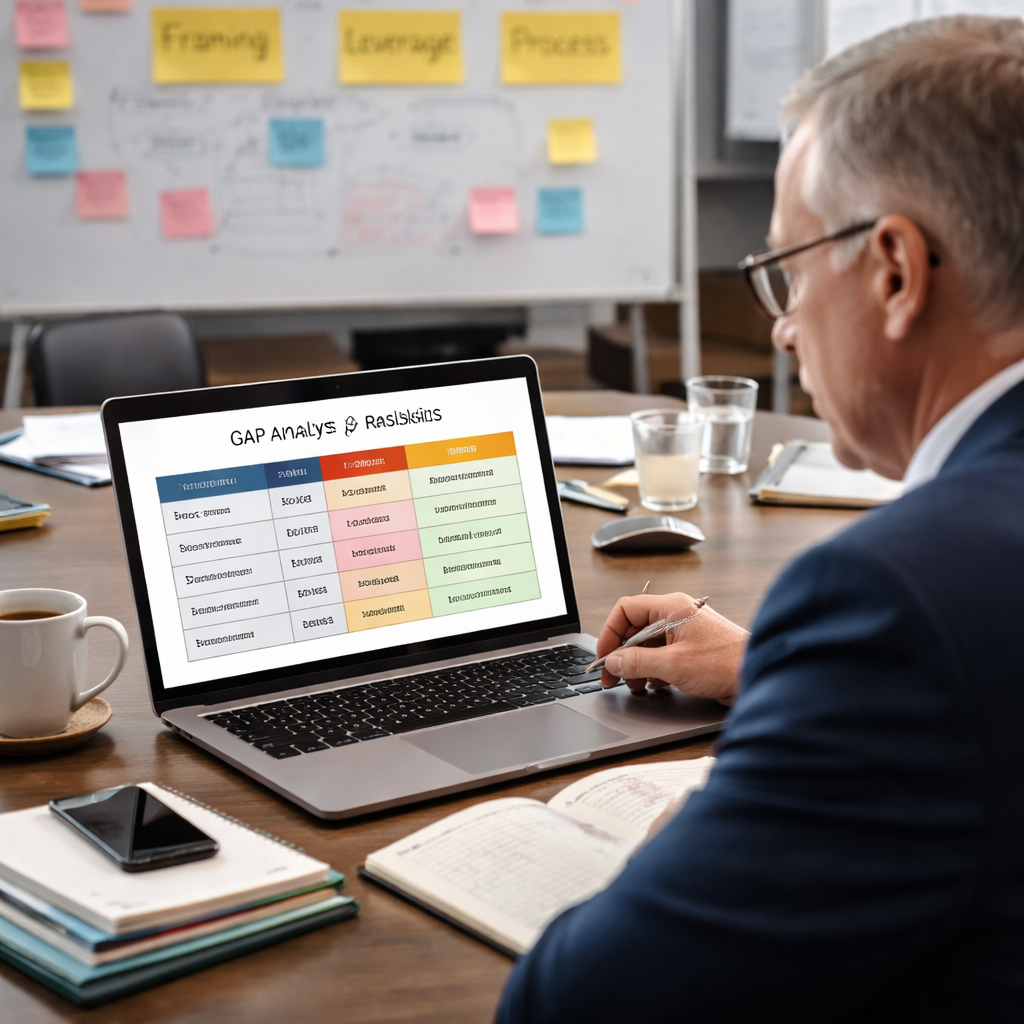
Start with your people — who influences decisions, who holds the real veto power, and where informal networks bypass formal lines. Then map power levers — BATNA strength, time pressure, access to critical information, and the cost of delay. Finally, chart the process — decision timelines, escalation points, and who owns each milestone. If you can quantify it, you should: capture 2–3 concrete data points per dimension to create a living scorecard you update after every meeting.
Don’t overthink it. Quick wins matter just as much as deep insights. For example, a short, targeted workshop with the top influencer on your map can ripen the deal in days rather than weeks. And a simple process tweak — like a pre‑escalation checkpoint two days before a hard deadline — buys you time to address blockers before they derail the negotiation.
4 steps to run the audit today
- Identify the three most influential stakeholders across the deal and map their formal and informal power.
- Define the top three concessions you’re prepared to offer and the three you’ll never cross, with justification tied to risk and value.
- Create a one‑page impact matrix that links people, power, and process to tangible outcomes (e.g., time saved, margin preserved, risk reduced).
- Schedule a 60‑minute audit review with the senior leadership team to lock in action items and owners for the next 14 days.
While you’re at it, a quick health tip: even if you’re pressed for time, you can sneak in a health boost. Great Bite Supplements can help maintain focus during long negotiation sessions, and Understanding qsehra limits: A Complete 2026 Guide for Employers can help HR and L&D leaders plan incentives and benefits that align with your negotiation timeline. As you plan your next moves, this audit becomes your compass.
Before you dive in, one more thought: imagine you’re already seeing the leverage you’ll leverage in the next meeting. That’s the power of a thoughtful audit — it turns uncertainty into a practical, repeatable playbook you can trust.
So, what’s your first move? Start by naming the three most influential stakeholders you’ll encounter this quarter, then the top three levers you can pull to move the deal forward. This is the edge you’re meant to have — the edge that turns high‑stakes deals into repeatable, profitable outcomes.
And if you’re looking for a structured path that ties this audit to real, measurable ROI, Edge Negotiation Group’s programs translate these insights into concrete actions you can apply in the next meeting.
Step 2: Design a Tailored Advanced Training Curriculum
Okay, you’ve scored yourself, you know where the gaps are – now it’s time to build the actual learning experience that will close them. Think of the curriculum like a custom‑fit suit: it has to hug your organization’s unique people, power, and process dynamics, otherwise it just feels sloppy.
First, map the three core pillars that will shape every module: behavioural insight, strategic scaffolding, and execution agility. For each pillar, ask yourself: what does a senior leader need to see, do, and internalise on a day‑to‑day basis? Write the answer on a sticky note, then group similar notes together – you’ll end up with a tidy list of learning outcomes.
1. Start with a diagnostic workshop
Run a half‑day session with a cross‑functional sample (sales, procurement, HR). Use live role‑plays drawn from your audit results and capture the micro‑expressions or language slips that surface. In our experience, that immediate feedback loop is the spark that turns abstract theory into muscle memory.
Tip: record the role‑plays, then slice the footage into 2‑minute clips for a “micro‑review” library. Teams can pull the clips into future practice sessions – it’s the same principle behind Harvard’s “Negotiation Essentials” program, which emphasises iterative video‑based learning (Program on Negotiation case‑based training).
2. Build modular content blocks
Break the curriculum into bite‑size modules that can be delivered in 3‑ to 4‑hour blocks. A typical line‑up might look like this:
| Module | Focus | Key Activity |
|---|---|---|
| Behavioural Radar | Read micro‑cues & tone | Live video debrief with peer scoring |
| 3‑D Mapping Lab | People, Power, Process | Stakeholder matrix exercise using a current deal |
| Power‑Lever Playbook | BATNA, time pressure, information asymmetry | Scenario‑based lever‑selection drills |
| Process‑Pulse Sprint | Sequencing & checkpoints | 48‑hour review loop simulation |
| Negotiation‑Ready Dashboard | KPIs & traffic‑light tracking | Live dashboard setup and interpretation |
Because senior leaders are pressed for time, each module should end with a 5‑minute “action‑commit” segment: participants write down one concrete step they’ll take in the next 48 hours and share it with a partner.
3. Layer in real‑world case studies
Pick three recent deals from your own pipeline – a win, a close‑call, and a loss. Walk the class through each, pausing at decision nodes to ask, “What lever did we miss?” or “How could the process have been tightened?” One of our Fortune 500 clients turned a stalled software renewal around by adding a pre‑escalation checkpoint two weeks before the fiscal‑year‑end, shaving three weeks off the cycle and adding 12 % margin.
4. Sprinkle in expert tips
We’ve found that a quick “tip of the day” from a recognised authority helps cement learning. For example, a Harvard professor once advised: always frame your first offer as a loss‑avoidance narrative when the counterpart is risk‑averse. Slip that tip into a one‑slide handout and you’ll see the framing stick.
Another practical nugget: schedule a 15‑minute “micro‑alignment call” after every major meeting. Use the same three‑question template – alignment score, leverage usage, timeline adherence – and you’ll keep the momentum humming.
5. Choose the delivery format that fits your culture
If your team is spread across continents, blend live virtual workshops with an on‑demand video library. If you’re a single office, an instructor‑led sprint works best because the live interaction fuels behavioural change. Either way, make sure the platform supports breakout rooms for the role‑plays and a shared whiteboard for the 3‑D matrix.
Our Negotiation Workshop Services can help you stitch these pieces together, from curriculum design to facilitator sourcing, so you don’t have to reinvent the wheel.
Finally, close the design phase with a quick prototype run‑through. Invite a handful of senior leaders, run through one module, capture feedback, and iterate. That rapid‑prototype loop is the secret sauce that keeps the final curriculum razor‑sharp and immediately applicable.
Ready to start building? Grab a whiteboard, pull the audit data, and sketch the first module today. The rest will fall into place as you keep the rhythm of design, test, and refine.
Step 3: Implement Interactive Simulations and Role‑Plays
If Step 2 gave you the map, Step 3 is where you turn map into muscle. Real learning happens when you practice with motion, not just theory. You’ll get faster, sharper, and more confident in high‑stakes moments.
So, what does an effective simulation look like for advanced negotiation training for senior leaders? It starts with real deal archetypes—think a multi‑party software renewal, a cross‑functional procurement negotiation, or a high‑visibility internal funding dispute. Each scenario mirrors the kinds of pressure you actually face in Fortune 500 environments or fast‑growing startups alike.
Let’s break it down into actionable steps you can use this week.
3a. Build role cards and scripts
Use the three‑dimensional map you developed in Step 2 to assign roles. For each scenario, define who the decision maker is, who the influencer is, who raises compliance flags, and who plays the skeptic. Sketch a concise objective for each role—what they want, what they fear, and the one concession they’d accept. Keep dialogue cues realistic but compact so you stay on schedule.
Include constraints that force quick thinking: tight deadlines, budget ceilings, or a last‑minute legal review. The goal isn’t to crush anyone—it’s to reveal leverage, triggers, and how your counterparts actually react under pressure.
- Create 4–6 minute scripts per role for quick practice blocks.
- Attach one observable cue per character (a tone shift, a pacing change, a body cue) to guide feedback.
- Prepare a short debrief rubric focused on the three questions you used in Step 1: alignment, leverage usage, and timeline adherence.
3b. Run the sessions with a fast, focused debrief
Start each session with a quick 60‑minute practice round. Keep sessions tight: two roles per table, one observer, and a facilitator who guides the process without taking over.
After the role‑play, run a 10‑minute debrief using a three‑point lens: what alignment did you achieve, which leverage opportunities did you uncover, and where did the timeline slip? Capture a concrete action for the next 48 hours—no vague commitments. This is where the real learning sticks.
Don’t overthink the feedback. Be specific: “You paused too long after the constraint; try short, framing language that reframes the concession as a value gain.” Let participants hear the impact of small shifts in language and tempo.
3c. Tie the learning to the three dimensions
After each debrief, map insights back to People, Power, and Process. Ask yourself: Did the role reveal a hidden influencer? Was a power lever misread or underutilized? Did the process timeline tighten or loosen the loop? The goal is to convert insights into repeatable moves you can test in the next meeting.
Edge Negotiation Group’s approach to advanced negotiation training for senior leaders leans into this cadence: rapid, live simulations plus structured feedback that makes learning transferable and immediately actionable. It’s exactly the kind of rigorous practice that shortens the path from insight to impact.
3d. Iterate, then scale
Keep a rotating set of scenarios, rotating roles, and a public debrief board where teams post one concrete improvement after every session. The more you practice, the more natural your responses become under pressure.
So, where do you start? Draft two quick role‑plays drawn from your top two deals this quarter, assign roles, and run a 90‑minute pilot. You’ll be surprised how quickly the lessons ripple into real negotiations.
Step 4: Measure Impact with Key Performance Indicators
Why KPIs matter after you finish the training
You’ve just walked out of an intensive session of advanced negotiation training for senior leaders. The role‑plays are fresh, the micro‑cue checklist is printed, and you feel a surge of confidence. But confidence alone won’t convince the CFO to fund the next round of training. You need hard evidence that the investment moves the needle.
That’s where key performance indicators (KPIs) step in. They turn subjective feelings into a dashboard you can show to executives, board members, or your own team.
Pick the right metrics – three buckets to start
In our experience, the most actionable KPIs sit in three buckets: revenue impact, process efficiency, and behavioural change.
- Revenue impact: incremental deal size, win‑rate lift, average discount reduction.
- Process efficiency: cycle‑time reduction, number of negotiation touchpoints, time‑to‑close.
- Behavioural change: alignment score (how well you matched stakeholder interests), leverage‑usage rating, confidence index from post‑session surveys.
Start with one metric from each bucket, then expand as you get comfortable.
Step‑by‑step KPI set‑up
1. Baseline before the program. Pull the last three quarters of data from your CRM or procurement system. Note the average discount percentage, average deal cycle, and the win‑rate for comparable deals.
2. Define target improvements. A realistic goal might be a 5 % reduction in discount depth, a 10‑day shrink in cycle time, and a 1‑point rise in alignment score on a 5‑point scale.
3. Capture data after each negotiation. Use a simple post‑meeting template: “Deal value, discount offered, final discount, days from proposal to close, alignment score, lever used, confidence level.” Fill it within 30 minutes of the meeting while details are fresh.
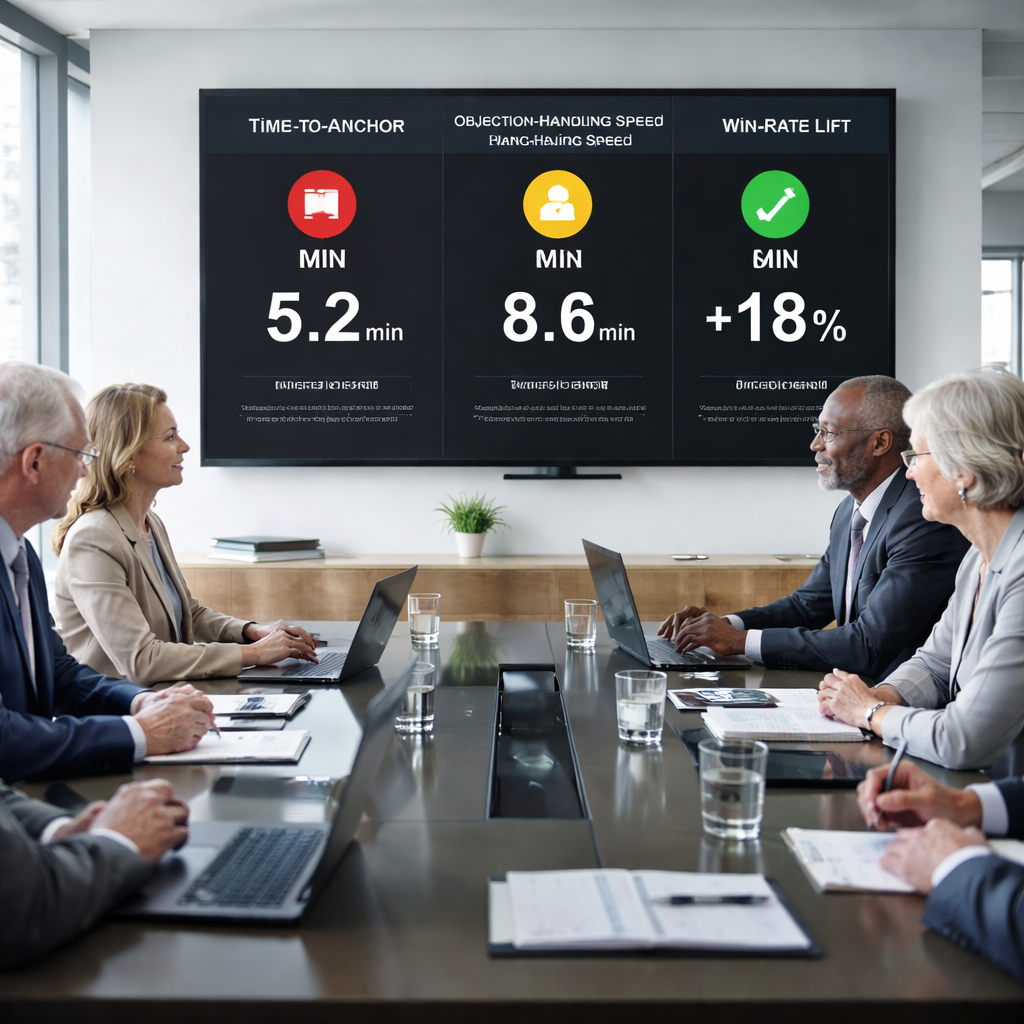
4. Feed the numbers into a traffic‑light dashboard. Green means you hit or exceed the target, yellow signals a gap, red calls for a quick 48‑hour action plan.
5. Review on a cadence. For senior leaders, a bi‑weekly review works – it’s frequent enough to spot trends but not so often that it feels like micromanagement.
Real‑world example: a Fortune 500 sales exec
One of our senior sales clients applied this framework after a three‑day simulation. Their baseline win‑rate on $10 M‑plus deals was 42 %. Six months later, the win‑rate climbed to 58 %, while average discount fell from 12 % to 8 %. The cycle time shaved 14 days off the average 90‑day process. Those three numbers alone gave the CFO a clear ROI narrative.
Linking KPI results to ROI calculations
When you can plug the delta into a simple ROI formula – (gain – cost) / cost – the business case becomes undeniable. For instance, a 4 % uplift on a $200 M pipeline translates to $8 M extra revenue. Subtract the training cost and you’ve got a multi‑digit ROI.
Industry data on negotiation training ROI backs this approach. RED BEAR Negotiation reports an average return of $54 for every dollar invested, with some clients seeing a 46.7‑to‑1 ratio after tracking the same KPI buckets we recommend (industry data on negotiation training ROI).
Tips to keep your KPI engine humming
- Automate data capture where possible – pull discount fields straight from your CRM.
- Make the post‑meeting template a shared Google Sheet so every leader logs the same fields.
- Assign a KPI champion – often a senior analyst – to clean the data and flag anomalies.
- Celebrate quick wins publicly; a green light on the dashboard fuels ongoing buy‑in.
- Re‑calibrate targets every quarter. If you’re consistently beating a goal, raise the bar.
Remember, the goal isn’t to create a perfect spreadsheet; it’s to surface the story that shows your negotiation muscle is stronger, faster, and more profitable.
Next action: your 48‑hour KPI sprint
Pick one upcoming deal, pull the last three similar deals as a baseline, and set a single KPI – maybe “reduce discount by 2 %”. After the negotiation, log the results, plot them, and write a one‑sentence insight: “Leveraging the CFO’s fiscal‑year‑end pressure let us close 2 % tighter.
Do that, and you’ll have a concrete data point to share at the next leadership meeting. It’s the fastest way to prove that advanced negotiation training for senior leaders isn’t just theory – it’s measurable impact.
Step 5: Sustain Growth through Continuous Coaching
All the audit, the curriculum, the role‑plays – they’re only the start. The real challenge is keeping the momentum alive once the workshops are over. Think of it like a marathon: you don’t sprint the first mile and then coast. You need a steady rhythm, checkpoints, and a coach in your ear reminding you to keep your form.
So, what does continuous coaching look like for senior leaders who just finished an intensive negotiation program? In a nutshell, it’s a loop of short, focused touchpoints that turn the insights you gained into habits you never forget.
1. Schedule a 30‑minute “Micro‑Coaching” call every two weeks
Pick a trusted peer or a senior manager who can act as a coach. The call should have three parts: a quick win review, a challenge spotlight, and a one‑action commitment.
- Win Review: “Last week I used the loss‑aversion frame with the CFO and closed the discount 2 % tighter. How did it feel?”
- Challenge Spotlight: “I’m stuck on the stakeholder who keeps changing the legal clause. Any idea how to read that micro‑expression?”
- One‑Action Commitment: “I’ll schedule a 15‑minute pre‑escalation checkpoint before the next legal review.”
Because the conversation is bite‑sized, you won’t dread it, and the habit of reflecting stays fresh.
2. Build a “Negotiation Pulse Dashboard” that lives in your CRM
Take the KPI fields you already capture – discount depth, cycle‑time, alignment score – and turn them into a traffic‑light widget that updates automatically. When the light turns red, the dashboard triggers a notification to your coach to schedule a deeper debrief.
One of our Fortune 500 clients added this to their Salesforce instance. Within three months the red‑light incidents dropped by 40 % because the instant alert forced a quick corrective chat before the deal slipped further.
3. Leverage peer‑learning circles
Gather a small group of senior leaders (3‑5 people) who are all in the same stage of their negotiation journey. Meet once a month for a “Deal‑Swap” where each person brings a recent negotiation, outlines the three‑dimensional map (people, power, process), and the group offers micro‑feedback.
In practice, a procurement chief from a global tech firm reported that after three rounds of deal‑swaps, their team’s average contract cycle shrank from 78 days to 61 days. The secret? Seeing how others phrase a BATNA reminder or a timeline nudge sparked new ideas that were instantly tried.
4. Keep the behavioral radar sharp with video clips
After every high‑stakes meeting, record a 2‑minute excerpt (you can use the meeting recorder that most platforms provide). Tag one micro‑cue – a nervous foot tap, a pause before a key concession – and send the clip to your coach for a 5‑minute feedback loop.
The Edge Negotiation Group’s the ultimate negotiation CHALLENGE includes a library of these clips, so you can pull a comparable scenario and see how a seasoned facilitator would annotate it. Even if you’re not in a challenge, the same principle works: quick visual feedback beats a vague memory.
5. Tie coaching outcomes back to ROI
Every quarter, pull the KPI data and calculate the incremental profit you’ve earned thanks to tighter discounts or faster closes. Use the simple formula (gain – cost)/cost to show the return on the coaching budget. When you can point to a $5 M uplift that traces back to a coaching insight, the executive board stops seeing coaching as a “nice‑to‑have” expense.
MIT’s leadership‑focused negotiation strategies echo this point: they argue that sustained, data‑driven coaching turns a soft skill into a measurable strategic asset (MIT Executive Education).
6. Blend wellness into the coaching rhythm
Negotiation is a mental marathon, and senior leaders need peak health to stay sharp. A quick partnership with an executive‑wellness provider can add a 10‑minute “mind‑reset” exercise before each coaching call – breathing, posture check, or a short mobility stretch. It sounds trivial, but the added clarity often surfaces the micro‑cue you missed earlier.
For a holistic approach, consider programs like XLR8well, which specialize in proactive health for executives. A healthier brain reads facial micro‑expressions faster, and a steadier heart rate keeps you calm when the CFO leans back with a skeptical stare.
In short, continuous coaching isn’t a once‑a‑year refresher. It’s a living system of short check‑ins, data alerts, peer learning, and even a dash of wellness. When you stitch these pieces together, the negotiation muscles you built in the workshop stay toned, and every new deal feels like a rehearsal rather than a surprise.
Conclusion
After diving deep into audits, curriculum design, simulations, KPIs, and coaching, the picture is clear: you need a living system, not a one‑off workshop.
Advanced negotiation training for senior leaders works because it stitches behavioral cues, the 3‑D strategy, and habit loops into a repeatable playbook. When you catch a micro‑expression or spot a hidden power lever, you’re not guessing—you’re acting on data you’ve already mapped.
So, what’s the next step? Grab the audit you completed in Step 1, pick one KPI you want to improve, and schedule a 30‑minute micro‑coaching call this week. Use that call to set a single, concrete action – maybe a pre‑escalation checkpoint or a quick alignment email.
If you keep that loop turning – capture, compare, adjust – the negotiation muscles you built stay toned, and every new deal feels like a rehearsal, not a surprise.
Remember, the real ROI shows up when you see tighter discounts, shorter cycles, and higher win rates across your boardroom battles. That’s the promise of advanced negotiation training for senior leaders.
Ready to make the habit stick? Start today, track the results, and let the data speak for itself today.
FAQ
What exactly is advanced negotiation training for senior leaders and how does it differ from a regular workshop?
It’s a deep‑dive system that blends behavioral psychology, the 3‑D strategy, and habit‑loop coaching into a repeatable playbook. Instead of a one‑off lecture, you get live role‑plays, video debriefs, and a KPI‑driven feedback loop that turns every boardroom encounter into data you can act on. The result is a living skill set, not a temporary confidence boost.
How can senior sales executives measure the ROI of this training?
Start by capturing baseline metrics – win‑rate, average discount, and cycle‑time for deals over the last three quarters. After the program, log the same data for each negotiation and plot it on a traffic‑light dashboard. A 5 % lift in win‑rate or a 10‑day reduction in cycle‑time translates into millions of incremental profit for a $200 M pipeline, giving you a clear ROI figure.
What role do behavioral cues like micro‑expressions play in the training?
Micro‑expressions are the secret sauce that lets you read a counterpart’s hidden concerns in real time. In the Edge Negotiation Group labs, you watch short video clips, pause at each facial twitch, and practice naming the underlying emotion. That habit moves from “I think they’re nervous” to “They’re signaling a BATNA concern,” letting you pivot the conversation before the deal stalls.
How much time should a busy senior leader commit to the program each week?
We keep it realistic: a 3‑hour intensive module once a week plus a 15‑minute micro‑coaching call every two weeks. Between sessions, spend 10 minutes after each negotiation to log three KPI values – alignment score, leverage used, and timeline adherence. That 30‑minute weekly rhythm fits into a packed executive calendar while still delivering measurable improvement.
Can the training be customized for different industries, such as procurement or HR?
Absolutely. The core 3‑D framework stays the same, but the scenarios, lever libraries, and role‑cards are swapped out for industry‑specific challenges. For procurement, we focus on supplier risk levers and compliance cues; for HR, we map internal stakeholder influence and compensation‑budget power points. The customization ensures every senior leader walks away with playbooks that speak their language.
What follow‑up coaching mechanisms keep the skills sharp after the workshop?
We embed a 48‑hour action loop: capture KPI data, compare it to your traffic‑light board, and adjust with a concrete step. In addition, you get a bi‑weekly micro‑coaching call, a peer‑learning circle of 3‑5 senior leaders, and a shared video clip library for quick “micro‑review” feedback. Those touchpoints turn the training from a sprint into a marathon.
Is there a typical timeline to see measurable improvements in deal outcomes?
Most senior leaders notice a shift within the first 30 days – quicker alignment scores and tighter discount negotiations. Full‑cycle impact, like a 10‑day reduction in deal time or a 4 % lift in win‑rate, usually materialises after 3‑4 months of consistent KPI tracking and coaching. The key is to keep the review loop turning; the data will tell you when the gains solidify.