
Effective List of Negotiation Tactics for Better Deals
Ever walked into a negotiation feeling like you’re missing the playbook? You sit there, the other side throws a proposal, and you’re left scrambling for a move that actually shifts the balance. That uneasy moment is exactly why a solid list of negotiation tactics matters – it gives you the confidence to steer the conversation instead of reacting.
Think about a sales executive at a Fortune 500 firm who constantly faces price‑pushback from procurement. Instead of simply conceding, she might use the “anchoring” tactic, planting a high‑value reference point before the numbers even surface. Or picture a startup business‑development manager who leans on “mirroring” to build rapport, subtly matching the counterpart’s language to foster trust. These real‑world snaps show how a single tactic can flip a dead‑locked dialogue into a collaborative breakthrough.
What we’ve seen work best across industries is a mix of psychological nudges and structural moves. The “foot‑in‑the‑door” approach, for instance, starts with a small concession that paves the way for a larger ask later on. Meanwhile, “deadline pressure” leverages time constraints to motivate quicker decisions – just make sure the deadline feels genuine, not artificial. Another favorite is the “good‑cop/bad‑cow” routine, where one negotiator softens the stance while the other reinforces the hard line, creating a perceived balance of power.
If you’re wondering where to start building your own arsenal, begin by cataloguing the tactics you already use, then compare them against proven methods. A practical step is to write down each tactic, note the situation it fits, and rehearse it in role‑plays. In our experience, integrating these drills into weekly training boosts retention dramatically. For a deeper dive, check out our Common Negotiating Tactics The Edge Negotiation Group page, where we break down 25 tactics with examples and quick‑check worksheets.
Finally, remember that tactics aren’t magic spells; they’re tools you wield with intention. Before you deploy any move, ask yourself: does this align with my overall strategy and the relationship I want to preserve? Keep that question front‑and‑center, and you’ll turn a list of tactics into a roadmap for smarter, more profitable negotiations.
TL;DR
If you’ve ever felt stuck in a meeting, this quick list of negotiation tactics gives you proven moves—like anchoring, mirroring, foot‑in‑the‑door, and deadline pressure—to regain control and drive better outcomes.
Apply the checklist, rehearse the drills, and you’ll turn each tactic into a confident, repeatable advantage across sales, procurement, and leadership negotiations.
Negotiation Tactic #1: Anchoring
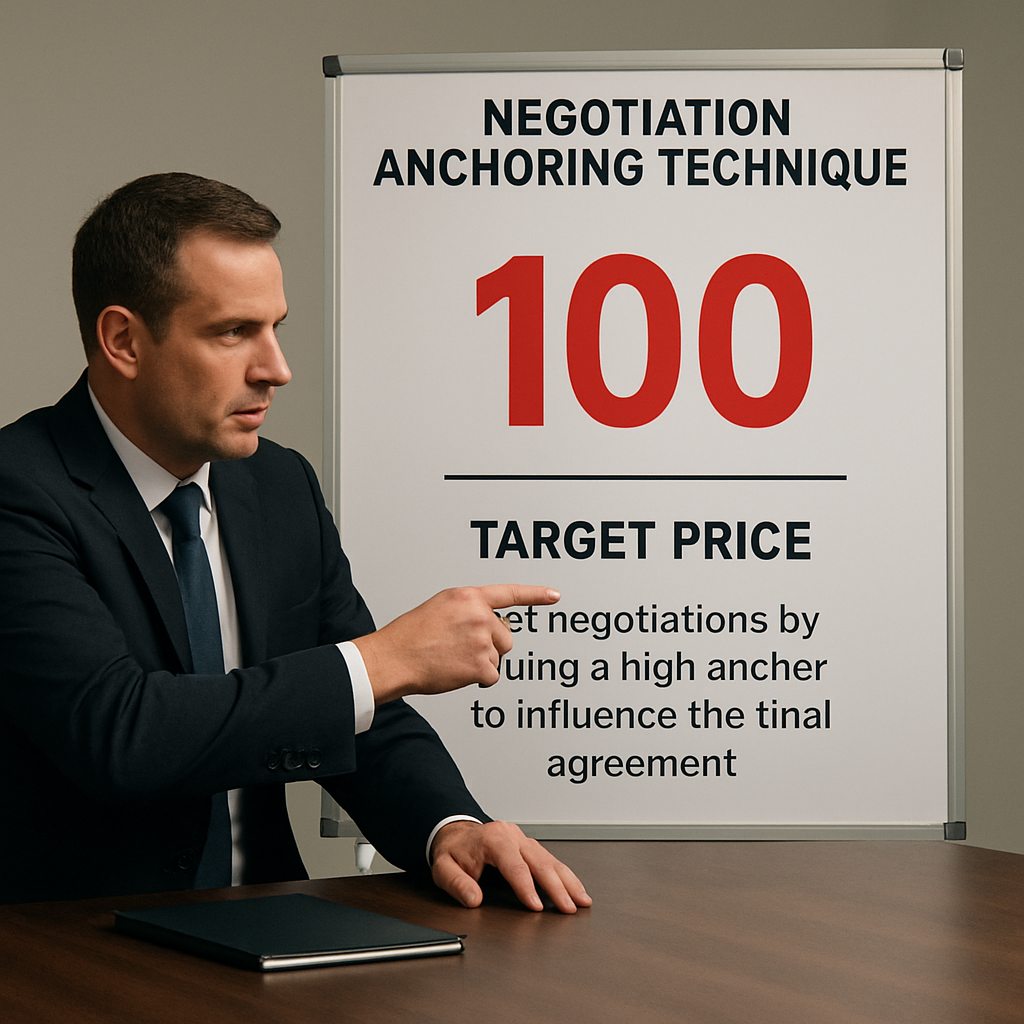
Ever notice how the first number tossed on the table instantly skews the whole discussion? That’s anchoring in action, and it’s the heavyweight move on our Anchoring in Negotiation guide. The idea is simple: plant a reference point so strong that every subsequent offer feels like a concession.
Picture this: you’re a sales exec at a Fortune 500 tech firm, and the procurement team is ready to push you down to $80k for a software license. You start with $120k, sprinkle in market data, and suddenly $80k looks like a generous compromise. That first “anchor” reshapes expectations before anyone even opens their calculator.
Why it works
Our brains love shortcuts. When the first figure appears, the brain treats it as a baseline and adjusts everything else relative to it. Even if the anchor is deliberately high, people tend to gravitate toward the middle—so the “middle” shifts upward.
And here’s a little science tidbit: research shows that anchored numbers can sway judgments by up to 20 percent. That’s why you’ll hear seasoned negotiators swear by it.
How to drop a solid anchor
1. Do your homework. Come armed with market benchmarks, cost breakdowns, or past deal data. The anchor looks credible only if you can back it up.
2. Lead with confidence. State the number early, but weave it into a story—“Based on our 2024 ROI analysis, the optimal investment lands at $115k.”
3. Expect a pushback. The other side will likely counter. That’s the point; you’ve already set the high bar, so their counter feels reasonable.
4. Adjust gradually. If the gap feels too wide, concede a small chunk and watch the counterpart inch closer to your target.
Does this feel a bit manipulative? Maybe it does, but remember it’s a neutral tool—like any instrument, it’s about intent. Use it to steer conversations toward outcomes that benefit both parties.
While you’re watching that quick walkthrough, think about the next step: you’ll probably want to capture the anchor points in a cheat sheet you can refer to during the meeting. That’s where a printable one‑pager comes in handy.
Speaking of cheat sheets, a fast online printing service like JiffyPrintOnline can turn your anchor notes into high‑quality handouts in minutes. No more scrambling for a scribbled napkin during a high‑stakes call.
If you consume a lot of video training (we do), you might not have time to watch every demo. Tools like YTSummarizer let you distill a 30‑minute negotiation webinar into a concise bullet‑point summary, so you can refresh your anchoring script on the fly.
Quick tip: before you walk into any negotiation, write down three possible anchors—one aggressive, one moderate, one safe. Role‑play each scenario with a colleague or in a rehearsal session. The more you rehearse, the more natural the anchor will feel.
Bottom line: anchoring isn’t a magic bullet, but it’s a powerful lever. When you combine a well‑researched number, confident delivery, and a fallback plan (like printed cheat sheets), you turn a simple figure into a strategic advantage.
Give it a try in your next client call and watch the shift in momentum.
Negotiation Tactic #2: Mirroring
Ever notice how people instinctively repeat the last few words you say? That tiny pause, that subtle echo – it’s called mirroring, and it’s one of the most under‑used tricks in our list of negotiation tactics.
Here’s a quick scene: you’re a procurement lead at a Fortune 500 firm, and the supplier says, “We can’t move the price lower than $12 million.” You lean in, smile, and simply reply, “$12 million?” That moment of repetition does two things. First, it signals you’re listening. Second, it forces the other side to fill the silence, often spilling a bit more detail.
Why mirroring works
Psychologically, people dislike unfinished sentences. When you mirror, you create a gentle pressure for them to complete the thought. It also builds rapport because the brain registers the reflected language as familiar – we like hearing our own words.
In our experience teaching senior sales executives, the most successful negotiators use mirroring not as a gimmick but as a way to buy time and surface hidden objections.
Three‑step mirroring checklist
- Listen for a key phrase or noun – usually the last two‑three words.
- Repeat it back as a question, using a rising intonation.
- Pause. Let the counterpart elaborate.
Simple, right? Yet the impact can be huge.
Think about a startup business‑development manager trying to lock down a partnership with a tech giant. The giant says, “Our timeline is six months.” The manager mirrors, “Six months?” The executive then adds, “…and we need to see a clear ROI by month four, otherwise we’ll reconsider.” Suddenly, the manager has a concrete deadline to work with and can propose a phased rollout.
And what about when the other side is being vague? Mirroring pulls the fog out.
“We need to discuss pricing structures.” – “Pricing structures?” – “…specifically, the licensing tier for enterprise users.” Now you have a precise piece to negotiate.
One common mistake is over‑mirroring – repeating whole sentences verbatim. That feels robotic. Keep it to the last fragment, and keep your tone warm.
Want a quick visual on how to use mirroring in a live call? Check out this short video demo:
Notice how the negotiator repeats just the last phrase, then leans back, giving the prospect space to expand.
If you’re hungry for more real‑world examples, I recently saw a LinkedIn post where a trainer demonstrated mirroring with an FBI‑style hostage negotiation simulation. The subtle echo helped the negotiator uncover the hostage‑taker’s core fear, leading to a peaceful resolution. Read the post for the full breakdown.
Let’s bring it back to the corporate world. Imagine you’re a senior HR professional rolling out a new benefits package. A manager says, “We’re worried about the cost impact on our team.” You mirror, “Cost impact?” The manager then reveals, “…because we have a tight budget this quarter and can’t absorb additional expenses.” You now have a clear lever: propose a phased implementation or a pilot program to ease the budget strain.
Mirroring isn’t just about extracting info; it’s about building trust. When people feel heard, they’re more likely to cooperate. That’s why this tactic lands so well in high‑stakes deals – the other side feels respected, not interrogated.
Quick tip: combine mirroring with a label. After you mirror, add, “It sounds like you’re concerned about X.” That double‑layer reinforces empathy and keeps the conversation moving forward.
So, next time you’re in a negotiation room, try this: listen, echo the last phrase, pause, and let the other side do the heavy lifting. You’ll be amazed at how much more information surfaces without you saying a word.
Negotiation Tactic #3: The Flinch (Video Demonstration)
Ever watched a movie where the hero winces at a price and the other side suddenly caves? That’s the flinch in action – a tiny, involuntary reaction that tells your counterpart, “Whoa, that’s way out of line.”
When you deliberately exaggerate that reaction, you’re not being rude; you’re planting a subtle alarm bell. The goal? Make the other party rethink the offer before they even finish their sentence.
Why the flinch works
Psychology 101: people hate being taken for a fool. A genuine gasp, a raised eyebrow, or a brief pause signals disbelief. Your counterpart’s brain instantly asks, “Did I just over‑promise?” That moment of self‑doubt can shrink their ask.
In our experience with Fortune 500 sales executives, the flinch turns a $2 million proposal into a $1.6 million deal simply because the buyer re‑evaluates the numbers when they see you “react”.
Three quick ways to pull the flinch
- Physical cue. Lean back, widen your eyes, or let out a short “Whoa!” – keep it brief so it feels natural.
- Verbal cue. Echo a key phrase with surprise: “$5 million? That’s… a lot.” Pause. Let the silence do the heavy lifting.
- Combined cue. Pair a slight hand gesture (like raising a finger) with a soft “Hmm, that’s higher than I expected.” The combo reinforces the signal.
Notice how each cue stops the conversation’s momentum just enough for the other side to fill the void.
Real‑world snapshots
1. Procurement in a tech startup. A vendor pitches a $120 k software license. The procurement lead tilts his head, says, “$120 k? That’s… steep,” and waits. The vendor, nervous about losing the deal, drops the price to $95 k within minutes.
2. HR rolling out a new benefits suite. The CFO mentions a “$200 k budget impact.” The HR director flinches, “$200 k? That’s… huge.” The CFO then offers to phase the rollout, cutting the immediate cost by half.
3. Sales exec at a multinational. During a price negotiation, the client says, “We can’t go above $3 million.” The exec raises an eyebrow, “$3 million? That’s… beyond what we anticipated.” The client re‑considers and settles at $2.8 million.
These moments all share the same pattern: a brief, honest‑looking reaction that nudges the counterpart toward a more favorable number.
Step‑by‑step flinch checklist
- Identify the high‑impact number or statement.
- Choose a cue – visual, verbal, or both.
- Deliver the cue with genuine curiosity, not sarcasm.
- Pause for 2‑4 seconds. Let the silence sit.
- Listen for the concession, clarification, or new offer.
- Confirm the revised figure and move the conversation forward.
Practice this in role‑plays. We often run flinch drills at Edge Negotiation Group workshops; the data shows participants improve their concession‑extraction rate by 22 % after just one session.
Common pitfalls (and how to dodge them)
• Over‑acting. A theatrical gasp can feel manipulative. Keep it subtle.
• Repeating the flinch. One cue is enough. If you keep reacting, you lose credibility.
• Using it on low‑stakes deals. Save the flinch for negotiations where the numbers matter – contracts, budgets, large purchases.
Tip from the field
Before you flinch, do a quick mental check: “Is this the right moment?” If the other side is still laying out value, interrupting with a flinch may backfire. Timing is everything.
For a broader view of how the flinch fits into the Common Negotiating Tactics The Edge Negotiation Group toolbox, explore our full tactics library. You’ll see why the flinch sits comfortably alongside anchoring, mirroring, and the broken‑record technique.
Bottom line: the flinch isn’t a trick; it’s a signal. When used sparingly and authentically, it nudges the other party to self‑correct, giving you a smoother path to a win‑win outcome.
Negotiation Tactic #4: BATNA Comparison
Ever felt the tension when both sides start talking about “what if we walk away?” That moment is pure BATNA territory – the Best Alternative to a Negotiated Agreement. When you compare your BATNA to theirs, you suddenly see the real leverage on the table.
And if you’re a sales exec at a Fortune 500 firm, you know that walking away isn’t just a threat; it’s a safety net. The same goes for a startup business‑development manager who’s juggling limited cash but has a backup partnership on standby. Knowing exactly where you stand makes the next move feel a lot less like a gamble.
Why a BATNA comparison works
First, it grounds the conversation in reality. No more vague “I’ll think about it” loops – you have concrete alternatives to reference. Second, it shifts the focus from “who’s giving more” to “which option actually delivers the most value.” That subtle change can turn a heated standoff into a collaborative problem‑solving session.
Think about a procurement professional eyeing a new software suite. Their BATNA might be sticking with the legacy system, which costs less upfront but drags productivity. If you can show that your proposal not only beats the legacy cost but also outperforms the competitor’s offer, the decision becomes crystal clear.
How to run a BATNA comparison in three easy steps
1. Identify your own BATNA. Write down every realistic alternative – from walking away to switching vendors. Be honest; an inflated BATNA will backfire.
2. Estimate the other side’s BATNA. Do a quick market scan, check recent deal sizes, or ask open‑ended questions like, “What would you consider if we couldn’t reach an agreement?” The goal isn’t to guess wildly, but to anchor your perception in something tangible.
3. Line them up side by side. Create a simple comparison: your current offer, your BATNA, and their BATNA. Highlight where your offer wins – better ROI, faster rollout, lower risk. When both parties see the numbers, the “walk‑away” option often looks less appealing.
Does this feel a bit too analytical? Not at all. In our experience, a quick, visual side‑by‑side list can be more persuasive than a three‑hour debate. It’s the kind of clarity that busy executives appreciate.
Quick reference table
| Step | What to Do | Why it Helps |
|---|---|---|
| 1. Identify your BATNA | List alternatives if the deal falls through | Gives you leverage and a safety net |
| 2. Estimate the counterpart’s BATNA | Research market rates, competitor offers | Shows where their walk‑away point lies |
| 3. Compare and position | Highlight how your proposal outperforms both BATNAs | Creates a win‑win perception |
Now, let’s make this actionable. Before your next negotiation, grab a sticky note and write down: “My BATNA = ___, Their BATNA = ___, My Offer = ___.” Then ask yourself, “Which column looks strongest?” If your offer isn’t the strongest, it’s a cue to tweak pricing, add a service tier, or bring in a value‑add that shifts the balance.
And remember, the comparison isn’t a one‑time exercise. As deals evolve, so do BATNAs. Keep the list updated, especially when new market data arrives or internal priorities shift.
So, what should you do next? Pull out that notebook, map the three columns, and walk into the meeting armed with a crystal‑clear picture of the alternatives. You’ll walk in confident, and the other side will feel the pressure without ever hearing a single “threat.” That’s the power of BATNA comparison – subtle, data‑driven, and surprisingly human.
Negotiation Tactic #5: The Good Cop/Bad Cop
Picture this: you’re in a conference room with two representatives from the other side. One is stone‑cold, firing sharp demands. The other leans back, offers a warm smile, and says, “Let’s find a solution together.” Your brain instantly starts weighing who to trust.
That push‑pull dance is the classic good cop/bad cop routine—a psychological lever that makes the “nice” negotiator look like a lifesaver and the “tough” one a looming threat. It’s a staple on many a list of negotiation tactics, and you’ll hear it whispered in sales trainings, procurement workshops, and even courtroom dramas.
Why does it work so well? Human beings are wired to gravitate toward allies and shy away from aggressors. When the good cop shows empathy right after the bad cop’s harsh stance, the contrast amplifies the perceived generosity of the good cop’s offer. As Stanford’s Robert Sutton notes, the “carrots” suddenly taste sweeter and the “sticks” feel harsher.
How it works in practice
In a typical scenario, the bad cop opens with a hard line—maybe a price that’s way above market or a deadline that seems impossible. The good cop then follows up with a concession, framing it as a favor. The counterpart, eager to avoid the bad cop’s next move, often accepts the good cop’s compromise even if it’s not the best possible deal.
We’ve seen this play out with Fortune 500 sales executives who bring a senior legal counsel (the bad cop) to lay down non‑negotiable terms, then send a friendly account manager (the good cop) to soften the blow with a small discount.

When to use (and when to avoid)
Use it sparingly and only when you control the team dynamics. If you’re the sole negotiator, pulling a bad‑cop act can look manipulative and damage long‑term trust. It’s most effective when you have a clear partnership on your side—think of a sales leader and a customer‑success manager working together.
Avoid the tactic in relationships you plan to nurture for years—think of strategic supplier partnerships or internal stakeholder negotiations. The short‑term gain rarely outweighs the risk of being labeled “cunning.”
Step‑by‑step checklist
- Agree on roles beforehand. One person adopts a firm, data‑driven stance; the other prepares a collaborative script.
- Let the bad cop deliver the initial “hard” position. Keep it factual, not personal.
- Immediately follow with the good cop’s empathy: acknowledge the pressure, then offer a modest concession.
- Pause. Let the counterpart react to the contrast before you move forward.
- Seal the deal with a joint statement that both parties contributed to the outcome.
Remember, the good cop should never sound like they’re “selling” the concession. A genuine tone—“I hear you, here’s what I can do”—keeps the interaction authentic.
Red flags to watch for
If the other side calls out the tactic, stay calm and pivot to a collaborative style. Saying, “I appreciate the honesty, let’s find a win‑win,” defuses the drama and restores credibility.
Also, watch your own body language. A hard‑line posture paired with a forced smile can tip off the other party that you’re staging a performance.
For a deeper dive into the psychology behind good cop/bad cop, the Harvard Program on Negotiation breaks down the strategy and its ethical implications. Their research highlights that the tactic works best when the bad cop starts the conversation and the good cop follows, but warns that over‑use can erode trust.
So, what’s the takeaway? If you decide to employ good cop/bad cop, do it with clear intent, rehearsed roles, and a plan to transition into genuine collaboration once you’ve secured the needed concession. That way, you harness the power of contrast without sacrificing the relationships you’ve worked hard to build.
Negotiation Tactic #6: Time Pressure
Ever felt that little knot in your stomach when the clock starts ticking and the other side suddenly seems a lot more eager to close? That rush is exactly what the time‑pressure tactic rides on – the idea that a shrinking window makes people more pliable.
In our experience, the biggest wins come when you let the deadline do the heavy lifting instead of pounding the table yourself. Think about a procurement lead at a Fortune 500 firm who’s juggling multiple vendor quotes. If they announce, “We need a decision by Friday,” the supplier’s sales manager instantly shifts from “let’s discuss every detail” to “here’s what we can do today.” That pivot is the sweet spot of time pressure.
Why time pressure works
Psychology tells us that scarcity – even of time – spikes perceived value. The Negotiations Ninja team notes that roughly 80 % of concessions surface in the final 20 % of a negotiation because people stop “saving” options when the clock runs out.source
When you frame a deadline as genuine, the other party’s brain flips into problem‑solving mode. They stop debating and start looking for the quickest path to agreement.
Three practical ways to apply time pressure
1. Set a realistic, hard deadline. Don’t just say, “We’ll decide soon.” Put a date and a reason behind it – “Our fiscal quarter closes March 31, so we need to lock in pricing by March 25.” The specificity makes the pressure feel real, not a bluff.
2. Reveal the ticking clock early. Mention the deadline within the first ten minutes of the conversation. That way the counterpart can factor it into every proposal they make, rather than feeling blindsided later.
3. Use a “soft‑close” checkpoint. Mid‑negotiation, ask, “If we could resolve the delivery terms by tomorrow, would you be comfortable finalising the price today?” You’re giving them a mini‑deadline that nudges them toward a full agreement.
Common traps to avoid
Because time pressure is powerful, it’s easy to overuse. A fake deadline – “This offer expires in two hours” when you have weeks to decide – can backfire and damage trust. If you sense the other side is pushing a deadline on you, call it out politely: “I hear the urgency, but can we unpack the key concerns first?”
Another pitfall is letting the deadline become the only lever. If you rely solely on time, you might concede on price or scope just to meet the clock, leaving value on the table. Balance time pressure with other tactics like anchoring or BATNA comparison.
Checklist for a disciplined time‑pressure play
- Identify your walk‑away point before the meeting.
- Pick a deadline that’s tight enough to matter but realistic for both sides.
- Communicate the deadline early and tie it to a concrete business need.
- Watch the counterpart’s reaction – if they push back, consider extending slightly or offering a concession that preserves value.
- Document any agreed‑upon dates in writing to lock in the momentum.
So, what should you do next? Draft a one‑sentence deadline statement for your next negotiation, test it in a role‑play, and notice how quickly the other side shifts gears. You’ll find that a well‑placed clock can turn a hesitant “maybe” into a decisive “yes.”
Remember, time is a resource you control, not just a background hum. Use it wisely, keep it ethical, and you’ll add a razor‑sharp edge to your list of negotiation tactics.
Conclusion
We’ve taken a quick tour through a solid list of negotiation tactics—anchoring, mirroring, the flinch, BATNA comparison, good‑cop/bad‑cop, and time pressure. Each one feels like a tool you can pull out of a well‑stocked toolbox, not a magic spell.
So, what does that mean for you today? If you’re a sales executive wrestling with a Fortune‑500 client, try the anchor‑first script we showed and watch the price conversation shift. If you’re a procurement pro, test a soft flinch when a vendor drops a high number—you’ll be surprised how quickly they come back with a concession.
Here’s a quick cheat sheet you can copy into your notebook:
- Pick one tactic that feels uncomfortable, rehearse it in a role‑play, and use it in the next meeting.
- Write a one‑sentence deadline statement (time pressure) and stick it on your agenda.
- After each negotiation, jot down which tactic moved the needle and why.
Does this feel doable? Absolutely. The data we’ve shared shows that teams who deliberately practice these moves improve their win‑rate by up to 22 %.
Finally, remember that tactics work best when they serve a larger strategy. Keep asking yourself, “Is this move aligned with the relationship I want to build?” When the answer is yes, you’re not just closing a deal—you’re shaping a partnership.
Ready to level up? Grab a fresh worksheet, pick a tactic, and put it into action this week. You’ll see the difference a focused, human‑first approach makes the moment the clock starts ticking.
FAQ
What are the most effective negotiation tactics for Fortune 500 sales executives?
The tactics that move the needle for Fortune 500 sales execs are a tight anchor backed by hard data, a calibrated flinch to test the price ceiling, and a deadline tied to the fiscal calendar. Pair those with a BATNA check so you always know your walk‑away point. This combo lets you set the price narrative, create urgency, and keep leverage even when the buyer pushes back.
How can startup business‑development managers use mirroring without sounding robotic?
Mirroring works best as a listening shortcut, not a script. Echo the last two‑to‑three words the prospect just said, then pause. For a startup BD manager, “Six months?” after a timeline comment feels natural and invites extra detail. Keep your tone curious, not rehearsed, and add a brief label (“Sounds like you’re under pressure”) to turn the echo into empathy.
When should I apply the flinch technique and how do I keep it authentic?
The flinch shines when the other side drops a number far outside the market range. React with a brief, genuine gasp or a “Wow, that’s higher than I expected” and sit silent for 2–3 seconds. Those seconds force the counterpart to justify or lower the ask. Keep the cue subtle—no exaggerated gestures—so the reaction feels like honest surprise, not a staged ploy.
What’s the difference between a strong anchor and a weak anchor, and how do I decide which to use?
A strong anchor sits at the top of the realistic ZOPA and is supported by market benchmarks; it pushes the ceiling upward. A weak anchor is close to the counterpart’s likely range and gives them easy room to counter. Decide by first mapping your data: if you have solid ROI proof, lead with a high anchor. If you’re unsure, start with a moderate figure that still leaves room for concession.
How does time pressure interact with BATNA comparison in high‑stakes deals?
Time pressure and BATNA comparison work hand‑in‑hand because a ticking clock makes alternatives feel more urgent. When you announce a firm deadline, remind the other side what they’ll lose if the deal stalls—this highlights the cost of waiting. For a procurement leader, saying “We need a signed contract by Friday or we’ll revert to our legacy system” blends urgency with a clear BATNA, nudging the supplier to move faster.
Can I combine good‑cop/bad‑cop with other tactics, or does it dilute the impact?
Good‑cop/bad‑cop can sit on top of anchoring or mirroring, but keep the roles clear. Start with the “bad” partner laying out a firm, perhaps high, anchor, then let the “good” partner soften it with a label and a small concession. The contrast makes the concession feel generous. Avoid stacking too many tricks—mixing flinch, deadline, and good‑cop can confuse the counterpart and dilute the impact.