
How to Use a Negotiation Bias Checklist
We all have blind spots. In a negotiation, those blind spots can cost you money, time, and relationships. A negotiation bias checklist helps you spot those blind spots before they steer your deal off course.
But here’s the surprising thing: an analysis of 24 negotiation biases across four sources shows that only one‑fifth of the checklist actually tells you how to counter the bias. That’s a big gap for a tool meant to improve deal‑making. So how do you build a checklist that works? And more importantly, how do you use it in real life?
In this guide, you’ll get a step‑by‑step method to create and use a negotiation bias checklist. You’ll learn the most common biases, how to spot them in yourself and others, and what to do when they show up at the table.
This data comes from a systematic search on April 26, 2026. The team looked at web pages and YouTube transcripts for “negotiation bias checklist” and pulled out 24 unique bias entries from four domains. Nine biases had enough detail to compare. The methodology is straightforward: only entries with at least three populated fields (name, definition, impact, example) made it into the table.
Step 1: Identify the Most Common Negotiation Biases
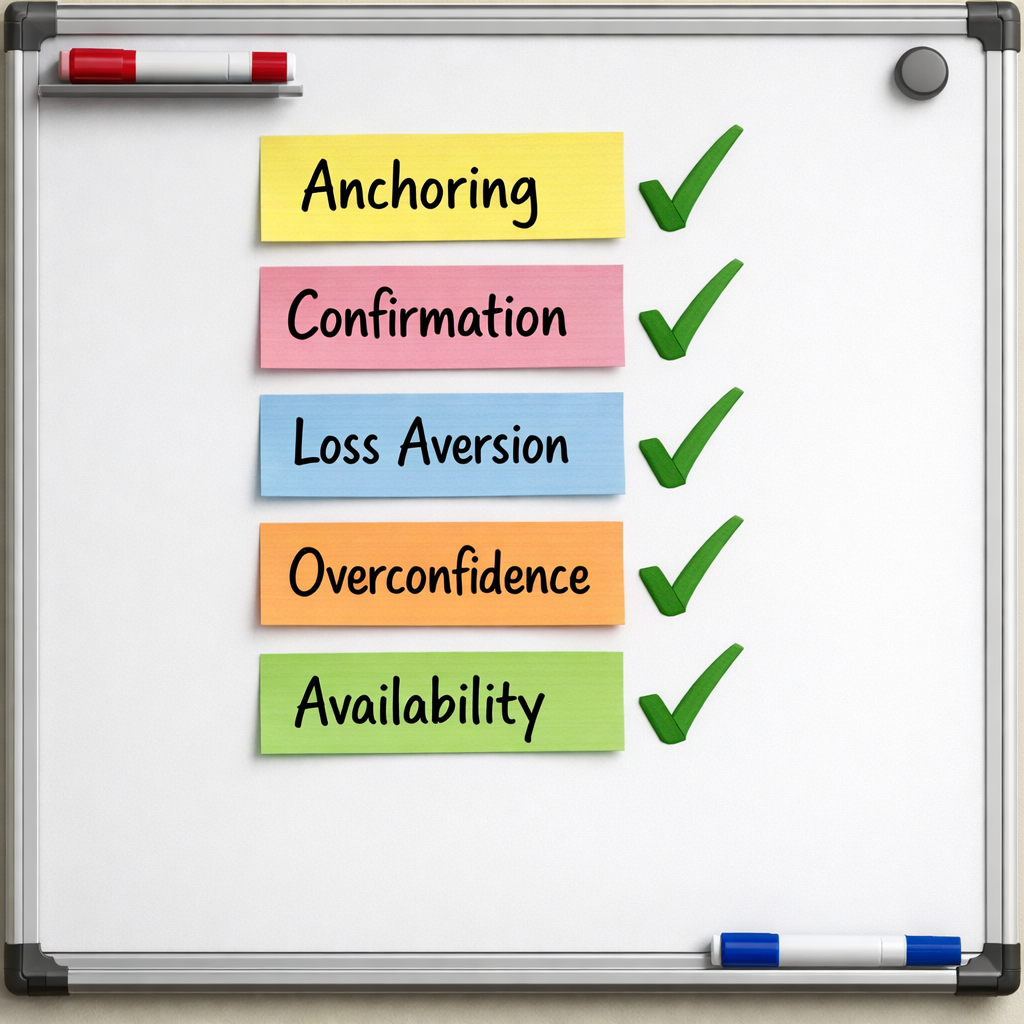
Before you can use a negotiation bias checklist, you need to know what you’re looking for. The research table above lists nine biases, but there are more. Let’s focus on the ones that show up again and again at the bargaining table.
Anchoring bias is the big one. It happens when the first number you hear pulls the whole conversation toward it. Say a vendor opens with $100,000. Even if you know that’s high, your counteroffer often ends up closer to that number than it would have been otherwise. As the Wikipedia entry on anchoring explains, this bias affects everyone, even experts.
Confirmation bias is another frequent troublemaker. You look for evidence that supports your side and ignore what doesn’t fit. In a negotiation, that means you might miss a good offer because it contradicts your assumptions.
Loss aversion bias makes you play too safe. You’d rather avoid a small loss than chase a big gain. That leads to missed opportunities.
Overconfidence bias makes you think you’re better than you are. You set unrealistic targets or assume you’ll win easily.
Availability bias tricks you into focusing on the most recent information, even if it’s not the most important.
That’s a huge problem. A checklist that shows you the bias but not what to do about it is like a map with no roads. You know where you are, but you can’t get anywhere.
So when you build your own negotiation bias checklist, make sure each entry includes three things: the name, a real‑world example, and a specific counter‑move. Without the counter‑move, the checklist is just a list of problems.
Let’s look at the biases from the table that do have impact statements: Overconfidence, Anchoring, Confirmation, Selective perception, Loss aversion, Availability, Framing, Value conflict, and Fairness. That’s only 9 out of 24 (38%). The rest have no stated outcome at all. That limits the checklist’s practical usefulness.
Pro Tip: When you create your checklist, skip the biases that only have a name and definition. Focus on the three or four you actually encounter. For most corporate negotiators, that’s Anchoring, Confirmation, and Loss aversion. Start there.
Bottom line: Build your negotiation bias checklist around a small set of high‑impact biases that come with concrete examples and mitigation steps.
Step 2: Assess Your Own Biases Before the Negotiation
You can’t fix a bias you don’t see. The best time to spot your own blind spots is before you ever sit down at the table. A negotiation bias checklist used in preparation can save you from costly mistakes.
Start by asking yourself some tough questions. Am I overconfident about this deal? Am I only looking for data that supports my plan? Am I afraid of losing something I already have? Am I relying too much on a recent win or loss?
Write down your answers. Then run them through the checklist. Here’s a simple four‑step self‑assessment you can do in ten minutes:
- Identify your default bias. Which bias do you fall into most often? If you’re a salesperson, it might be overconfidence. If you’re a procurement manager, it might be loss aversion. Be honest.
- List your assumptions. Write down three things you believe about the negotiation. Then, for each one, ask: What evidence contradicts this? If you can’t find any, you might be in confirmation bias territory.
- Check your anchor. What’s your opening number or position? Did you just pick it out of thin air, or is it backed by data? Anchoring bias works both ways , your own anchor can lock you in.
- Imagine a reversal. Picture yourself on the other side. What would you want? What would seem fair? This outsider lens can reveal blind spots.
Research from the Program on Negotiation at Harvard Law School shows that even judges, who are trained to be impartial, fall for cognitive biases. If judges can’t escape, neither can you. That’s why a structured assessment is so important.
Let’s say you’re about to negotiate a software contract. Your default bias might be overconfidence , you’ve closed similar deals before, so you assume this one will go the same way. But what if the buyer has new constraints? A quick checklist would prompt you to question that assumption.
Or imagine you’re negotiating a partnership. You’ve invested a lot of time and energy. The sunk cost fallacy (a cousin of loss aversion) could make you cling to a bad deal just because you’ve already put in the hours. The checklist catches that.
Bottom line: A pre‑negotiation self‑assessment using a negotiation bias checklist helps you spot your own biases when you still have time to adjust.
Step 3: Apply the Checklist During the Negotiation
You’ve done your prep. Now you’re in the room. The pressure is on. Your negotiation bias checklist is your safety net.
During a live negotiation, your brain switches to System 1 thinking , fast, automatic, intuitive. That’s exactly when biases take over. The checklist forces you to slow down and engage System 2 , slow, deliberate, analytical.
Keep the checklist somewhere you can glance at it. If the conversation is on a video call, tape it to your monitor. If it’s in person, slide it under your notepad. When you feel yourself reacting emotionally or making a snap decision, look at the checklist.
Watch this short video that walks through how to stay aware of biases in real time:
Now, what do you actually look for? Here are three in‑the‑moment checks:
- The anchor check: Did the other party just drop a number? If so, you’re at risk of anchoring bias. Pause. Say something like, “Let’s set that aside for a moment and talk about the value first.” Then bring up your own data.
- The confirmation check: You feel yourself nodding along because the other side’s story matches what you believed. Stop. Ask a question that challenges that belief. For example: “What factors might make this less favorable than it seems?”
- The loss aversion check: You feel a tightness in your chest because giving something up feels like a loss. Remind yourself of the BATNA (best alternative to a negotiated agreement). If your alternative is solid, you can afford to take more risk.
Let’s make this concrete. Imagine you’re buying a house. The seller anchors at $500,000. You feel that’s high, but you start mentally justifying it , maybe because you’ve already fallen in love with the property. Your checklist reminds you to defuse the anchor before making a counter. So you say, “I understand you’re at $500,000. Based on comparable sales in this area, I’m seeing numbers more in the $450,000, $470,000 range. Let me show you the data.” That’s the checklist in action.
“The most dangerous bias is the one you don’t know you have.”
Pro Tip: If you’re on a team, assign one person to be the bias monitor. Their only job is to watch the checklist and call out biases as they appear. That takes the pressure off you.
The negotiation bias checklist works best when it’s integrated into your process, not treated as an afterthought. Practice with it in low‑stakes conversations first , a lunch negotiation with a colleague, a quick price discussion with a vendor. That builds the habit.
Bottom line: Use your negotiation bias checklist as a real‑time tool during the negotiation, especially when you feel emotional or when a number is first mentioned.
Step 4: Review and Learn from Past Negotiations
The last step is also the start of your next improvement cycle. After every negotiation, pull out your negotiation bias checklist again. This time, use it to debrief.
Most people skip the debrief. They close the deal, high‑five, and move on. That’s a mistake. The best negotiators, like top athletes, review their performance to find weak spots.
That statistic from our analysis shows you why a post‑negotiation review is so valuable. If your checklist didn’t have a mitigation step for the bias you encountered, now is the time to create one. Over time, you build a personalized checklist that actually works for your situations.
Here’s a simple debrief structure:
-
- What bias showed up? Look at the list. Which one hit you? Maybe you fell for anchoring and accepted a price that was too high. Or maybe you ignored contrary data (confirmation bias).
- When did it happen? Pinpoint the moment. Was it at the opening? During a concession? At the end?
- What did you do about it? Did you catch it? If not, what could you have done differently?
- What will you add to your checklist? If the bias wasn’t on your list, add it. If the mitigation tactic was weak, strengthen it.
For example, one post‑negotiation debrief framework from Black Swan Group calls this a “hot wash.” You and your team go through what went right and what went wrong. The goal is to improve, not to blame.
Keep a journal. After each negotiation, spend 15 minutes writing down the answers to those four questions. After a dozen entries, you’ll see patterns. You’ll know which biases you struggle with most. That’s where you focus your practice.
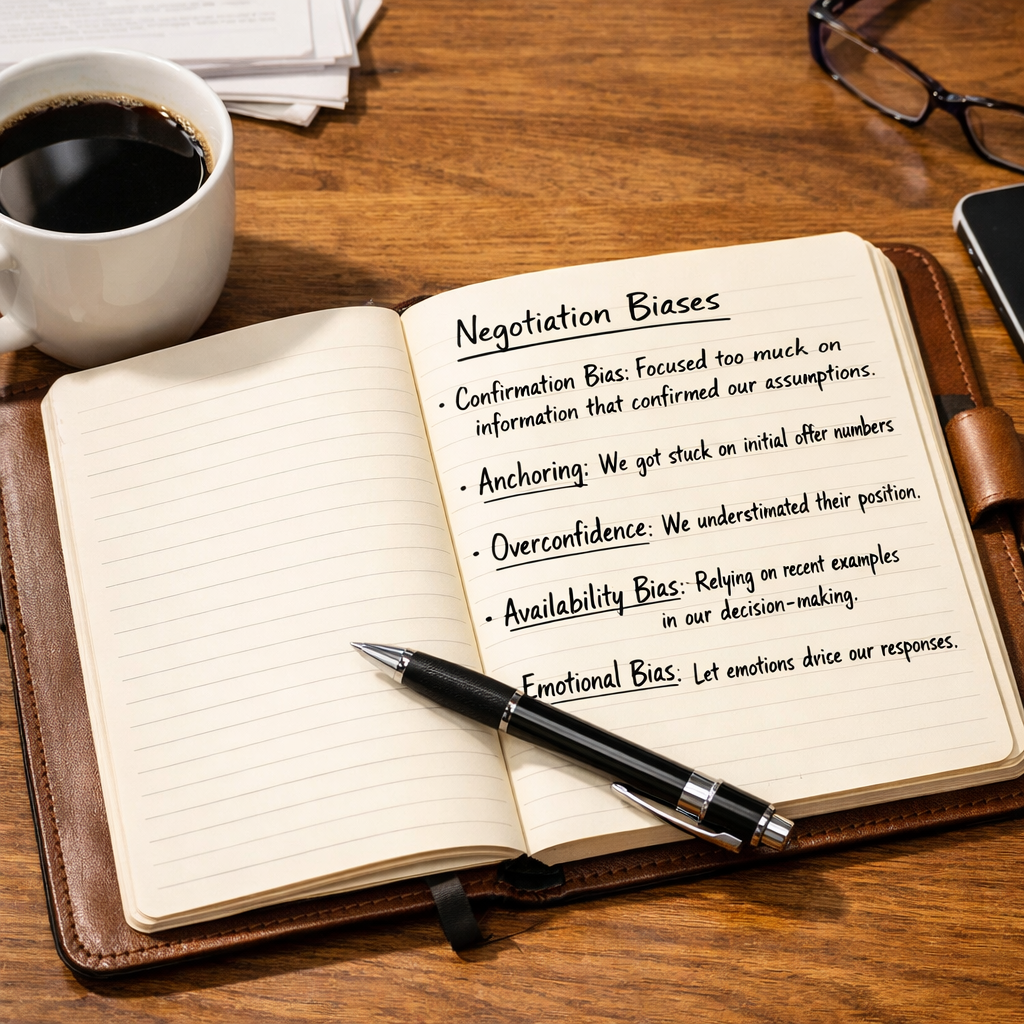
Let’s walk through a real example. You’re a sales executive who just closed a deal with a major client. During the debrief, you realize you accepted a 5% discount too easily because you were anchored by the client’s opening request. Your checklist didn’t have a step for defusing an anchor. Now you add it: “When the client asks for a discount, first ask: ‘What is that based on?’ before responding.” Next time, you’ll be ready.
Bottom line: Use a negotiation bias checklist post‑negotiation to systematically review your performance and add new counter‑moves for next time.
Frequently Asked Questions
What is a negotiation bias checklist?
A negotiation bias checklist is a structured tool that lists common cognitive biases and their counter‑measures. It helps you prepare, stay aware during the negotiation, and debrief afterward. The best checklists include the bias name, a clear example, and a specific action you can take to reduce its effect. Without the action step, the checklist is incomplete.
How many biases should I include in my checklist?
Start with three to five biases that affect you most often. Anchoring, confirmation bias, and loss aversion are good starting points for almost any negotiator. Adding more than five makes the checklist too hard to use in the moment. You can expand it over time as you become more skilled at spotting biases. Quality matters more than quantity.
Where can I find a ready‑made negotiation bias checklist?
You can download templates from negotiation training sites like Edge Negotiation Group, or you can build your own using the table in this article. Many universities and business schools also publish free checklists. Just make sure the checklist includes mitigation tactics, not just definitions. A checklist without action steps is just a vocabulary list.
How do I remember to use the checklist during a heated negotiation?
Practice is key. Use your negotiation bias checklist in low‑stakes talks first. Also, keep it physically visible , tape it to your laptop or desk. If you’re on a team, assign a colleague to be the bias spotter. Over time, the checks become automatic, and you’ll start spotting biases without the sheet.
Can a negotiation bias checklist help with team negotiations?
Yes. In team negotiations, different members may have different biases. One person might be overconfident; another might be loss‑averse. A shared negotiation bias checklist creates a common language. You can call out biases without pointing fingers. It also helps the team stay objective when groupthink starts to take over.
What if I use the checklist and still make a biased decision?
That’s normal. No checklist is perfect. The goal is to reduce bias, not eliminate it. If you catch the bias after the fact, you’ve still learned something. Add that insight to your checklist for next time. Improvement happens over many negotiations. The checklist is a tool for that journey, not a magic wand.
How often should I update my negotiation bias checklist?
Update it after every significant negotiation. Add new biases you noticed, refine the counter‑measures based on what worked, and remove anything that didn’t help. The research we did found that most checklists are static , they don’t change. That’s a mistake. Your checklist should be a living document that grows with you.
Is loss aversion bias the most important one to watch for?
Based on our research, loss aversion is the most actionable bias in the standard checklists. It’s the only one that pairs a clear impact with a concrete mitigation (“focus on possible advantages”). But importance depends on your role. If you’re in sales, overconfidence might be a bigger risk. If you’re in procurement, anchoring might be more dangerous. Tailor your checklist to your context.
Conclusion
A negotiation bias checklist is one of the simplest, most powerful tools you can carry into any deal. It helps you see the invisible forces that can push your decisions off track. The research we reviewed shows that most checklists are missing the most important part: what to do about the bias. But that’s easy to fix. By adding a specific counter‑move for each bias, you turn a list of problems into a practical guide.
Here’s your action plan. First, build your own negotiation bias checklist using the table in this article. Start with Anchoring, Confirmation, and Loss aversion. Write a concrete step you can take for each one. Second, use the checklist before your next three negotiations. Spend 10 minutes on self‑assessment. Third, during the negotiation, keep it visible and glance at it when you feel yourself reacting emotionally. Fourth, after the negotiation, debrief with the checklist. What worked? What didn’t? Update your list.
Over time, your negotiation bias checklist becomes second nature. You’ll spot biases faster. You’ll make fewer costly mistakes. And you’ll walk away from the table with better deals. If you want to go deeper, check out our advanced training on Understanding Cognitive Biases in Negotiation and learn how to apply behavioral science in your next meeting with our guide to behavioral science in negotiation.
Start using your checklist today. The next deal will be better because of it.