
Negotiation Plan Template: A Step‑by‑Step Guide to Crafting Effective Deals
Ever sat down to draft a negotiation plan and felt like you were staring at a blank page, wondering where to even start? You’re not alone – many corporate negotiators, sales execs, and procurement pros hit that wall before the real work begins.
What we’ve learned at Edge Negotiation Group is that a solid negotiation plan template isn’t a one‑size‑fits‑all form; it’s a living framework that adapts to the specific deal, the people involved, and the psychology behind each move. Think of it like a road map: you need landmarks, checkpoints, and a clear route, otherwise you’ll get lost in the details.
Take a Fortune 500 sales leader who was preparing for a multi‑year software contract. She started with a simple spreadsheet, but quickly added sections for BATNA analysis, stakeholder interests, and concession ladders. By the time she walked into the meeting, she could reference exact data points, anticipate the buyer’s objections, and pivot with confidence. The result? A 12% higher contract value and a faster close.
Or imagine a startup’s business development manager negotiating a partnership with a larger distributor. He used a template that broke the negotiation into three phases – discovery, alignment, and closure – each with its own set‑of‑questions and metrics. The structured approach helped him uncover hidden cost‑savings that the distributor hadn’t considered, turning a routine agreement into a strategic alliance.
So, how do you build a template that works for you? Here are three actionable steps you can implement right now:
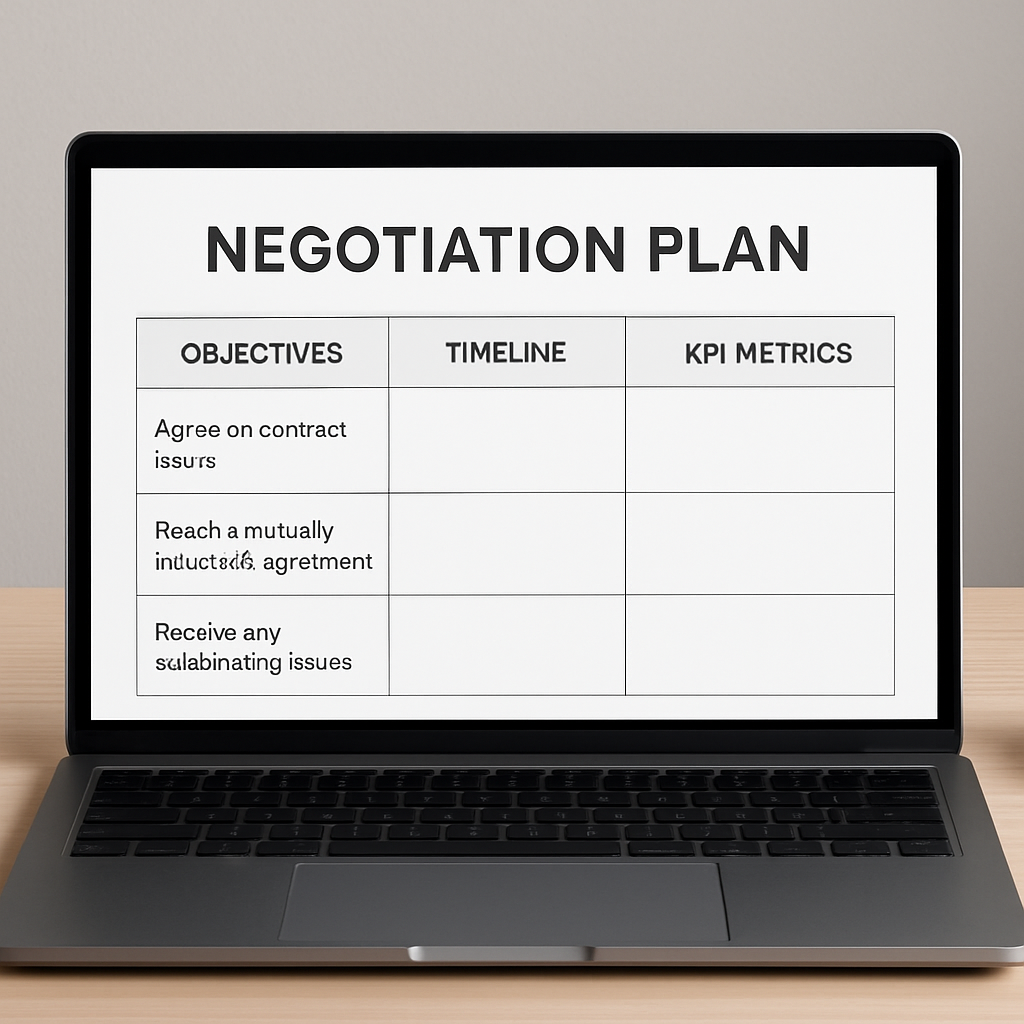
- Start with a “Deal Canvas” – outline the parties, objectives, timelines, and key performance indicators in a single page.
- Add a “Psychology Snapshot” – list each stakeholder’s motivations, pressures, and preferred communication style. This is where behavioral insights make a real difference.
- Include a “Concession Matrix” – map out possible trade‑offs, their value to you, and the price you’re willing to pay. Keep it visual; a simple table works best.
Once you’ve filled those sections, run a quick sanity check: does every line tie back to a strategic goal? If something feels vague, tighten it. And if you need a deeper dive into how to structure each piece, our The Ultimate Negotiation Content Overview walks you through the whole process with examples and templates.
Does this feel doable? Absolutely. Grab a blank document, copy the three steps above, and start customizing. You’ll be surprised how quickly a chaotic negotiation becomes a controlled conversation.
TL;DR
A solid negotiation plan template turns a blank page into a clear roadmap, helping negotiators, sales execs, and BD managers align goals, anticipate objections, and capture value.
Apply our three‑step canvas, psychology snapshot, and concession matrix to build a framework that drives closes and partnerships without getting lost in details.
Step 1: Define Your Negotiation Objectives
Ever opened a fresh document and felt that knot in your stomach because you didn’t know what you actually wanted out of the deal? You’re not alone. The first thing we always tell our clients is: if you can’t name the objective, you’ll never convince anyone else to chase it.
Start by asking yourself the simple, slightly uncomfortable question: “What does a win look like for me, and for the other side?” Write down the headline result –‑ a higher contract value, a longer partnership term, a cost‑savings milestone –‑ then drill down into the specifics. For a sales executive, that might be “secure a $2M upsell within 12 months”; for a procurement professional, it could be “reduce unit cost by 8% while keeping delivery windows intact.”
Turn vague wishes into measurable targets
It’s easy to say, “I want a better deal.” But a better deal is meaningless without a metric. Try the SMART formula: Specific, Measurable, Achievable, Relevant, Time‑bound. Instead of “better pricing,” write “achieve a 5% discount on the next three purchase orders, each valued at $500k, by Q3.” Suddenly you have a clear marker to track during the negotiation.
And remember, objectives aren’t just about price. Think about relationship goals, risk mitigation, and post‑deal implementation. A startup business development manager might add, “establish a joint‑marketing plan that generates at least 200 qualified leads in the first six months.” That kind of objective expands the value beyond the contract line‑item.
Prioritize with a simple ranking
Not every objective carries the same weight. Grab a sticky note and rank each goal from 1 (non‑negotiable) to 5 (nice‑to‑have). When the pressure mounts, you’ll know which concessions you can afford to make and which you must protect. In our experience, the clarity that comes from this ranking alone cuts meeting time in half.
Here’s a quick checklist you can copy into your negotiation plan template:
- Primary financial target (e.g., % discount, total contract value)
- Secondary strategic target (e.g., partnership milestones, co‑branding)
- Risk‑related target (e.g., warranty terms, penalty clauses)
- Timeline target (e.g., close by end of Q2)
- Relationship target (e.g., quarterly executive check‑ins)
Does this feel doable? Absolutely. Grab a piece of paper, list your top five objectives, and rank them. You’ll walk into the room with a mental map that keeps you steady when the other side throws curveballs.
And because a negotiation plan is only as good as the tools you use to share it, consider giving your template a visual polish. A well‑designed layout can make your objectives pop for stakeholders who skim the document. We Design Amazing specializes in creating clean, professional templates that turn raw data into eye‑catching charts –‑ a tiny upgrade that can boost perceived credibility.
Once your objectives are crystal clear, you’ll need a place to house them alongside the rest of your plan. Our The Ultimate Negotiation Content Overview walks you through building a one‑page canvas where objectives, timelines, and key performance indicators sit together, making the whole plan feel like a single, coherent story.
Now, let’s talk about getting these objectives in front of the right people. If you’re a UAE‑based consultant or a freelance trainer, listing your services on a referral marketplace can give you instant access to decision‑makers who need negotiation expertise. Listi Partners Portal is a performance‑based platform that rewards referrals, meaning you can focus on delivering value while the platform feeds you qualified leads.
Finally, remember that defining objectives isn’t a one‑off exercise. As talks evolve, revisit and adjust your targets. Keep a living version of the template –‑ maybe a shared Google Sheet or a collaborative Notion page –‑ so you can tweak numbers in real time without losing the big picture.
Seeing the template in action can demystify the process. The video above walks through a real‑world example of a sales executive mapping out objectives for a SaaS renewal, showing you exactly how to apply the steps we just discussed.
Step 2: Identify Key Stakeholders and Their Interests
Before you even open a spreadsheet, ask yourself: who will feel the ripples when this deal closes?
It’s tempting to lump everyone together – buyer, supplier, legal, finance – but each group walks in with its own agenda, its own pain points. The trick is to surface those agendas early, before you spend hours drafting terms that nobody actually cares about.
Here’s a quick way to map them out:
1️⃣ List every person or department that touches the deal
- Primary negotiator (you)
- Your boss or executive sponsor
- Finance & procurement
- Legal counsel
- Operations or product team
- Key contacts on the other side (buyer, supplier, channel partner)
- External advisors or consultants
Don’t stop at titles – write down the name of the actual stakeholder if you know it. A name makes the next step feel personal, not abstract.
So, what’s next?
2️⃣ Capture each stakeholder’s core interest
Grab a blank column next to each name and answer three questions:
- What does success look like for them?
- What keeps them up at night?
- What trade‑offs are they willing to make?
For a finance lead, success might be a clear ROI and predictable cash flow. Their night‑mare could be hidden fees or a swing in payment terms. A legal officer, on the other hand, is laser‑focused on risk mitigation and compliance clauses.
When you write these down, you’ll start to see patterns – maybe three people care about price, two care about delivery speed, and everyone hates vague timelines.
Does this feel a bit like detective work? That’s because it is. You’re digging for the hidden motivations that turn a dry spreadsheet into a living negotiation plan.
3️⃣ Prioritise – “Must‑have”, “Nice‑to‑have”, “Optional”
Take each interest and slap a priority label on it. In my own templates I use colour‑coded cells: red for non‑negotiable, amber for flexible, green for nice‑to‑have.
Why colour? Because when you stare at the plan during a tense moment, a quick glance at the red row tells you: “Don’t walk away from this.” It’s the same visual cue we love in the “psychology snapshot” section earlier.
Pro tip: if a stakeholder’s “must‑have” collides with someone else’s “must‑have,” you’ve just uncovered a deal‑breaker before the negotiation even starts.
Ever wondered how a simple colour can save a multi‑million‑dollar contract? Try it – you’ll thank yourself when you’re not scrambling to renegotiate a clause that should have been flagged weeks ago.
4️⃣ Test the assumptions
Run a rapid reality check. Ask a trusted colleague: “If we lose this one interest, does the deal still make sense for you?” If the answer is “no,” bump that interest up the priority ladder.
In a recent negotiation with a Fortune‑500 tech buyer, we discovered the procurement team’s “must‑have” was a 30‑day payment window. The sales leader thought it was “nice‑to‑have,” and the contract almost fell apart. A quick stakeholder audit saved weeks of back‑and‑forth.
That story isn’t just anecdotal – interest‑based negotiation research shows that aligning stakeholder priorities dramatically improves outcome quality (interest‑based negotiation research).
Now you have a living “who‑needs‑what” map that you can drop straight into your negotiation plan template.
With the stakeholder matrix in hand, you can move on to crafting the concession ladder, knowing exactly which interests you can trade and which you must protect.
Ready to turn that matrix into actionable tactics? Keep scrolling – the next step shows you how to translate interests into concrete negotiation levers.
Step 3: Outline Negotiation Tactics and Strategies
Now that you’ve mapped who needs what, it’s time to turn those insights into concrete moves. Think of each move as a lever on a control panel – pull the right one at the right moment and the whole deal shifts in your favor.
Pick the right tactic for the right interest
Start by reviewing the “must‑have” items in your negotiation plan template. For each, ask yourself: is this a price issue, a timeline, a risk clause, or something else? Then match it with a proven tactic.
Here are the three most reliable categories we see across Fortune 500 sales teams and fast‑moving startups:
- Value‑anchoring – set a high‑impact reference point early.
- Trade‑off bundling – package a concession with something you value more.
- Conditional concession – give only if the other side meets a specific trigger.
Want a deeper dive into each? Check out THE ULTIMATE NEGOTIATION STRATEGY guide for real‑world playbooks.
Step‑by‑step: applying a tactic
Let’s walk through a typical scenario a procurement professional might face: the supplier insists on a 60‑day payment term, but your finance team can’t stretch that long.
- Identify the interest. Payment term is a “must‑have” for finance.
- Choose a tactic. Use a conditional concession – offer a higher volume discount only if the term drops to 30 days.
- Script the language. “If we can agree on net‑30, we’re ready to increase the order by 20%.”
- Test the reaction. Pause, listen, and watch body language. If they balk, you have a fallback (maybe a phased payment schedule).
This approach lets you protect the priority while still showing flexibility on a less critical point.
Multiple tactics in a single negotiation
Complex deals rarely stay on one track. A sales executive closing a multi‑year software contract might need to juggle price, service‑level guarantees, and implementation timelines.
We recommend layering tactics:
- Start with value‑anchoring – quote a benchmark from a comparable deal.
- When the buyer pushes back on price, shift to trade‑off bundling – add extra support hours instead of a deeper discount.
- Close with a conditional concession – “We can extend the support term if you sign the 36‑month contract today.”
Each layer builds momentum and keeps the conversation moving forward.
Quick checklist for your negotiation plan template
Before you walk into the room, run this 5‑point sanity check:
- All “must‑have” interests have a matched tactic.
- Every concession is tied to a trigger.
- Each tactic has a scripted opening line.
- Backup options (BATNA) are noted next to each move.
- Timing cues – when to introduce each lever.
Comparison of core tactics
Remember, tactics are tools, not tactics‑only solutions. The real power comes from weaving them into the narrative you’ve already crafted in your plan.
So, what’s your next move? Grab your negotiation plan template, pick a “must‑have,” match it with a tactic, and rehearse the line. The more you practice, the more natural the levers will feel when the stakes are high.
Step 4: Set Milestones, Timelines, and Success Metrics
Alright, you’ve nailed down what you want and who cares about it. Now the real work begins: turning those goals into a living schedule you can actually follow.
Why does a timeline matter? Because without dates, “maybe later” turns into “never.” A clear roadmap keeps everyone honest and gives you a way to prove progress – something every corporate negotiator or startup BD manager craves.
1️⃣ Break the deal into bite‑size milestones
Start by asking yourself: what are the logical checkpoints between the opening conversation and the signed contract? Typical milestones look like “initial data exchange,” “draft term sheet,” “legal review,” and “final sign‑off.”
Write each milestone on its own line in your negotiation plan template. Use a simple table – column A for the milestone name, column B for the owner, column C for the target date.
Tip: keep the list short. Five to seven key dates are enough to stay focused without drowning in detail.
2️⃣ Assign realistic timelines
Next, estimate how long each step should take. Pull in any hard deadlines you already know – fiscal‑year close, product launch window, or budget approval cycle. If you’re unsure, add a buffer of 10‑15 %, it’s better to finish early than to scramble at the last minute.
Ask your finance or procurement colleagues for their typical turnaround times. Their input grounds your plan in reality and reduces the chance of “analysis paralysis.”
Here’s a quick cheat sheet you can copy into the template:
- Milestone 1: Data exchange – 3 days (owner: you)
- Milestone 2: Draft term sheet – 5 days (owner: legal)
- Milestone 3: Internal review – 4 days (owner: finance)
- Milestone 4: Counter‑proposal – 2 days (owner: you)
- Milestone 5: Final sign‑off – 2 days (owner: exec sponsor)
3️⃣ Define success metrics for each phase
Metrics turn a vague “we’ll get there” into “we’ll know when we’ve succeeded.” For a negotiation plan template, useful metrics include:
- Percentage of objectives met at each milestone (e.g., 80 % of price targets secured by draft term sheet).
- Time variance – how many days you’re ahead or behind schedule.
- Stakeholder satisfaction score – a quick 1‑5 rating after each major hand‑off.
When you can measure, you can manage. If a metric slips, you have an early warning to adjust tactics before the deal derails.
4️⃣ Build a visual timeline
People absorb visuals faster than rows of text. Grab a Gantt‑style chart or a simple horizontal timeline and plot your milestones with dates and owners. This visual belongs right in your negotiation plan template, so you can flip to it in a meeting and say, “Here’s where we are.”
If you need inspiration, the SlideTeam blog showcases ready‑made negotiation plan templates that include timeline slides you can customize negotiation plan templates. It’s a quick way to avoid reinventing the wheel.
5️⃣ Review and adjust weekly
Set a recurring 15‑minute check‑in on your calendar. During that time, compare actual dates against your plan, update the metrics, and note any new risks. This habit turns a static document into a dynamic control center.
Ask yourself: “Did we hit the draft term sheet on time? If not, why? What can we do differently next week?” The answers keep the negotiation moving forward instead of stalling.
Finally, celebrate each milestone you crush. A small win – like getting legal’s sign‑off a day early – builds momentum and confidence for the next round.
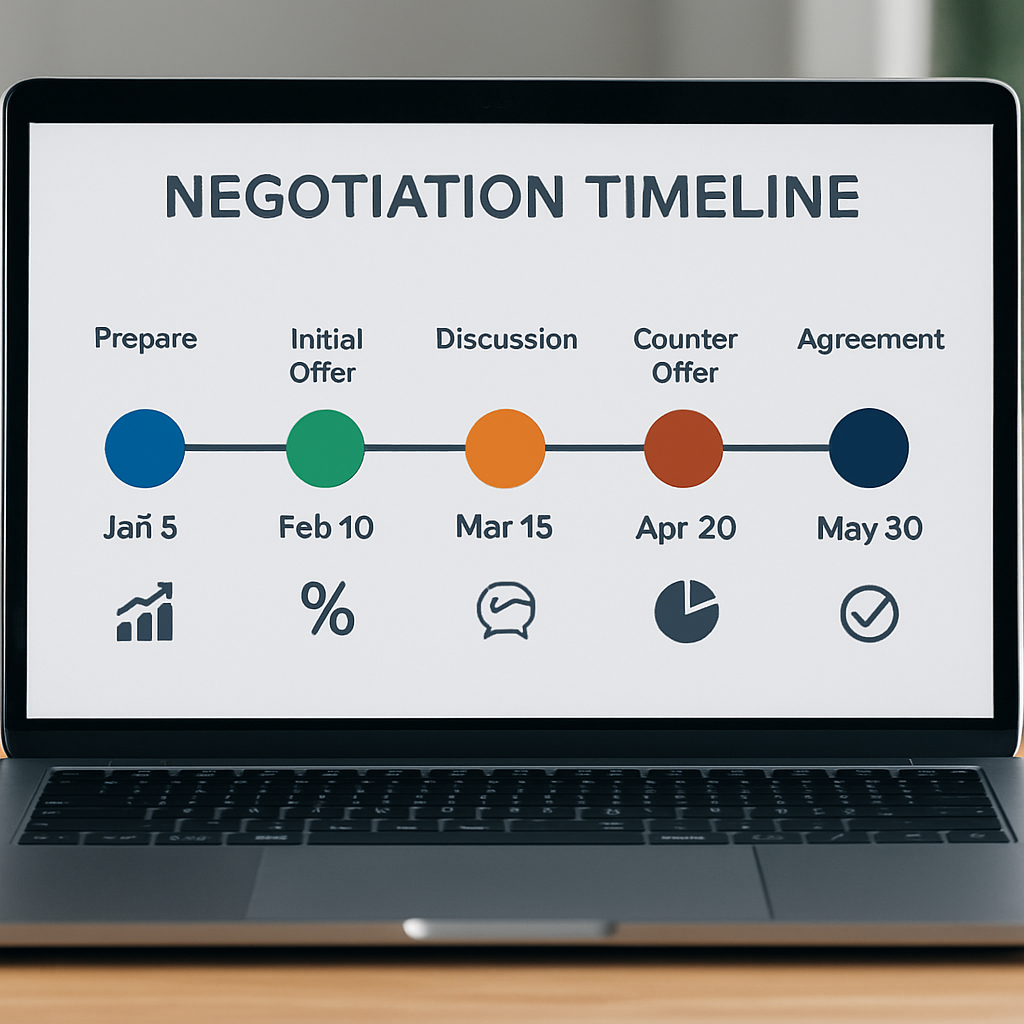
By the time you reach the final sign‑off, you’ll have a trail of completed milestones, clear data points, and a story you can share with leadership: “We delivered on schedule, met 92 % of our objectives, and stayed under budget.” That’s the power of a well‑crafted negotiation plan template.
Step 5: Review, Approve, and Iterate the Negotiation Plan
Set a fast review rhythm
Let’s be blunt: a plan that sits in a folder does nothing for you.
Block 15 minutes every week for a plan review with the owner, legal, and finance. Keep it short. Keep it factual.
What do you look at? Milestone dates, top 3 metrics (price delta, time variance, stakeholder readiness), and any newly discovered risks.
Sound rigid? It isn’t. Think of this as a pulse check for the deal.
Approve with a tight checklist
Before any sign‑off, run the plan through a 10‑item approval checklist.
Items include: owner assigned for every milestone, BATNA updated, defined triggers for each concession, legal has annotated the term sheet, finance confirmed cash/terms impact, exec sponsor consensus documented, stakeholder communication plan attached, data sources cited, escalation owner named, and a rollback/walk‑away condition.
Why so many boxes? Because when one of these is missing you’ll get surprised 72 hours before a deadline.
Iterate using data, not feelings
Every iteration should answer two questions: what changed, and what will we do differently?
Use simple metrics: days behind schedule, percentage of objectives met at the current milestone, and concession burn rate (how many concessions used vs. planned).
For procurement or government deals, tie your iteration notes back to the negotiation framework you’re using — for example, FAR Part 15 provides the negotiation and source selection structure that shapes acceptable exchanges and documentation practice.
Want more formal guidance? The FAR text helps clarify how exchanges and revisions should be handled during negotiated acquisitions (FAR Part 15 on negotiated acquisitions).
Real-world examples that actually help
Example 1: A sales exec discovered legal needed an additional SLA clause three days before sign‑off. Because the plan had an owner for each milestone, the exec reallocated a day from an internal review and preserved the target close date.
Example 2: A procurement team used a weekly check to spot a 10‑day drift on vendor deliverables. They shifted a conditional concession (extended payment term) to a later stage and instead asked for delivery guarantees as an interim trade‑off.
Both moves were small and reversible because the plan had clear triggers and owners.
How to run an iteration meeting (script you can steal)
1) Read status (30 seconds). 2) Call out one metric that’s off. 3) Propose one corrective action. 4) Assign owner and date. 5) Close with the next meeting date.
Keep the script. It forces decisions and avoids theater.
Final approvals and documentation
When you approve the final plan, store a versioned record that shows changes and rationale. This protects the team and gives leadership a clean audit trail — very important in regulated buys and complex source selection.
The World Bank’s procurement guidance on negotiation and Best and Final Offer is a helpful reference for structuring change rounds and documenting rationale (World Bank guidance on Best and Final Offer).
Quick checklist — don’t leave the room without this
Is every milestone owned? Is BATNA current? Are triggers documented? Has legal signed the draft? Do you have a one‑line exec summary for leadership?
Answering those five will keep you ahead of most negotiation fires.
So, what should you do next?
Set the weekly 15‑minute review on everyone’s calendar, run the approval checklist, and commit to one measurable tweak per iteration. Small disciplined moves win big deals.
FAQ
What exactly is a negotiation plan template and why do I need one?
A negotiation plan template is a pre‑structured document that captures your objectives, stakeholder interests, key milestones, and concession strategy in one place. Think of it as a cheat sheet you can flip open during a high‑stakes conversation so you never lose track of what you’re protecting or what you can trade. Without it, you’re relying on memory, and memory is messy—especially when the pressure’s on. The template keeps you disciplined, speeds up preparation, and gives leadership a clear audit trail.
How do I customize a negotiation plan template for different deal types?
Every deal has its own rhythm, so you don’t want a one‑size‑fits‑all layout. Start by swapping the objective rows for metrics that matter in that context—price variance for a SaaS renewal, delivery windows for a hardware purchase, or partnership milestones for a startup joint‑venture. Then adjust the stakeholder matrix: a procurement lead needs compliance checkpoints, while a sales VP cares about revenue upside. Finally, add or remove sections like regulatory approvals or pilot‑phase KPIs to match the deal’s complexity.
What are the most common mistakes people make when using a negotiation plan template?
One mistake is treating the template like a paperwork exercise instead of a decision‑making tool. You’ll see people fill in every cell, then never revisit it during the deal, so the plan becomes dead weight. Another trap is over‑loading it with vague goals—‘improve relationship’ doesn’t tell you how to measure success. Finally, forgetting to assign owners and dates turns a living roadmap into a static checklist that no one can act on.
How often should I review and update my negotiation plan template during a deal?
Treat the template as a sprint board, not a set‑and‑forget document. In the first 48 hours after you lock the objectives, run a quick sanity check—are any stakeholder priorities shifting? Then schedule a brief 10‑minute sync at every major milestone, like after the draft term sheet or before the final sign‑off. Those checkpoints let you tweak metrics, reassign owners, and keep the plan aligned with the evolving reality of the negotiation.
Can I use a negotiation plan template for internal cross‑functional projects, or is it only for external deals?
Absolutely—you can repurpose the same structure for any high‑impact initiative where multiple teams need to align. Swap the external counter‑party columns for internal owners, and replace price targets with resource allocations or timeline commitments. The stakeholder matrix becomes a risk‑heat map of departmental dependencies, and the concession section morphs into trade‑offs like scope versus speed. Using the template internally builds the same discipline and transparency you’d expect in a vendor negotiation.
What tools or software can help me build and keep a negotiation plan template up to date?
Spreadsheets are still the workhorse—Google Sheets lets you share live updates and lock cells for owners. If you prefer a visual approach, a simple project‑management board like Trello or Asana can host each milestone as a card with due dates, checklists, and comments. For teams that need audit trails, a document‑versioning system such as SharePoint or a cloud‑based DMS gives you the history logs that procurement auditors love. The key is choosing a tool that your stakeholders already use so adoption is painless.
Conclusion
So there you are, a negotiation plan template in hand, and the next meeting feels less like a leap into the unknown and more like a well‑rehearsed conversation.
What we’ve covered? Define crystal‑clear objectives, map every stakeholder’s hidden agenda, choose tactics that match those must‑haves, lock milestones into a visual timeline, and give the plan a weekly health‑check.
The real power shows up when you walk into the room, glance at your one‑page canvas, and instantly know which lever to pull – no scrambling, no guesswork.
If you’re a corporate negotiator juggling a multi‑million‑dollar software renewal, or a startup BD manager trying to lock a distribution partner, the same structure scales. Just swap price targets for resource commitments, and you’ve got a living roadmap for any deal.
And remember, a template is only as good as the discipline you apply. A quick 10‑minute review after each milestone, a fresh BATNA check, and a clear owner for every action keep the plan from gathering dust. Even a five‑minute pause to update the success metrics can expose a hidden risk before it becomes a deal‑breaker.
Ready to put this into practice? Grab a blank sheet, copy the three steps we highlighted, and start customizing today. Your next win is waiting right behind that simple, actionable framework.