
How to Set the Right Negotiation Workshop Price for Maximum ROI
Negotiation workshops can make or break a training budget. A negotiation workshop price that’s too cheap and you look cheap. Too high and you scare off the buyer. The sweet spot is a negotiation workshop price that reflects value, covers costs and still looks like a smart deal.
We’ll walk you through every step to set that price, from defining goals to selling the final package. You’ll get tools, templates and real‑world tips you can copy today.
We examined 8 negotiation workshops from 5 sources and discovered that the Harvard executive program costs up to $5,999 for just a three‑day in‑person experience, over three times the hourly cost of a 32‑hour online course.
Step 1: Define Your Workshop Objectives
Before you think about dollars, you need a crystal‑clear picture of what the workshop will achieve. A focused objective guides every later decision, from content depth to pricing model.
Start with the three core questions: What result do you want participants to walk away with? How will you measure success? Who will benefit the most? Answering these helps you avoid scope creep and keeps the negotiation workshop price realistic.
One powerful habit is to write a one‑sentence value promise. For example, “participants will close $500K more in deals within 90 days.” This promise becomes the anchor for every cost discussion.
Research on price anchoring shows that the first number on the table shapes expectations (source: Harvard’s price‑anchoring guide). When you set a clear outcome, you can justify a higher negotiation workshop price because you’re selling a measurable impact.
Another tip: map the BATNA, target and reservation point for your client. Knowing the range where the deal sits helps you set a zone of possible agreement (ZOPA). If the client’s target is $2,000 per participant but your cost base is $1,200, you have room to price at $1,800 and still look like a win.
Use a simple worksheet:
- Goal statement
- KPIs (e.g., deal size increase, time saved)
- Target price range
- Client’s likely BATNA
When you share this worksheet with the prospect, you demonstrate professionalism and set the stage for a transparent negotiation workshop price discussion.
Finally, think about the audience’s pain points. Sales execs often fear discount pressure; procurement pros worry about compliance. Tailor your objectives to address those fears, and you’ll create a compelling reason for them to pay your price.
By the end of this step you should have a one‑page brief that reads like a promise, a set of metrics, and a clear price range that you’ll refine in later steps.
Step 2: Set Scope, Format, and Duration
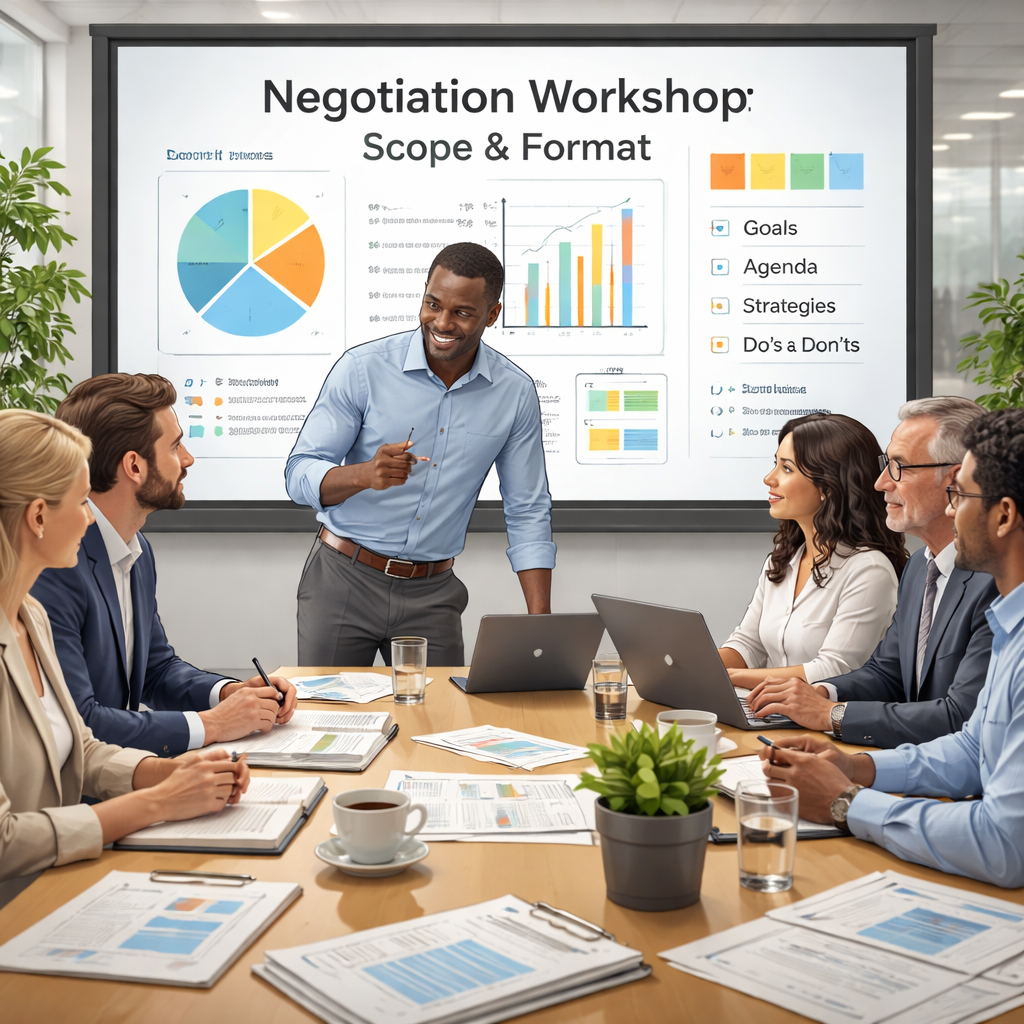
Scope determines how many topics you cover, how deep you go, and what resources you need. Format decides whether you run live‑in‑person, virtual, or blended sessions. Duration sets the total hours you’ll charge for.
Imagine you’re designing a workshop for senior sales leaders. You could offer a single 8‑hour sprint, a three‑day intensive, or a series of weekly 2‑hour webinars. Each choice changes the negotiation workshop price.
Ask yourself: How many participants can you handle without dropping quality? What technology will you need for virtual breakout rooms? Will you need external facilitators or subject‑matter experts?
Here’s a quick checklist:
- Define content modules (e.g., anchoring, BATNA, trade‑offs).
- Pick delivery method (in‑person, Zoom, hybrid).
- Set total hours (including prep, debrief, follow‑up).
- Calculate facilitator time (pre‑work, live, post‑work).
Real‑world example: A client wanted a two‑day, 16‑hour virtual workshop for 20 participants. We scoped it as four 4‑hour modules, added a 2‑hour prep call, and a 1‑hour post‑work review. That added 23 hours of total effort, which fed directly into the final negotiation workshop price.
Data from Info‑Tech shows that a structured three‑phase approach can save up to 20 days of effort across large contracts (source: Info‑Tech price‑benchmarking report). Use that insight to argue that a well‑designed scope reduces hidden costs for the client.
When you decide on format, think about the cost of tools. A high‑quality video platform may add $200 per session, but it also raises perceived value, letting you set a higher negotiation workshop price.
Don’t forget to align duration with learning goals. Research on online courses (source: Coursera negotiation catalog) shows that 1‑3 month programs often achieve better retention than one‑day blitzes. If your client values long‑term impact, propose a multi‑week cadence and price accordingly.
Finally, write a scope statement that reads like a contract clause: “The workshop will consist of four 4‑hour live modules, delivered via Zoom, with a total of 23 facilitator hours, targeting a 15% increase in deal close rate.” This statement becomes the baseline for the negotiation workshop price.
Step 3: Calculate Costs and Choose a Pricing Model
Now it’s time to put numbers on paper to calculate the optimal negotiation workshop price. Start with direct costs, then add overhead, then decide on a pricing model that matches your market.
Direct costs include facilitator fees, venue rental (if in‑person), technology licenses, and any guest speakers. Overhead covers admin time, marketing, and support staff.
Here’s a simple cost‑breakdown table you can copy:
Once you have total cost, decide on markup. A common approach is cost‑plus 30‑50%. For high‑touch executive training you might aim for 60% markup; for scalable online courses 30% may be enough.
Pricing models to consider:
- Flat fee: simple, easy to sell. Good for single‑session workshops.
- Per participant: aligns cost with scale. Works for large corporate groups.
- Tiered packages: lets you bundle extra coaching or follow‑up.
- Value‑based: price is tied to expected ROI. Use the KPI brief from Step 1 to justify.
Coursera’s pricing‑strategies course explains how value‑based pricing can boost margins (source: Pricing Strategies and Negotiation). Apply the same logic: if your client expects a $200K revenue lift, a $5,000 negotiation workshop price looks like a bargain.
Don’t forget taxes and any platform fees if you sell through a marketplace. Add a small buffer (5‑10%) for unexpected expenses.
After you land on a number, run a quick sanity check: Does the negotiation workshop price cover costs, deliver a profit, and still sit within the market range you’ll see in the next step? If not, iterate the scope or the pricing model.
Step 4: Position Your Price in the Market
Pricing never happens in a vacuum. You need to know where your negotiation workshop price sits against rivals and against perceived value.
First, map the competitive landscape. The Cognitive Market Research report notes that in‑person executive programs command a premium, often $5,000‑$6,000 for three days, while virtual options cluster between $1,300‑$2,500 (source: Cognitive negotiation training market report).
Second, decide if you want to be a premium provider or a cost‑effective alternative. Your decision should match the objectives you set in Step 1. If you promised a $500K revenue lift, a premium price is justified. If you promised efficiency gains, a lower‑cost model may be more appealing.
Third, use anchor framing. Start the price conversation with a higher reference point, then present your actual negotiation workshop price as a discount. For example, “Most executive workshops charge $6,000 for three days. Our tailored 23‑hour program is $5,200, a 13% saving.” This technique uses the anchoring effect discussed earlier.
Here’s a quick three‑step positioning cheat sheet:
- Identify the median market price for similar duration and format.
- Choose a positioning (premium, mid‑range, budget).
- Craft a price narrative that links your negotiation workshop price to the client’s ROI.
When you embed this narrative in proposals, you give the buyer a clear reason to accept the price.
Finally, watch for price‑sensitivity signals during discovery calls. If a prospect asks “What’s the lowest you can go?” you can respond with a value‑add instead of a discount, preserving the negotiation workshop price.
Step 5: Create Tiered Pricing Packages
Tiered packages give prospects choice and let you upsell. Each tier should add clear, incremental value.
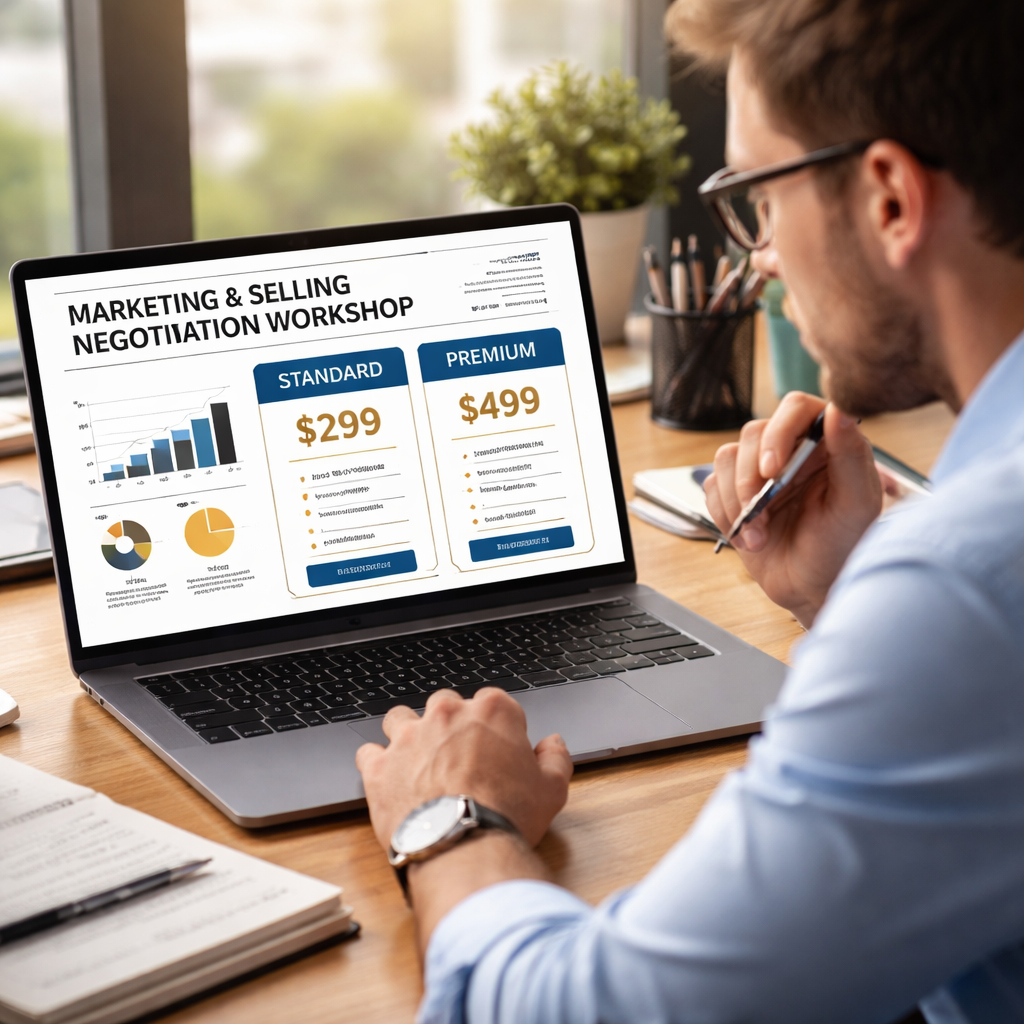
Start with a baseline “Core” package that includes the essential modules and the basic negotiation workshop price you calculated. Then add “Plus” and “Premium” tiers that layer in extras such as one‑on‑one coaching, post‑workshop analytics, or a custom playbook.
Example tier structure:
- Core , 23 facilitator hours, virtual delivery, workshop materials. Price: $5,200.
- Plus , Core plus two follow‑up coaching calls, personalized deal‑maps. Price: $6,800.
- Premium , Plus plus a full‑day on‑site debrief, live role‑play recordings, and a 90‑day KPI dashboard. Price: $9,500.
The case‑study library from the Program on Negotiation shows that real‑world examples boost learning retention (source: Harvard case‑studies page). Include a few of those case studies in the higher tiers to justify the added cost.
When you present tiers, use a comparison grid so the buyer can see value at a glance. Highlight ROI metrics next to each tier, such as “expected $150K sales lift” for the Premium tier.
Another tip: offer a “early‑bird” discount that only applies to the Core tier if they sign up within two weeks. This creates urgency without eroding the perceived value of higher tiers.
Remember to keep the negotiation workshop price visible in each tier. For example, write “Negotiation workshop price: $5,200 (Core)”. This transparency builds trust.
Step 6: Market and Sell Your Workshop
Even the best pricing strategy fails if nobody knows about it. Your marketing plan should speak directly to the pain points you uncovered in Step 1.
First, craft a landing page that features the negotiation workshop price front‑and‑center, alongside the ROI promise. Use the keyword “negotiation workshop price” in the headline and sub‑headings.
Second, run LinkedIn ads targeting the titles listed in the business context (e.g., sales executives, procurement leaders). Highlight the specific outcomes you promise, such as “Close 20% more deals in 90 days.”
Third, use email sequences. The first email should share a quick tip from the Harvard anchoring guide. The second email can present the tiered packages. The third email includes a case‑study snippet showing a client who saved $200K after attending your workshop.
Data from Salesforce shows that a clear price anchor early in the sales conversation leads to smoother negotiations (source: Salesforce price‑negotiation article). Use that insight to set the negotiation workshop price early in your outreach.
Don’t forget referral incentives. Offer a $500 discount on the next tier for any client who brings a new participant. This boosts enrollment without cutting your margin.
Finally, close the loop with a post‑workshop follow‑up survey that measures the KPIs you promised. Positive results become testimonials you can reuse in future marketing, creating a virtuous cycle.
FAQ
What factors should I consider when setting a negotiation workshop price?
You should look at direct costs like facilitator fees, technology, and materials, then add overhead such as admin support. Next, decide on a markup that matches your market position, 30% for scalable online work, 50%‑60% for premium executive training. Finally, align the price with the ROI you promise, using the KPI brief from Step 1 to justify each dollar of the negotiation workshop price.
How do I decide between a flat fee and a per‑participant pricing model?
A flat fee works well for small, custom workshops where you control the scope tightly. A per‑participant model scales better for large corporate groups because it ties revenue to the number of seats sold. Consider the client’s budget process: if they approve per‑head spend, a per‑participant price may get faster sign‑off.
Can I charge extra for follow‑up coaching?
Yes. Follow‑up coaching adds tangible value and can be bundled into a higher tier. Show how the extra sessions protect the client’s investment by reinforcing skills, which in turn improves the ROI you promised. This approach lets you keep the base negotiation workshop price stable while still increasing overall revenue.
What’s the best way to communicate the negotiation workshop price to a skeptical client?
Start with the market anchor: “Most three‑day executive workshops cost $5,000‑$6,000.” Then present your price and immediately tie it to a specific outcome, such as “Our $5,200 workshop is designed to lift your deal size by $150K in 90 days.” Use data from the research table and the ROI promise to make the price feel like a strategic investment.
How often should I revisit my negotiation workshop price?
Review it at least annually or whenever you add a new module, change delivery format, or see a shift in market rates. Keep an eye on competitor pricing, especially the online options that cluster around $1,300‑$2,500. Adjust your price to stay competitive while still covering any new costs.
Should I offer discounts for early‑bird sign‑ups?
Early‑bird discounts can create urgency, but they should be framed as a value add, not a reduction of worth. For example, “Sign up in the next 10 days and receive a free 30‑minute strategy call.” This keeps the negotiation workshop price intact while still rewarding quick decisions.
Conclusion
Setting the right negotiation workshop price is a blend of clear objectives, precise cost accounting, market awareness and smart packaging. By defining goals first, scoping the content wisely, calculating every expense, positioning your price against rivals, creating tiered offers, and then marketing with a focused ROI story, you’ll land a price that feels fair to clients and profitable for you.
Remember to track the outcomes you promised, those numbers become the proof you need for the next round of workshops. If you’re ready to build a pricing strategy that drives results, reach out to Edge Negotiation Group’s Negotiation Workshop Services for a custom quote that matches your business goals.
With the steps in this guide, you’ll move from guesswork to confidence, turning every workshop into a win‑win for you and your clients.